Investigation of Electronic Energy Levels in a Weak Ferromagnetic Oxygen-Deficient BiFeO2.85 Thick Film Using Absorption and X-Ray Photoelectron Spectroscopic Studies
Published in Materials
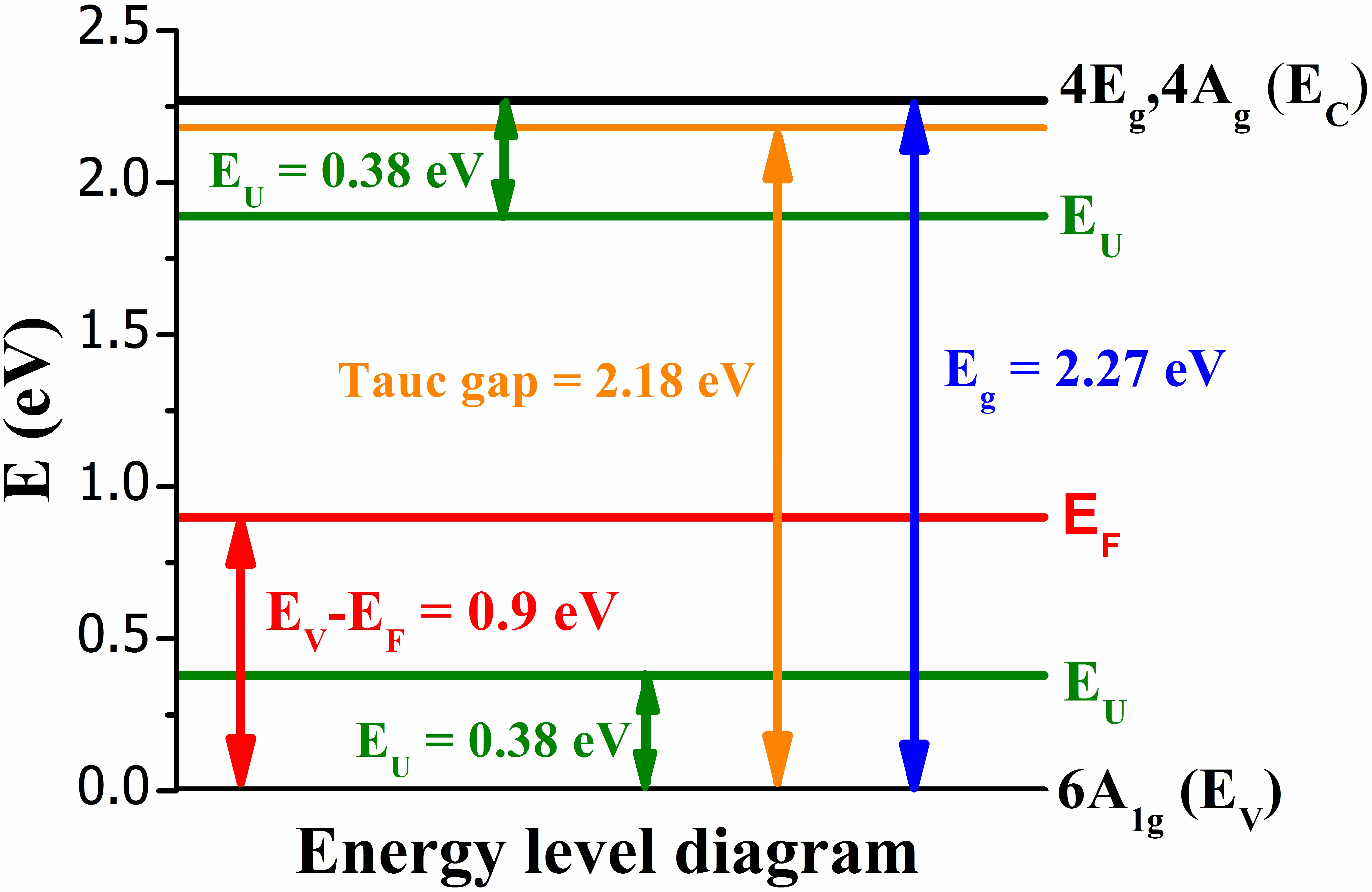
Our manuscript "Investigation of electronic energy levels in a weak ferromagnetic BiFeO3 thick film using absorption and X-ray photoelectron spectroscopic studies" deals with a detailed investigation of the optical properties of an optimized BiFeO3 thick film to study its electronic energy levels using experimental absorption and X-ray photoelectron spectroscopy data. This study aims to address whether the band-to-band transition in BiFeO3 is direct or indirect, as there is a discrepancy in the reported band-gap values which cover a wide range of 0.9-2.8 eV in the literature. Our analysis revealed that the band-to-band transition in the oxygen-deficient BiFeO3-thick film is direct, accompanied by the indirect transition due to the induced oxygen vacancies and other defects. Using the band-gap energy, Urbach energy, and the separation between the valence band and Fermi energy, we schematically drew the electronic energy-level diagram for the studied BiFeO3 film. Particularly, we attribute the Fermi energy shift towards the VBM of the BiFeO2.85 film to the electronic shifts rather than chemical shifts. That is, the oxygen vacancies-induced global electronic shift of the core-level of the constituent atoms in the BiFeO2.85 thick film was detected, which led to excellent absorption properties (i.e., weak reflectance behavior) in the 200–800 nm range, making it a promising material for optoelectronic applications such as photovoltaic or photodetector devices. Additionally, the BiFeO3 film exhibited weak ferromagnetic behavior across the entire temperature range from 2 to 300 K. Particularly, the switching of exchange bias field from positive to negative below 200 K is essentially due to the microstrain-induced modification in the magnetic structure of the BiFeO2.85 film. These observations indicate that the spin cycloid was only nearly destroyed by the induced microstrain (0.31%) in the (110)-textured oxygen-deficient BiFeO2.85 film.
Growth of the single-phase (110)-textured oxygen-deficient BiFeO2.85 film:
Growth conditions:
Base pressure: 5 × 10⁻⁶ mbar
Pumps used for creation of vacuum: Rotary and Diffusion Pumps
Substrate temperature: Ts = 525-625 oC
Oxygen partial pressure: Opp = 0.006-3 mbar
Technique: Pulsed Laser Deposition (PLD)
Laser used: Nd: YAG-based pulsed laser
Wavelength: 355 nm (second overtone, 3ω and UV laser)
Laser Fluence: 2.7 J/cm2
Frequency repetition: 10 Hz
Pulse width: 19 ns
Optimized growth condition for the single-phase BiFeO3 film: TS = 575 oC and O2pp = 0.06 mbar
Substrates: Si(100) and Quartz

Objective: I aim to enhance my skills and experience in the fields of experimental condensed matter physics and low-temperature physics. I like to explore new characterization techniques and novel materials for my future research.
Area of Interests: Experimental Condensed Matter Physics and Low-Temperature Physics: Strongly correlated electronic systems – multiferroics, magnetoelectric materials, thermoelectric compounds, shape memory alloys, topological insulators, Heusler alloys, and unconventional superconductors.
Skills and Expertise:
Multiferroics, Thermoelectricity, Magnetic Materials and Magnetism, Ferroelectric Materials, Ceramic Materials, Physical Properties, Magnetic Properties, Optical Properties, Pulsed Laser Deposition, Material Characterization, X-ray Diffraction, Scanning Electron Microscopy, Energy Dispersive X-ray Spectroscopy, Infrared and Raman spectroscopy, X-ray Photoelectron Spectroscopy, UV-Visible Spectroscopy, Differential Optical Absorption Spectroscopy, Electron Spin Resonance Spectroscopy, Thermal Conductivity, Seebeck Coefficient, Hall Effect, Thermal Analysis, Electrical Characterization