Probing electronic transitions and defect-induced Urbach tail bands in functional perovskite oxides using diffuse reflectance
Published in Materials


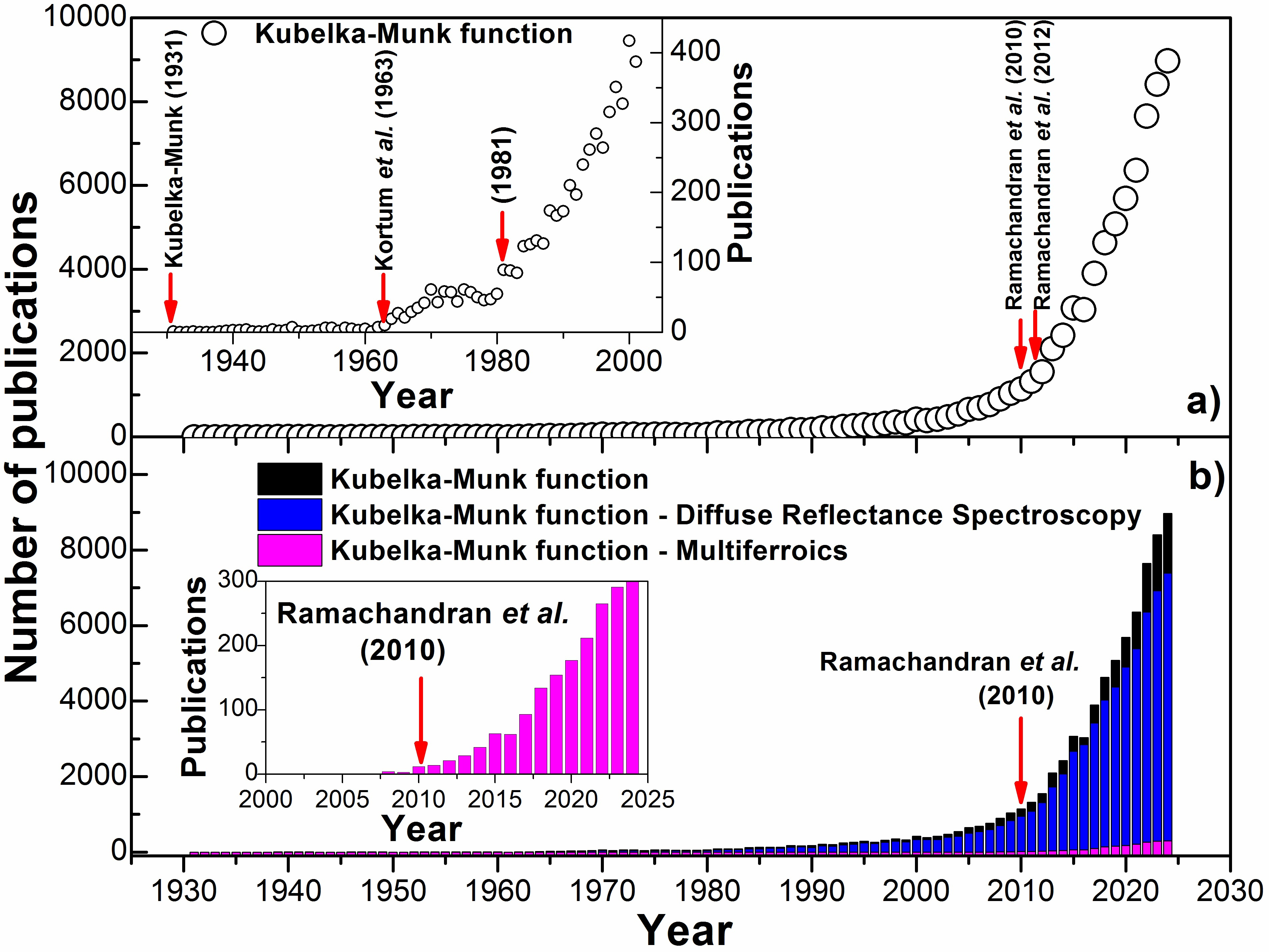
Outline of the article:
We believe that our article on "Investigation of electronic transitions and defects-induced Urbach tail bands in functional perovskite oxides using diffuse reflectance spectroscopy and the Kubelka-Munk function" is a timely report, as miniaturization and functionalization will drive the development of novel functional materials to achieve superior performance than conventional (monofunctional) materials. New-generation functional materials are being developed and characterized via material engineering. They can act as intelligent or smart materials, which tend to respond to environmental stimuli with particular changes in some of their variables. For example, they can act simultaneously as actuators and sensors. Hence, our detailed investigations on the diffuse reflectance spectra of a set of functional materials will be very useful for both researchers and industrialists, since our investigation eliminates external influences on the optical properties of the examined materials, namely: 1) the elimination of background absorbance in first derivative reflectance analysis and 2) the elimination of spectral reflectance in reflectance achieved via the dilution method. We also used the base–line method (as implemented by Makula et al., in J. Phys. Chem. Lett. 2018, 9, 6814−6817) in the Tauc plot analysis to correctly calculate the energies of direct and indirect electronic transitions in the inspected functional perovskite oxides. Due to our comprehensive and combined analyses, we obtained highly consistent and reliable energy values including the band-gap energy and Urbach energy for all studied materials. This type of complete analysis on the optical properties of the functional materials has not been done to the best of our knowledge. Therefore, we believe that our current article will attract a lot of attention among academicians and researchers in the field of science and technology.
Extended Abstract:
Novel (new-generation) functional materials have made significant progress in many fields including energy storage, communication, and information technology applications [1,2]. Many of these applications depend on the material's optical properties such as band-gap or optical absorption onset [2]. However, the distinct feature of the absorption edge has been hindered due to structural defects and thermal excitations, which lead to the formation of a tail band in the material according to the Urbach rule. This tail feature tends to induce a perturbation in the local potential and also broadens the band edge of the material [3]. To avoid miscalculation and/or misinterpretation of the energy of the band-gap and other electronic transitions of the examined functional materials, we employed a comprehensive analysis of the diffuse reflectance spectra of the investigated functional materials, namely vanadium pentoxide, barium tin oxide, lead zirconium titanate, bismuth manganite, and bismuth ferrite, using the Kubelka-Munk function, the first derivative of reflectance, and Tauc plot analysis. These combined analyses allowed us to consistently evaluate their optical band-gap and other electronic transitions. Additionally, we also calculated the Urbach energy related to induced defects for all inspected materials. Importantly, we showed the optical properties including the optical band-gap of magnetoelectric bismuth ferrite can be tuned by the induced chemical pressure via suitable doping or particle size reduction to achieve desirable properties for suitable optical applications. Finally, we proposed a general band structure for all studied functional materials with the band-to-band transition and possible indirect transitions from the conduction band maximum to the Urbach band above the valence band and/or from the Urbach band below the conduction band to the valence band minimum, as well as a comprehensive electronic structure with charge transfer and d-d transitions for a model multiferroic bismuth ferrite.
References:
- A. Tarancón, N. Pryds, Functional Oxide Thin Films for Advanced Energy and Information Technology, Adv. Mater. Interfaces 6, 1900990 (2019).
- A. Canul, Di. Thapa, et al., Mixed-strategy approach to band-edge analysis and modeling in semiconductors, Phys. Rev. B 101, 195308 (2020).
- J. I. Pankove, Absorption Edge of Impure Gallium Arsenide, Phys. Rev. 140, A2059 (1965).
Data Collection and Processing:
Raw Data Collection: Diffuse Reflectance (R) measured using relative reflectance and/or dilution method
Processing: Reflectance (R) data converted into the first derivative of reflectance (dR/dλ) as well as the Kubelka-Munk function, F(R) for the analysis. Absorption coefficient (α) also estimated using the F(R) data.
Benefit of the recorded R(λ) data:
1. The first derivative of reflectance analysis: The elimination of background absorbance in the first derivative reflectance analysis.
2. Dilution method helped us to the eliminate spectral/regular (mirror-like) reflection in the diffuse reflectance measurement.

Objective: I aim to enhance my skills and experience in the fields of experimental condensed matter physics and low-temperature physics. I like to explore new characterization techniques and novel materials for my future research.
Area of Interests: Experimental Condensed Matter Physics and Low-Temperature Physics: Strongly correlated electronic systems – multiferroics, magnetoelectric materials, thermoelectric compounds, shape memory alloys, topological insulators, Heusler alloys, and unconventional superconductors.
Skills and Expertise:
Multiferroics, Thermoelectricity, Magnetic Materials and Magnetism, Ferroelectric Materials, Ceramic Materials, Physical Properties, Magnetic Properties, Optical Properties, Pulsed Laser Deposition, Material Characterization, X-ray Diffraction, Scanning Electron Microscopy, Energy Dispersive X-ray Spectroscopy, Infrared and Raman spectroscopy, X-ray Photoelectron Spectroscopy, UV-Visible Spectroscopy, Differential Optical Absorption Spectroscopy, Electron Spin Resonance Spectroscopy, Thermal Conductivity, Seebeck Coefficient, Hall Effect, Thermal Analysis, Electrical Characterization