June Highlights from the Medicine and Life Sciences Research Communities
Published in Cancer, Sustainability, and Genetics & Genomics

Explore the Research
THE 17 GOALS | Sustainable Development
169
This month’s standout blogs offer both celebration and reflection. As Pride Month shines a light on the LGBTQIA+ community, several authors on the Research Communities have shared vital perspectives on advancing trans and gender-diverse health equity, from confronting transphobia in public health to highlighting inclusive research and clinical care.
June also commemorates Cervical Screening Awareness Week, with insightful pieces from Research Communities’ authors exploring efforts to expand access to screening and treatment and improving understanding of cervical cancer, including important new evidence supporting the efficacy of single-dose HPV vaccination.
Pride Month
Pride Month is a celebration of LGBTQIA+ communities, held every June to honour the history, resilience, and ongoing struggle for equality. Rooted in activism and protest, Pride is not only a time to celebrate identity and love in all its forms, but also a reminder of the work still needed to achieve a safe, equitable, and inclusive society for all.
Confronting Transphobia as a Public Health Crisis
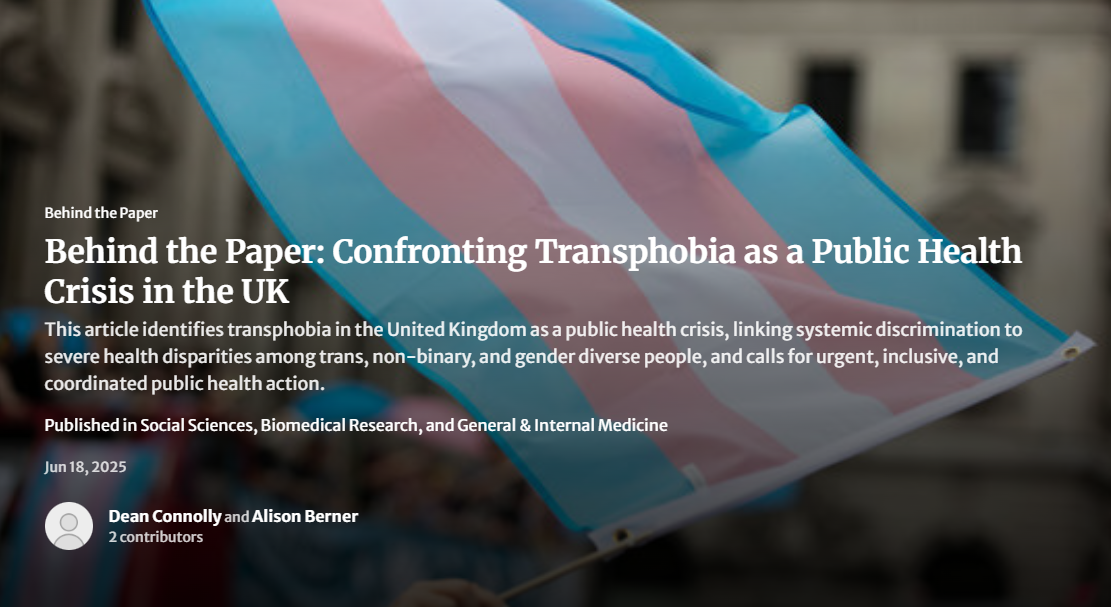
This blog by @Dean Connolly and @Alison Berner explains how transphobia in the UK has become a public health emergency. This Behind the Paper post, reflecting on the article from the International Journal for Equity in Health, outlines how transphobia operates across national policy, media, and everyday interactions to harm trans, non-binary, and gender-diverse people. With stark evidence of worsening health outcomes, systemic neglect, and dangerously long waits for gender-affirming care, this blog calls for a multi-sector response, from research reform and inclusive policy to education and advocacy.
This is a fascinating read for anyone invested in health equity and social justice. Read the full blog to understand what must change and how we can act.
Advancing Transgender Health Equity: A Global Call for Inclusive Care
A growing body of research demonstrates how transgender individuals face poorer health outcomes and widespread barriers to access care. In response to this, the International Journal for Equity in Health, has launched a dedicated article collection examining these disparities through the lens of Sustainable Development Goal 3 (SDG 3) - to ensure healthy lives and promote well-being for all at all ages. This From the Editors blog by @Rita Moreirareflects on the systemic discrimination that persists in healthcare settings, including troubling biases among providers, and the urgent need for reform, education, and structural change.
Transgender Care and Beyond: How IJIR is Shaping the Future of Sexual Medicine
The IJIR: Your Sexual Medicine Journal explains how sexual and reproductive health is not a one-size-fits all. This blog from our From the Editors channel written by @Virginia Mercerexplains how the IJIR is committed to advocating for health equity across all sexes and genders. IJIR is championing research that goes beyond the physical to include psychological, hormonal, and social dimensions of care. The Transgender Care collection showcases advance in gender-affirming treatments and underscores the journal’s broader mission to close research gaps and promote well-being for all in line with the Sustainable Development Goal 3: Good health and well-being.
Read more about this evolving field and explore how IJIR is pushing for inclusive, evidence-based care.
Cervical Screening Awareness Week
Cervical Screening Awareness Week, held each June, is a UK-wide initiative to highlight the importance of cervical screening (smear tests) in preventing cervical cancer. It’s an opportunity to raise awareness, address barriers to access, and encourage conversations that help more people understand the role of early detection and vaccination in protecting long-term health.
Understanding the WHO’s 90-70-90 Campaign
The WHO’s 90-70-90 initiative sets ambitious goals to eliminate cervical cancer worldwide: vaccinate 90% of girls by age 15, screen 70% of women by ages 35 and 45, and ensure 90% receive timely treatment. This blog, written by @Manuela Cazzanti, breaks down the recommended screening strategies for both general and high-risk populations, highlighting innovative approaches like the Point-of-Care strategy that combines diagnosis and treatment in a single visit.
For a clear overview of these critical strategies shaping the future of cervical cancer prevention, read the full blog.
One Dose HPV Vaccine: New Evidence from Fiji Supporting Global Cervical Cancer Prevention
This insightful Behind the Paper blog highlights groundbreaking research from Fiji, a country with one of the highest cervical cancer rates in the Pacific. The study, published in Nature Communications by @Zheng Quan Toh @Chau Quang and @A/Prof Paul Licciardi, followed girls vaccinated with one, two, or three doses of the HPV vaccine over six years and revealed that even a single dose offers durable immune protection, comparable to that of multiple doses. This evidence underpins the WHO’s recent recommendation of a one-dose schedule, improving vaccine accessibility worldwide. With ongoing long-term studies and regional collaborations, this work is shaping the future of HPV vaccination programs globally. Discover how this unique research is advancing cervical cancer prevention.
June also marks Sickle Cell Awareness Month in the UK, a vital opportunity to spotlight a disease that disproportionately affects the Black community and has long been underfunded and misunderstood. In a powerful Q&A blog written by @India Sapsed-Foster, @Marlene Stewart and @Flora Okumagba - members of Springer Nature’s Black Employee Network— the authors explore the genetic roots of the disease, barriers to diagnosis and treatment, and the urgent need for improved education, mental health support, and equitable care. They also highlight promising breakthroughs, including NHS approval of Voxelotor and gene-editing therapies, which offer real hope for the future. Read the full post to hear directly from those driving awareness and change.
Whether raising awareness, amplifying underrepresented voices, or pushing the boundaries of public health research, this month’s blogs remind us that inclusion and equity are not side notes, they are central to meaningful progress.
Don’t forget to like and start conversations in the comment section of the posts you enjoy. Is there more you would like to learn from the author? Let them know in the comments!
Further reading:

Helping researchers connect, collaborate, and communicate their work. Specialising in Medicine and Life Science and passionate about making science more visible and accessible.
Follow the Topic
-
Nature Communications
An open access, multidisciplinary journal dedicated to publishing high-quality research in all areas of the biological, health, physical, chemical and Earth sciences.
-
International Journal for Equity in Health
This journal presents evidence relevant to the search for, and attainment of, equity in health across and within countries and publishes research which improves the understanding of issues that influence the distribution of health and healthcare within populations.


📢 Introducing: # Mental Health
Mental Health is a Topic created to increase visibility and impact of research in this area and facilitate exchange amongst researchers.
Continue reading announcementRelated Collections
With Collections, you can get published faster and increase your visibility.
Elimination of infectious diseases of poverty as a key contribution to achieving the SDGs
Publishing Model: Open Access
Deadline: Ongoing
Health Inequities’ Lethal Impact
Advancing our collective understanding of health inequities remains essential for addressing the complex and often lethal consequences of systemic disparities in health outcomes. While significant progress has been made in recognizing the role of social determinants of health (SDOH), there is an urgent need to further investigate the structural injustices that perpetuate income inequality, racial and ethnic disparities, and the disproportionate burden of chronic disease—particularly among historically marginalized and underserved populations.
This Collection centers on the lethal impact of health inequities, with a primary focus on mortality and the systemic conditions that lead to preventable deaths. While morbidity—defined as the burden of disease and disability—plays a critical role in shaping health trajectories, it is the escalation to premature mortality that underscores the urgency of this research. Authors are strongly encouraged to examine how inequities contribute to death and life-shortening outcomes, rather than submitting work that addresses health equity in general without engaging with its fatal consequences.
Recent research has revealed that the relationship between morbidity and mortality is complex and non-linear. Some populations endure prolonged suffering due to chronic conditions, while others face abrupt and avoidable death due to systemic neglect. These patterns reflect the cumulative impact of adverse SDOH, such as housing insecurity, food instability, limited education, and lack of access to timely care.
Communities facing intergenerational trauma, persistent socioeconomic disadvantage, and discrimination—including Indigenous populations and other minoritized groups—are disproportionately affected. Individuals living in areas of high social vulnerability experience significantly higher all-cause mortality rates, and those with multiple concurrent adverse SDOH face the poorest health outcomes.
Ongoing examination of these issues is vital for informing evidence-based decision-making and equipping policymakers with the insights needed to foster equity in health. Beyond identifying policy failures, this Collection seeks to highlight mechanisms for translating research into equitable policy action. By bridging the gap between evidence and implementation, we aim to surface practical pathways for systemic change—whether through legislative reform, community-led initiatives, or integrated health system strategies.
We invite researchers to contribute to this special Collection, Health Inequities’ Lethal Impact. Topics of interest include, but are not limited to:
-Structural injustice and health
-The role of income inequality in health outcomes
-Racial and ethnic disparities in chronic disease
-Health inequities in Indigenous communities
-Policy interventions for reducing preventable deaths
-Mechanisms for translating evidence into equitable policy action
-Social determinants of health and morbidity
-Community-based approaches to health equity
-Examining policy failures in health systems
-Intersections of morbidity and mortality in vulnerable populations
This Collection supports and amplifies research related to SDG 3, Good Health and Well-Being and SDG 10, Reduced Inequalities, reinforcing the global imperative to ensure equitable access to health.
All submissions in this collection undergo the journal’s standard peer review process. Similarly, all manuscripts authored by a Guest Editor(s) will be handled by the Editor-in-Chief. As an open access publication, this journal levies an article processing fee (details here). We recognize that many key stakeholders may not have access to such resources and are committed to supporting participation in this issue wherever resources are a barrier. For more information about what support may be available, please visit OA funding and support, or email OAfundingpolicy@springernature.com or the Editor-in-Chief.
Publishing Model: Open Access
Deadline: Nov 02, 2026