Lactobacillus maintains healthy gut mucosa by producing L-Ornithine
Published in Microbiology
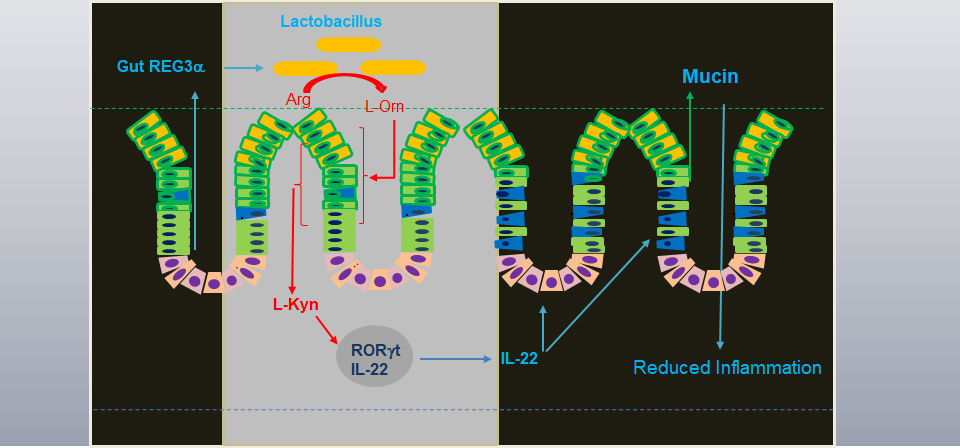


Gut microbiota play a critical role in maintaining gut homeostasis. They not only regulate gut innate immune but also adaptive immune cells. These immune cell responses are dictated not only via “endogenous” host-derived but also “exogenous” signals such as gut microbiota/their metabolites. Interestingly, many secreted antimicrobial proteins in the gastrointestinal tract may potentially affect the composition of gut microbiota via killing bacteria such as REG3. Thus we investigated the possibility for gut antimicrobial proteins to be involved in gut mucosal homeostasis through the altered microbiota.
We first found that mucus gel remarkably increased in the ileum of REG3Atg mice. Further studies showed that gut REG3A (Reg3a in mouse) promotes the formation of gut mucus layers in the small intestine and colon through RORγt (+) IL-22(+) ILC3 cells.
We next analyzed the composition of gut microbiota and found that the proportion of lactobacilli was high in the ileum and colon of human REG3A tg mice as compared to their control cohoused littermates. We demonstrated that increased lactobacillus in human REG3A tg mice was close to L. Murinus isolates. Previous studies showed that AhR ligand indole-3-aldehyde (IAld) from lactobacillus may contribute to AhR-dependent IL 22 transcription. However, this was not a case for REG3A-associated lactobacillus. We found that lactobacillus derived L-Orn is a critical factor for lactobacillus mediated RORγt (+) IL-22(+) ILC3 cells and gut mucus formation. L-Orn may be derived from Arg metabolism through ADI pathway in lactobacillus. Lactobacillus derived L-Orn promotes the production of AhR ligand L-Kyn in gut epithelial cells. We also found the AhR ligand L-Kyn produced by gut epithelial cells is responsible for lactobacillus mediated RORγt (+) IL-22(+) ILC3 cells. Thus, we demonstrate that lactobacillus may promote the homeostasis of gut mucus layer through producing L-Orn. L-Orn stimulates Trp metabolism to produce AhR ligands in gut epithelial cells, which induce accumulation of RORγt (+) IL-22(+) ILC3 in gut tissues.
For more details, check out the full manuscript here: https://www.nature.com/articles/s42003-019-0424-4

Follow the Topic
-
Communications Biology
An open access journal from Nature Portfolio publishing high-quality research, reviews and commentary in all areas of the biological sciences, representing significant advances and bringing new biological insight to a specialized area of research.

Related Collections
With Collections, you can get published faster and increase your visibility.
Lifespan changes in the human brain
Publishing Model: Hybrid
Deadline: Feb 01, 2027
Healthy Aging
Publishing Model: Open Access
Deadline: Dec 31, 2026