Larger Than Germany: Subsurface Ocean Warming Drove a Giant Antarctic Polynya During the Ice Age
Published in Earth & Environment and Education
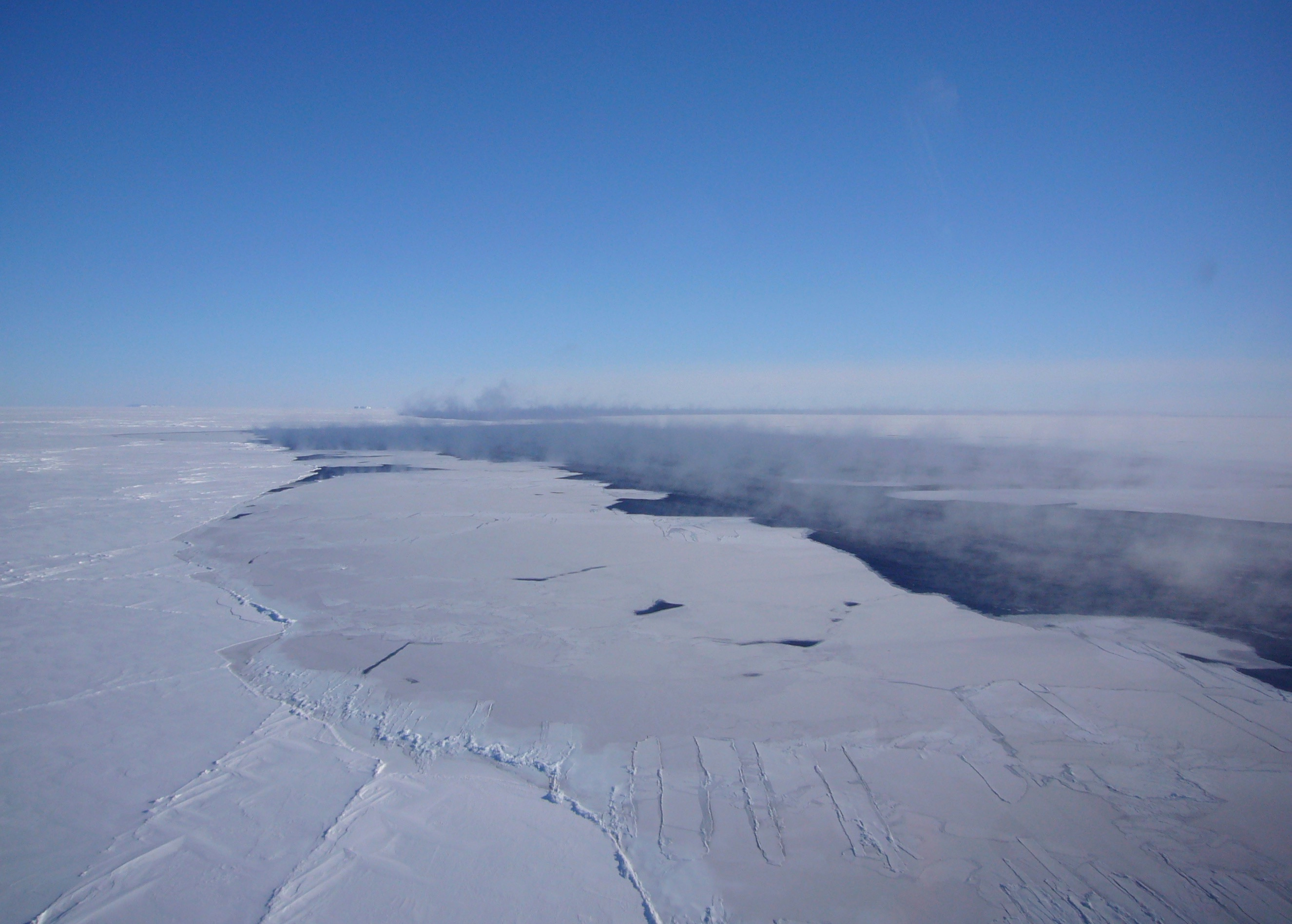


What do we imagine when we think of Antarctica during an ice age?
Before starting this study, I would have answered that question with a familiar image: a frozen ocean, locked beneath thick sea ice, with very little happening at the surface. But the Southern Ocean has a way of surprising us. Instead of a permanently sealed icy lid, our results point to repeated openings in the sea ice off East Antarctica during the last glacial period, between 75,000 and 19,000 years ago (https://www.nature.com/articles/s41467-026-70498-w). And not just small openings. We are talking about a giant polynya, an area of open water likely larger than Germany.
That idea felt striking from the beginning. How could such a large ice-free area exist in one of the coldest places on Earth, and during an ice age no less? That question stayed with me throughout my PhD.
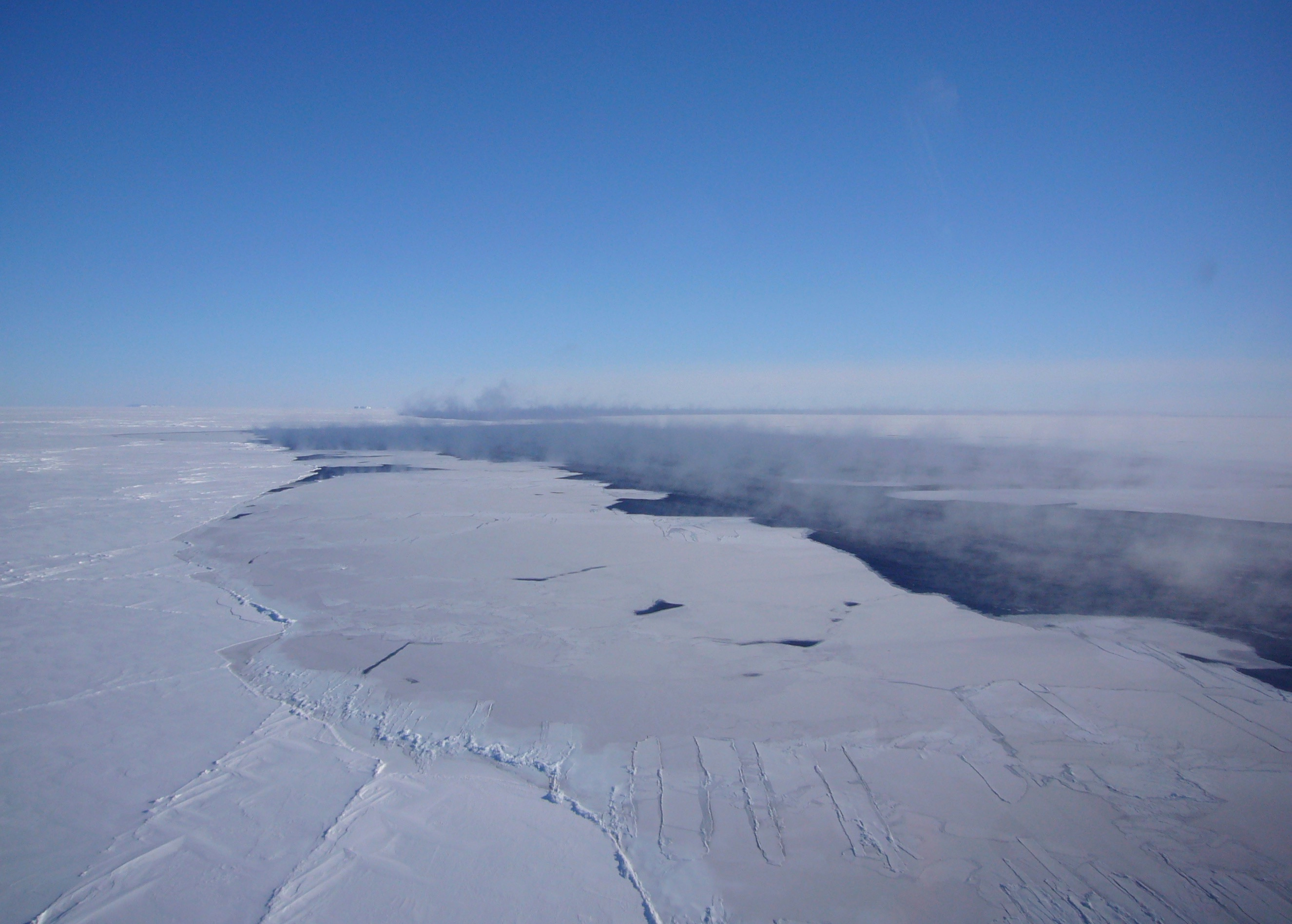
Figure 1. Modern steaming polynya from the cracked ice around Antarctica. Photo Jan Lieser, ACE CRC Australia (https://www.geomar.de/fileadmin/content/service/presse/Pressemitteilungen/2017/pm_Antarktis_Polynja_Bild-1.jpg). Note the
How can tiny fossil shells tell us anything about an ancient polar ocean?
The answer lies in planktonic foraminifera, tiny marine organisms that build calcite shells. When they die, their shells sink to the seafloor and become part of the sediment record. If those shells are well preserved, they carry chemical clues about the water in which they lived, including temperature and salinity.
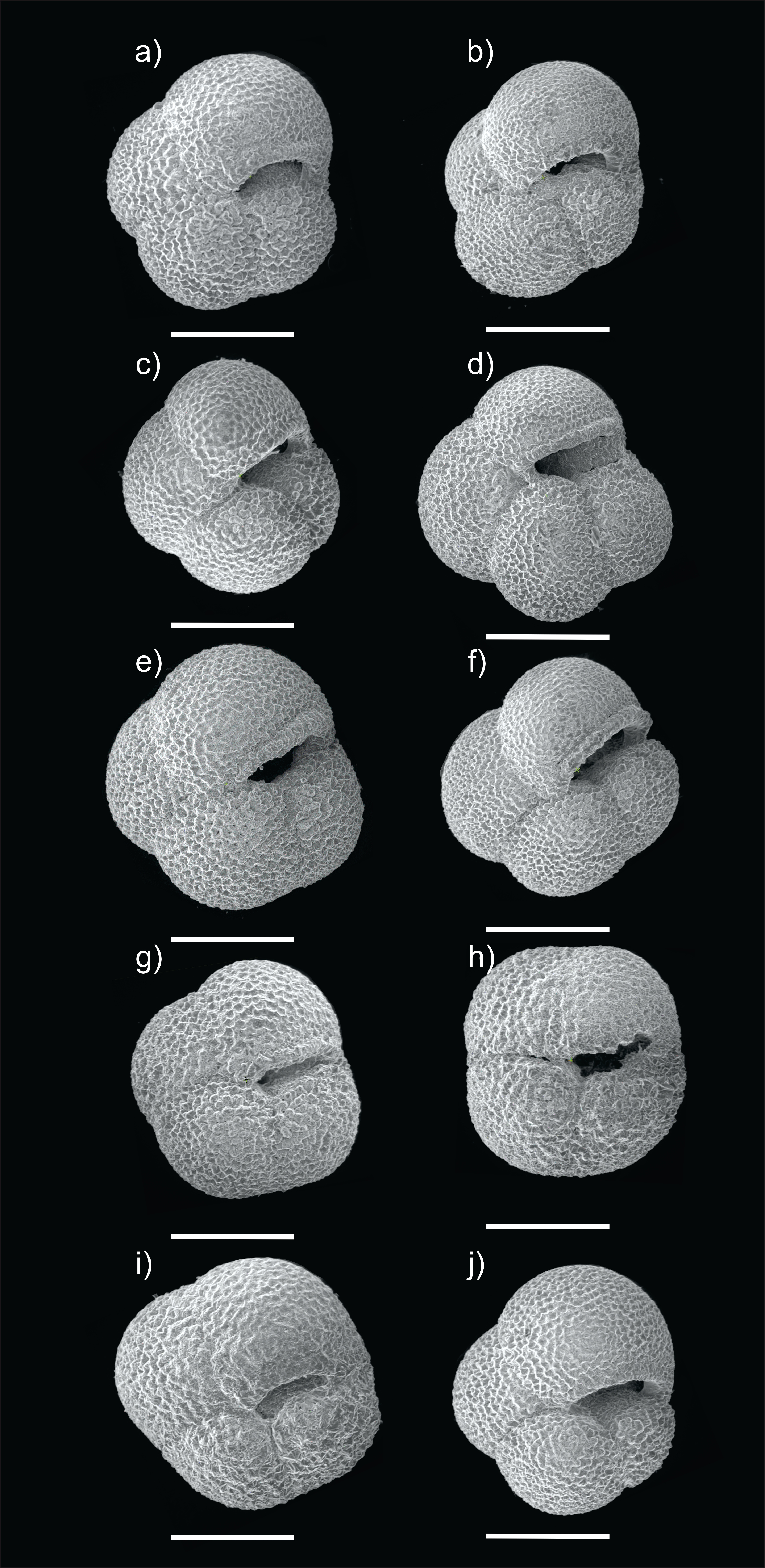
Figure 2. Scanning electron microscopy (SEM) images of Neogloboquadrina pachyderma sinistral from core PS128_2 during the last glacial period. White lines represent scale bars (200 μm) (Pinho et al., 2026).
That is where this study became both exciting and challenging. Antarctic glacial sediments rarely preserve enough of these fossils for detailed geochemical work. But in a sediment core from the Bungenstock Plateau, off Dronning Maud Land, we found an exceptional archive. Suddenly, it was possible to ask much more detailed questions about what the upper ocean looked like during the last ice age.
Working with these shells was painstaking. Some measurements required picking more than 1,000 individual specimens for a single data point. But that effort allowed us to provide the highest-resolution and southernmost subsurface temperature reconstruction for the last glacial period published so far.
What did the shells reveal?
They revealed a hidden source of warmth beneath the ice.
Today, the waters around Antarctica are strongly layered. Cold, relatively fresh surface water (Antarctic Surface Water, ASW) sits on top of warmer, saltier deep water (Warm Deep Water, WDW). This layering, known as stratification, helps keep the deeper heat from reaching the surface. In our record, however, that structure repeatedly weakened during cold Antarctic phases (Fig. 3). At those times, subsurface waters became warmer and saltier, a strong sign that deeper warm water was moving upward.
.jpg)
Figure 3. This figure summarizes our interpretation of ice-ocean-atmosphere interactions that led to polynya formation during Antarctic cold phases (panel a) and strong upper-ocean stratification with no polynya formation during Antarctic warm phases (panel b) (Pinho et al., 2026).
That upward movement matters because it provides a mechanism for melting sea ice from below. Once an opening forms, the ocean can release heat and moisture to the atmosphere, helping to keep that area ice-free. In other words, the ocean itself can help sustain a polynya.
For me, this was one of the most fascinating parts of the story. Antarctica is often described as a place controlled by cold. But here, the key process is hidden warmth below the surface, quietly destabilizing the ice cover from underneath.
Why does a polynya matter?
Because it is not just a hole in the ice.
A large polynya changes the way the ocean and atmosphere interact. It allows heat to escape from the ocean (Fig. 3). It releases moisture into the air. It can affect sea-ice production, ocean circulation, and even snowfall over Antarctica. In our study, we suggest that repeated polynya formation may have increased the moisture supply to the continent, potentially promoting snow accumulation and helping the ice sheet thicken along the East Antarctic margin (Fig. 3).
I find that especially compelling because it shows how climate processes can produce effects that seem almost counterintuitive (marine subsurface warmings during Antarctic cold phases). An opening in sea ice during an ice age may actually have helped parts of the Antarctic Ice Sheet grow.
Why look so far into the past?
Because the processes we are studying are not just ancient curiosities. They are deeply relevant to the present.
The same ingredients still shape Antarctica today: ocean heat, sea ice, freshwater input, and the layering of the upper ocean. But modern climate change is altering that balance. As melting ice adds freshwater to the ocean surface, stratification becomes stronger. That makes it harder for warm deep water to mix upward in the way we infer for the past. Instead, the heat can remain trapped below and be redirected toward ice shelves, where it can melt them from underneath.
So while this paper is about the last ice age, it also speaks to one of the big questions of our time: how will the Southern Ocean respond to continued warming, and what will that mean for Antarctica and global sea level?
What stayed with me most?
Probably the scale of the story hidden in such small fossils.
This study started with tiny shells in a sediment core and led us to evidence for a giant open-water area in the middle of an ice age. That contrast always amazes me. Some of the smallest archives in Earth science can reveal some of the biggest changes in the climate system.
And that, for me, is what makes paleoclimate research so rewarding. It allows us to recover pieces of an ocean we can no longer observe directly, and in doing so, it helps us understand both Earth’s past and its future.

I am a Chemistry Technician with a Bachelor’s degree in Environmental Management and a Master’s degree in Geosciences from the University of São Paulo, Brazil. I earned my doctoral degree summa cum laude at the Alfred Wegener Institute (AWI) in Bremerhaven, Germany. In 2025, I received the Bernd Rendel Prize from the German Research Foundation (DFG) (https://www.dfg.de/en/funded-projects/prizewinners/rendel-prize/2025/pinho), the most prestigious national award for young scientists at the PhD level in Germany. I received another national prize, the Helmholtz Doctoral Award 2026 as well as the regional AWI Doctoral Award 2026.
My primary research area is the paleoceanography and paleoclimatology of the tropical and subtropical Atlantic, the Southern Ocean, and Antarctic ice dynamics during the Late Quaternary. My work seeks to disentangle the complex climate teleconnections among these regions in order to improve our understanding of past ocean circulation, climate variability, and cryosphere-ocean interactions.
My scientific expertise encompasses a broad range of paleoceanographic subdisciplines and analytical techniques. These include grain-size analysis, clay and bulk mineralogy of surface samples and sediment cores, XRF and CT scanning, and geochemical methods such as Mg/Ca and clumped-isotope paleothermometry, alongside oxygen and carbon isotope analyses for reconstructing water-mass signatures. I also specialize in establishing stratigraphic frameworks through radiocarbon dating and isotope stratigraphy.
Follow the Topic
-
Nature Communications
An open access, multidisciplinary journal dedicated to publishing high-quality research in all areas of the biological, health, physical, chemical and Earth sciences.

Related Collections
With Collections, you can get published faster and increase your visibility.
Women's Health
Publishing Model: Hybrid
Deadline: Ongoing
Tumor Microenvironment Crosstalk and Therapeutic Implications
Publishing Model: Hybrid
Deadline: Nov 02, 2026