Light-modulated van der Waals force microscopy
Published in Materials



Background
AFM is a powerful tool for nanometer-resolution characterization of the 3D topography of material surfaces and has been widely used since its invention in the 1980s. However, since the working principle of AFM is to determine the probe-sample spacing by detecting the absolute interaction force between the probe tip and the sample surface, it can only measure the topography variation of the sample surface but not the material composition. In other words, “it can only see something, but cannot know what it is”.
What We Created
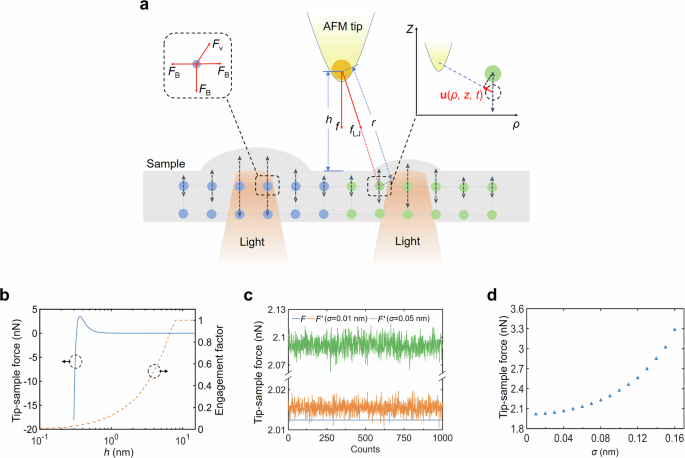
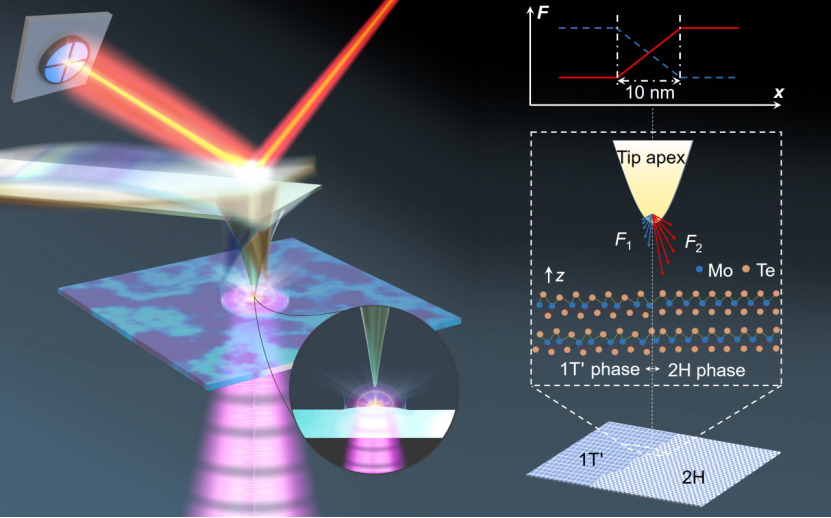
With an in-depth research on the tip-sample interaction force, our team proposed a new method of exciting the sample with a modulated laser and detecting the dynamic vdW force of the sample surface and the probe tip. The dynamic vdW force varies with the bonding forces between atoms or molecules inside materials and therefore contains information of the bonding state of the material atoms and molecules. Therefore, material composition can be determined by probing the dynamic vdW force during the probe scanning. Moreover, if the dynamic vdW force response curves with changed light excitation wavelength of different materials have been measured in advance, the material type can also be determined. This new method is named “light-modulated van der Waals force microscopy (LvFM)”.
More specifically, since the vdW force is very weak and is generally overwhelmed by other force signals and background noises, it is usually ignored in previous studies. Our team proposes a sideband modulation-demodulation method, in which a laser with a specific modulation frequency is used to irradiate the sample surface beneath the probe tip, which induces the enhanced thermal motions of sample molecules. Then the information of bonding force of molecules is incorporated in this thermal motion enhancement, which is reflected in the change of the dynamic vdW force between the sample and probe and can be extracted by sideband demodulation of the tapping-mode dual-frequency AFM cantilever. With this technique, LvFM enriches the functionality of AFM to be able to discriminate the material composition in nanometer precision.
Why It Matters
With experimental demonstrations, the LvFM shows advantageous performance in characterizing various materials including 2D materials (such as transition metal sulfides), carbon nanotubes, metals, semiconductors, polymers, and several types of nanoparticles. The LvFM shows a spatial resolution < 10 nm, a signal-to-noise ratio > 20 dB, a detection sensitivity of 10-5 V/mW, a scanning speed of 8 ms/point, a good signal stability within 8% in 15 s, and the ability to simultaneously acquire the surface topography and composition images in a single scan. In addition, since the working principle of LvFM is intrinsically different from that of near-field infrared spectroscopy and other methods, it is not necessary to accurately tune the excitation laser wavelength to match the molecule vibrational energy levels. Hence, the excitation wavelength can be selected in a wide band from visible to infrared with moderate laser power, which make it easy to use. Moreover, since LvFM can work in an atmospheric environment, it is easy to operate and is compatible with AFM. In this way, LvFM reaches the goal of “not only see something, but also know what it is”.
This work demonstrates that LvFM is a fast, accurate, non-destructive, label-free, and high-resolution characterization method for identifying material composition in a variety of complex scenarios, such as identifying heterogeneous crystalline phases in homogeneous materials, identifying composition of mixed heterogeneous nanomaterials, and detecting nanodefects in 2D semiconductor materials. Therefore, it is expected that LvFM may soon find important applications in various fields such as the metrology of 2D semiconductor materials, the characterization of low-dimensional and quantum materials, and the inspection and quality control of optoelectronic nanodevices.
Who's behind
Our team comes from the Department of Precision Instrument of Tsinghua university and the State Key Laboratory of Precision Measurement Technology & Instrument. The first author of the paper is Dr. Yuxiao Han, and the corresponding authors are Prof. Benfeng Bai and Prof. Hong-Bo Sun. This work was supported by the National Natural Science Foundation of China.

Prof. Benfeng Bai is the principal investigator of the Nanophotonics Group at the Department of Precision Instrument, Tsinghua University, China, with research emphases on advanced nano-devices, nano-fabrication and nano-measurement based on near-field optics. He has published 100+ research papers in leading SCI-indexed journals including Nature series, Light: Sci. Appl., ACS Nano, Nano Letters, Adv. Fun. Mater., etc. with 7500+ citations, has given 30+ keynote and invited talks in international conferences, and has been granted 30+ patents. As the responsible leader, he has led 10+ research projects funded by the Ministry of Science and Technology of China, the National Natural Science Foundation of China, etc. He provides services in many national and international academic organizations such as the board member of the National Technical Committee on Standardization of Nanotechnology of China (SAC/TC279) and the coordinator of the Sino-French Optoelectronics and Photonics International Research Network (PHOTONET). He has served as editors or board members for journals including Optics Letters, Micromachines, and Applied Physics B. He is currently the senior member of the Institute of Electrical and Electronics Engineers (IEEE), the Chinese Optical Society (COS), and the Chinese Society for Optical Engineering (CSOE).
Follow the Topic
-
Nature Communications
An open access, multidisciplinary journal dedicated to publishing high-quality research in all areas of the biological, health, physical, chemical and Earth sciences.

Related Collections
With Collections, you can get published faster and increase your visibility.
Women's Health
Publishing Model: Hybrid
Deadline: Ongoing
Tumor Microenvironment Crosstalk and Therapeutic Implications
Publishing Model: Hybrid
Deadline: Nov 02, 2026