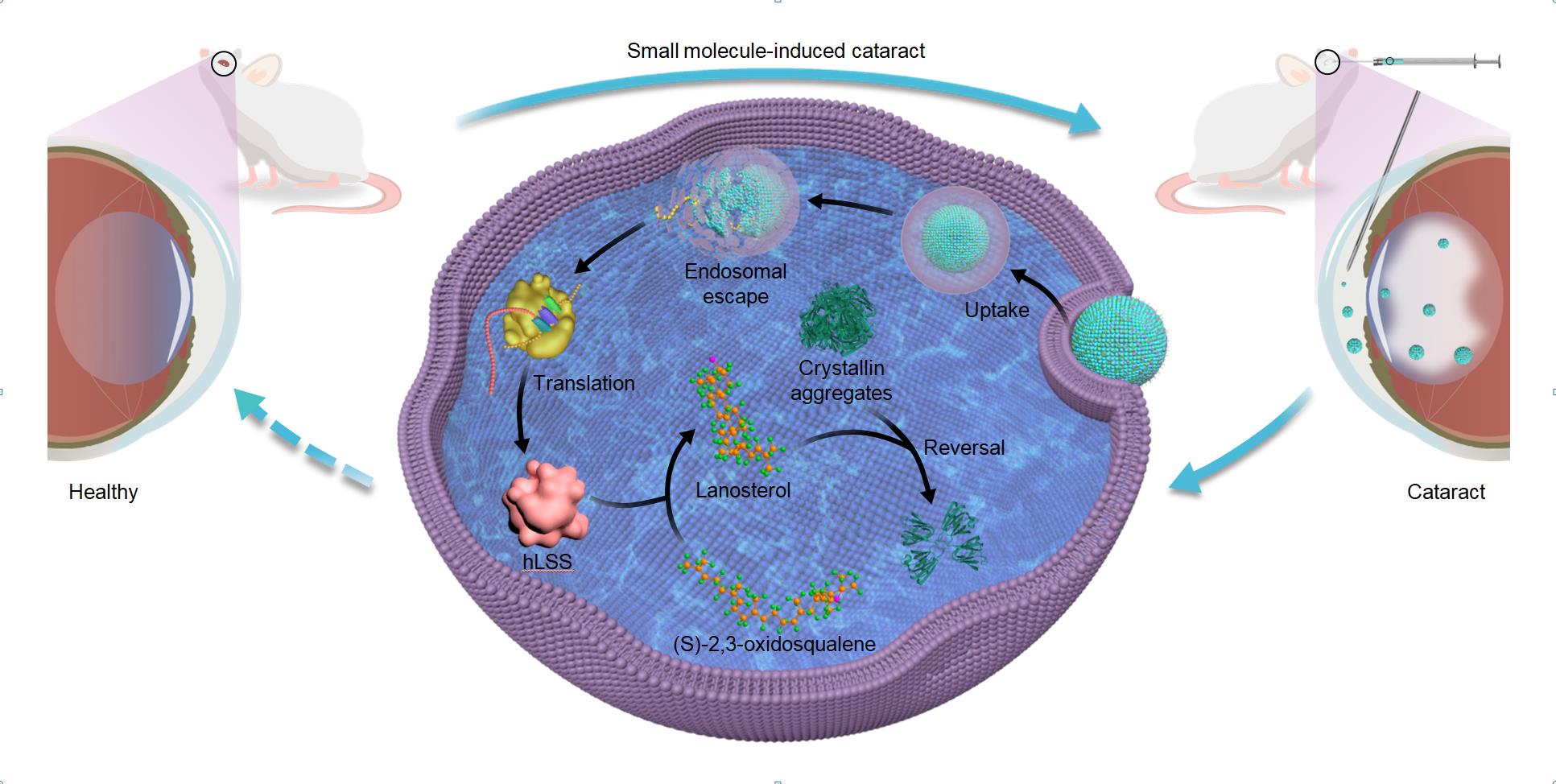


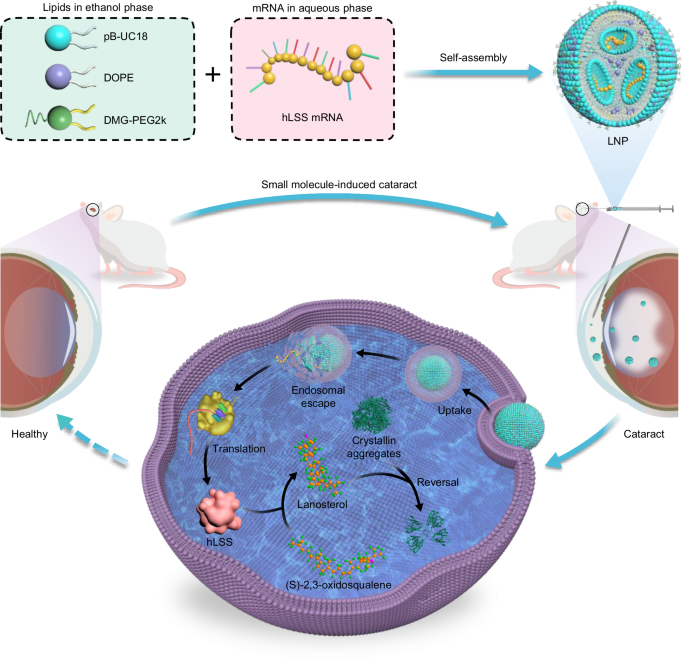

Cataract is a common age-related ocular disease that affects millions worldwide and imposes huge personal and societal healthcare burdens. It remains the leading cause of vision impairment and blindness, with surgery as the only treatment option. While effective, surgery is inaccessible to many due to cost, lack of surgical expertise, or medical contraindications. Our story begins with a fundamental question: Can we instruct the lens cells to produce a therapeutic protein that reverses cataract?
Lanosterol, a naturally occurring molecule in the cholesterol biosynthesis pathway, has been shown to dissolve the aggregated proteins that cause the lens to become opaque. However, lanosterol cannot be directly used owing to its poor solubility and short half-live. In the story behind the paper, we wondered if we could deliver mRNA encoding lanosterol synthase to command cells to make lanosterol in situ.
Given that the eye is a highly protected organ, and mRNA is a large, unstable molecule that cannot cross cell membranes on its own, we needed a customized delivery vehicle. We thus engineered a specific ionizable lipid (named pB-UC18) with an aromatic core and two para-substituted monounsaturated C18 alkyl chains. When formulated into LNPs, this lipid proved to be exceptionally efficient at shuttling mRNA into lens cells. Once inside, the nanoparticles facilitated endosomal escape and released the mRNA into the cytoplasm, where the cell's machinery could read the instructions and start producing functional hLSS protein.
The next critical step was finding the best route to deliver therapeutic LNP-mRNA formulations into the eye. We tested several routes in rats and found that intracameral injection resulted in sustained and selective protein production precisely in the lens, with minimal off-target effects in other organs like the liver.
In two established rat models of cataract: one mimicking an age-related nuclear cataract and the other a diabetic-like galactose cataract, we demonstrated that intracameral injection of hLSS mRNA-LNP formulations led to a remarkable reversal of lens opacity. Under the microscope, we saw that hallmarks of cataract, such as the disorganized, swollen lens fibers, and protein aggregates were significantly ameliorated. Notably, the treatment was safe, causing no significant damage to ocular structures or other major organs.
While there is more work, including studies in larger animal models and the development of less invasive delivery methods, to be done, this work demonstrates that mRNA therapy may serve as an alternative non-surgical approach for delaying or even reversing cataract.
For further details, please see the full paper published in Nature Communications. Song, R., Lin, Y., Zhang, M., Liu, Z., Zhang, R., Zhao, J., Li, B. Ocular delivery of lipid nanoparticles-formulated mRNA encoding lanosterol synthase ameliorates cataract in rats. Nat Commun 16, 8522 (2025). https://doi.org/10.1038/s41467-025-63553-5
Follow the Topic
-
Nature Communications
An open access, multidisciplinary journal dedicated to publishing high-quality research in all areas of the biological, health, physical, chemical and Earth sciences.

Related Collections
With Collections, you can get published faster and increase your visibility.
Women's Health
Publishing Model: Hybrid
Deadline: Ongoing
Tumor Microenvironment Crosstalk and Therapeutic Implications
Publishing Model: Hybrid
Deadline: Nov 02, 2026