On-body detection of unamplified nucleic acid
Published in Bioengineering & Biotechnology, Chemistry, and Materials

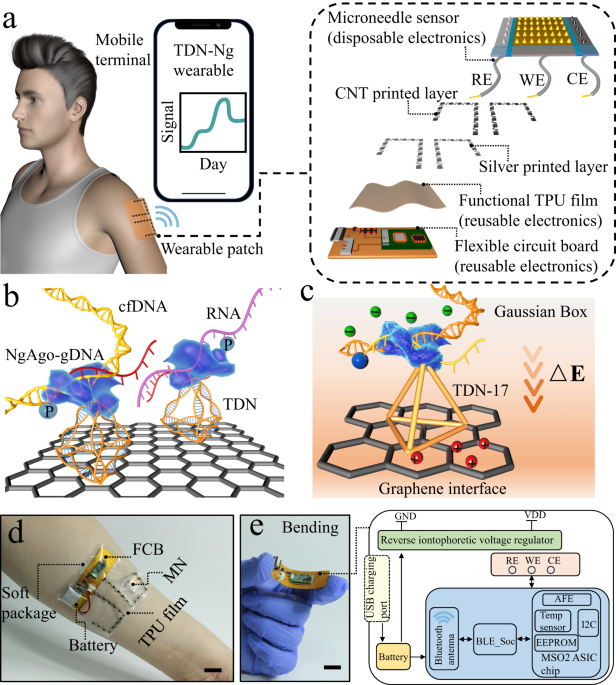

Recently developed genetic testing techniques allow the identification of related diseases through nucleic acid-based diagnostics. Among these established tools, amplification-free detection of unamplified target nucleic acids has been rapidly developed. However, in some circumstances, such as pandemic or intensive care unit patients monitoring, amplification-free methodologies require hand-free, sensitive, continuous monitoring, which might be approached by fully integrated wearable electronics.
In this study, we aimed to fabricate an integrated wearable electronics for highly sensitive and long-term stable nucleic acid detection, including DNA and RNA. For this, we devised a nano-scaffold consisting of tetrahedral DNA nanostructures (TDN) and prokaryotic argonaute (NgAgo-gDNA) for sepsis-associated intervention caused by Epstein-Barr virus, staphylococcus aureus and pseudomonas aeruginosa. The story of this study can be divided into four stages.
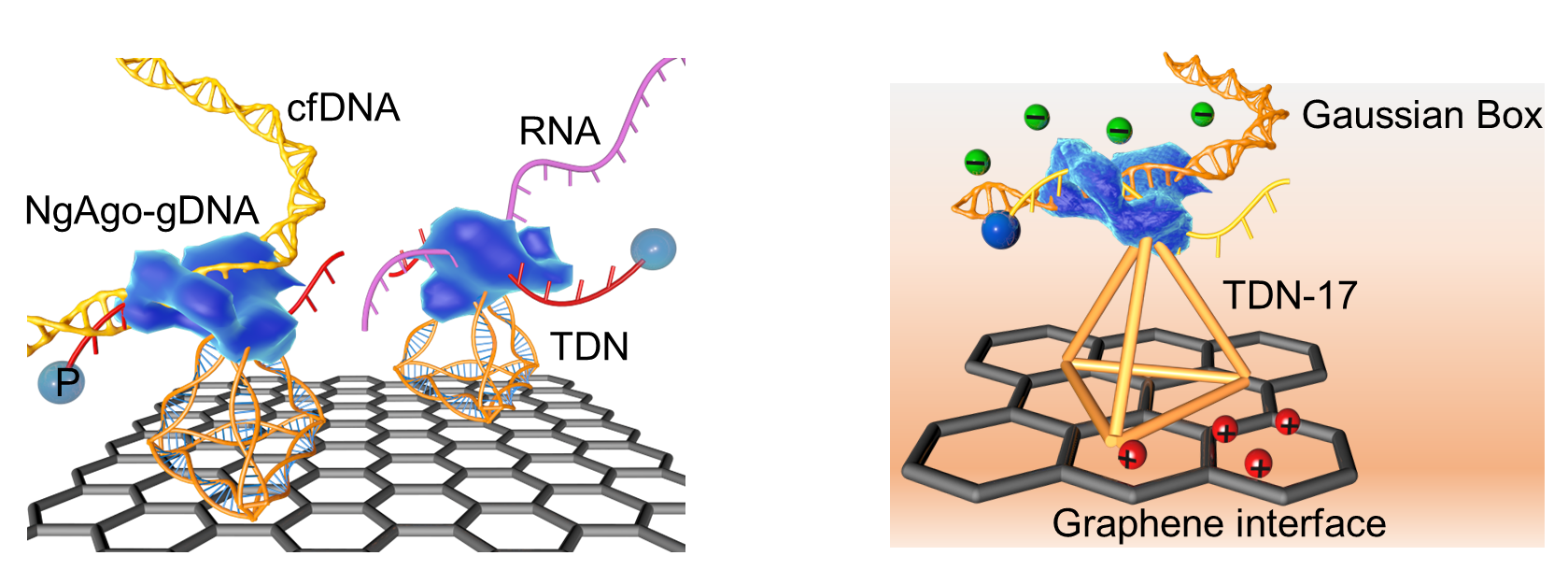
On the first stage, we found that as the height of the TDN continued to increase, the signal output and detection sensitivity increased. But this phenomenon has a threshold at the height of TDN-17 (approximately 5.8 nm). It preliminarily showed that the spatial height has a certain regulatory effect on Donnan’s potential of the interface within the range of suitable heights. Additionally, we discussed the detailed theory and deduction. It can be imaged that a Gaussian box contains all the charge in the diffuse layer and tight layer (electrical double layers) based on the Gouy-Chapman-Stern model. The potential in the electrical double layers largely depends on the Debye length, which measures the charge carried in solution as well as the continuous spatial range of the electrostatic effect. Within the Debye length, charged substances in electrical double layers output the current response. If the electrical double layers exceed the Debye length, the biosensing signal output might be impaired.
On the second stage, we explored the specific recognition and binding of target nucleic acid by NgAgo-gDNA system, which is extremely vital for this study. Through surface plasmon resonance, electrophoretic mobility shift assay, conventional microelectrode detection, we found that the recognition between the NgAgo-gDNA complex and target DNA. According to the affinity constant equation, strong binding between the NgAgo-gDNA complex and target cfDNA was determined, with a KD of 5.49×10⁻⁹ M-1. Furthermore, the predicted NgAgo-gDNA model theoretically supported the experimental data. In this study, we only unravelled the binding function of the NgAgo-gDNA system and don’t explore its potential in genome editing or DNA cleavage that is unknown. However, we still do not have full insight into how the NgAgo-gDNA complex binds to target cfDNA. Is the binding mechanism dependent on the allosteric NgAgo protein targeting to unwinding nucleic acid? Or does NgAgo conformation manipulate its targets?
On the third stage, we used SU-8 photoresist as substrate material to fabricate microneedle patch. The microneedle patch as an actuator plays an important role in the wearable electronics, because interface stability is one of the significant factors for biosensing. Compared with our proposed hydrogel microneedles, the rigidity of the SU-8 microneedle patch was improved by ~2.4-fold. We believed that the SU-8 microneedle patch might be a versatile platform for our proposed wearable platform, because they are superior to hydrogel microneedle patch in terms of low time consumption, operability, stability, and rigidity. Additionally, we fabricated functionalized thermoplastic polyurethane (TPU) film, and customized silver ink and carbon nanotube ink were successively spray-printed on the surface of the TPU film to decorate conductive patterns. It showed functional TPU film could be conformally laminated on the epidermis of human skin, which might be used for other flexible electronics.
On the fourth stage, we evaluated the practicability of the integrated wearable system in vitro and in vivo. For this, we investigated its sensitivity, quantitative detection, long-term stability, specificity, and anti-interference properties. Due to the rigid TDN structure and DNA-guided NgAgo system, the proposed MN was able to tolerate a complicated microenvironment in vivo within 14 days. To the best of our knowledge, the 14-day reliable stability of the device for real-time monitoring of nucleic acids in vivo should be satisfactory and meet the clinical requirements for intensive care unit (ICU) patients, which might be satisfactory results for in vivo long-term stable monitoring of biomacromolecules, with a detection limit of 3×10-16 M. Due to the programmability of the NgAgo-gDNA system, it can detect three kinds of sepsis-related cfDNA, even RNA.
For the conclusion of this story, this study proposed wireless, integrated wearable electronics for real-time monitoring of longitudinal nucleic acids for sepsis-related animal models through engineering biosensing interfaces. And it sheds light on the mechanism of the synergetic effect caused by TDN and NgAgo-gDNA. The wearable system was able to continuously track dynamic changes in cell-free DNA and RNA targets in vivo, with a sensitivity of 0.3 fM and reliable stability within 14 days in vivo.
Real-time monitoring of macromolecular biomarkers may provide insights into individual physiological conditions, especially for early-stage diagnosis, alarm management, prognosis, and pandemics such as SARS-CoV-2. For instance, as a global health problem, sepsis causes approximately one-third to a half of deaths in hospitals and contributes to ~11 million deaths worldwide every year. Most sepsis patients with life-threatening organ dysfunction are directly transferred to the ICU. Some ICU staff complained that more sensor cables hindered ICU patient health management. They said that it was important to increase frequency of monitoring sepsis patients in ICU. It is necessary to develop wireless, real-time monitoring, non-invasive or minimally invasive, remote controlling sensors in ICU scenarios, either to shoulder the burden of the medical system resulting from demographic change or to ameliorate ICU patient alarm management.

Follow the Topic
-
Nature Communications
An open access, multidisciplinary journal dedicated to publishing high-quality research in all areas of the biological, health, physical, chemical and Earth sciences.

Related Collections
With Collections, you can get published faster and increase your visibility.
Women's Health
Publishing Model: Hybrid
Deadline: Ongoing
Tumor Microenvironment Crosstalk and Therapeutic Implications
Publishing Model: Hybrid
Deadline: Nov 02, 2026