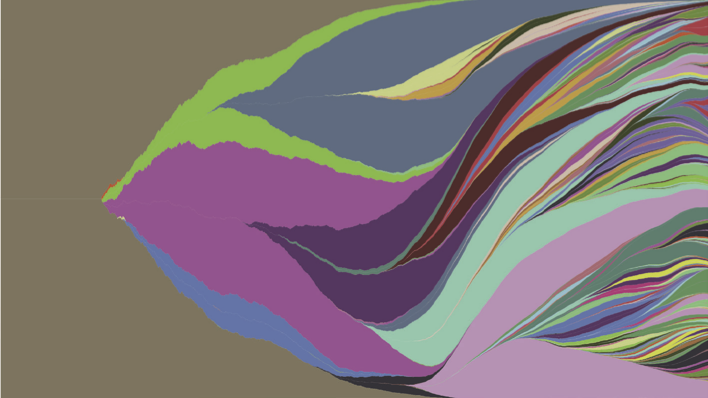
In 2017 I had moved to Switzerland for my second postdoc and was pondering one of the big questions in my research field: What is the mode – the general pattern or nature – of tumour evolution? Sequencing studies over the previous few years had led researchers to propose an assortment of possible modes. At one extreme was effectively neutral evolution, in which the mutant clones (cell subpopulations) that arise within tumours grow at similar rates, generating a patchwork of genetic diversity. At the other extreme, linear evolution would result if fitter mutant clones were to periodically spread and take over the entire tumour in what population geneticists call “selective sweeps”. Reading a 2017 review of the evidence for these and other potential modes of tumour evolution, I was struck by the paucity of theoretical predictions. What do mathematical models have to say about the fates of mutants that arise in a slowly expanding population?
I had already started investigating this question using software I had developed to simulate the evolution of expanding tumours, laying the groundwork for a 2021 paper exploring how a tumour’s spatial structure – how the cells are arranged and how they disperse – governs its mode of evolution. A general conclusion of this work (covered in a previous Behind the Paper post) was that selective sweeps are uncommon and are confined to the early stages of tumour development. But the problem with computational models is that they don’t provide general explanations and predictions. If I wanted to know the effect of changing a parameter value then I’d have to run a new batch of simulations. It occurred to me that mathematical analysis, within the framework of stochastic processes, could yield broader insights.
I soon derived results for a minimal model in which a “wildtype” population expands from a point at a constant speed in one dimension. Mutants can arise at any time and at any location in the expanding wildtype (so, in technical terms, the model is an inhomogeneous Poisson process). The mutants then expand within the wildtype. If the first arising mutant spreads quickly enough, it might reach both ends of the wildtype population and thus achieve a selective sweep. Alternatively, a second mutant might arise within the wildtype and block the first mutant’s expansion. My main result was a mathematical expression for the probability of the first mutant achieving a selective sweep, in terms of the model’s parameters. Interestingly, this probability was independent of the mutation rate. I presented this preliminary result as a single slide in a couple of talks in late 2017.
And that might have been the end of the story had I not, in early 2020, had the good fortune to be approached by a talented Physics student looking for a master’s project. The student, Alex Stein, told me he was interested in getting into mathematical biology. He had a strong background in calculus, probability theory, and stochastic processes. Perfect!
And then of course the bad luck: COVID came and we were ordered to evacuate our offices. I had just enough time to scan my old handwritten calculations, which I emailed to Alex as the starting point for his project.
The next months were difficult. My postdoc contract was coming to an end. I needed to get papers published and find a job while taking turns caring for my one-year-old daughter, whose nursery had shut. We became accustomed to Zoom calls. But Alex was unphased and in September submitted an excellent dissertation, the first half of which derived the probabilities and timing distributions of selective sweeps for populations expanding in one, two, and three dimensions.
Again, that could have been as far as we got. I took up my current job in London. Alex started a PhD, also in London, on a different (though related) topic. But Alex was persistent. He opted to keep pursuing his work with me as a side project. His PhD supervisor, Ben Werner, generously supported his doing so.
By June 2021 we had a 12-page draft with most of the mathematical results we needed. But to validate these results – to test whether our predictions held under more complicated, realistic conditions – we would also need to run simulations.
Fortune smiled on us again as, in October, I received an email from final-year PhD student Maciek Bak. Maciek had enjoyed a talk I’d recently given by video link to his department in Switzerland. “If you ever need some help from the software engineering side I would be happy to collaborate with you!” Well, as it so happens, that’s exactly what I did need.
Thanks to a small internal grant I was able to bring Maciek to London for two and half months in the autumn of 2022. He developed a computational workflow to make it much easier to run thousands of our simulations in parallel on a computing cluster. Using his workflow, Maciek confirmed the accuracy of our theoretical predictions.
Aided by Ram Kizhuttil – a talented fourth-year BS-MS student majoring in Physics at IISER Kolkata, who worked with us remotely over the summer – we posted a preprint in November 2023 and submitted to Nature Communications in May 2024.
As the public peer reviews attest, there followed two rounds of extensive revisions, mostly to add simulation results for more complex biological scenarios. My first-year PhD student Kate Bostock took on the bulk of this work, mastering the simulation workflow and figuring out the best ways to summarize and interpret more complicated outcomes.
That this “side project” has finally made it to publication, more than eight years after I conceived the idea, and more than five years after Alex submitted his master’s dissertation, is a testament to the dedication and teamwork of four early-career researchers. Appropriately, the scope of the work massively expanded and evolved over those years. The published paper presents results for a suite of alternative growth models and evolutionary scenarios. We derive surprisingly simple approximate results, which serve as useful rules of thumb. And we discuss implications for understanding the evolution not only of tumours but of other systems such as bacterial colonies and invasive species.
I’m pleased that our paper fits into a body of knowledge developed by researchers whose work I much admire. In a highly-cited 1998 paper, Philip Gerrish and Richard Lenski used an approach similar to ours to derive the selective sweep probability in a non-spatial, fixed-size population. Peter Ralph and Graham Coop (2010), and independently Erik Martens and Oskar Hallatschek (2011), obtained results for spatially structured, fixed-size populations. Tibor Antal and colleagues (2015) investigated a model in which mutants arise only at the boundary of an expanding population. In our paper we synthesize these prior results and explain how they relate to our new findings.
And as for the second half of Alex’s master’s dissertation? We don’t have it ready to submit to a journal yet but you can be sure we’re working on it.







Please sign in or register for FREE
If you are a registered user on Research Communities by Springer Nature, please sign in