Quantum error mitigation in quantum annealing
Published in Mathematics




Explore the Research

 Nature
Quantum error mitigation in quantum annealing - npj Quantum Information
npj Quantum Information - Quantum error mitigation in quantum annealing
A primary goal of quantum annealing processor development is to drive up coherence times and operational energy scales while offering the flexibility necessary to program and solve interesting and valuable problems. Understanding processor development tradeoffs is difficult in these dimensions. Many applications would benefit from improved understanding of increasingly lower-noise technologies.
Our paper shows how, with today’s technology, simple regression methods can be used to extrapolate results from higher- to lower-noise regimes, with the quality of outcome a function of the type of noise and nature of the targeted statistic.
The 1D transverse field Ising chain is one of the most accessible examples of quantum physics, but one that still leaves room for surprises. We realized this model in D-Wave’s ™ Advantage2™ annealing quantum processor. When fast annealing dynamics are applied, we see critical phenomena described by the Kibble-Zurek mechanism, the same mechanism that produced large-scale structure in the early universe. As shown in an earlier paper, we are able to establish defect-rate (also called kink-rate) statistics straightforwardly on short time scales, but with deviations on longer ones owing to noise (decoherence).
Ingenuity is required to lower noise, but it is not difficult to raise it. The challenge overcome in this paper is to develop and demonstrate ways of raising the noise while allowing controlled separation of the noise-impacted and noiseless dynamics with existing general-access processor features. With this solution in place, the problem then becomes one of simple regression: describing the low- noise regime using data obtained from higher- noise regimes.
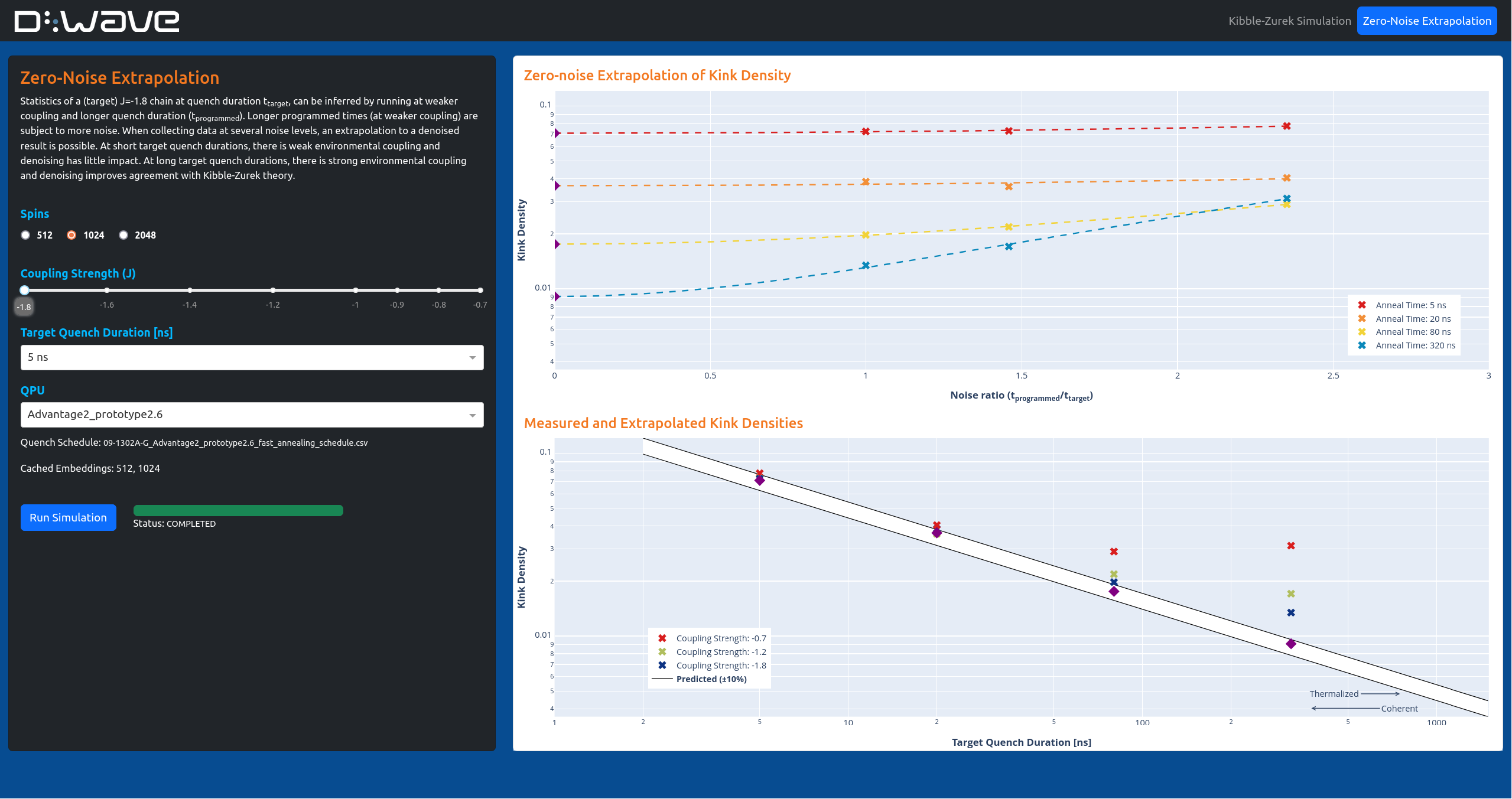
Our main result shows how an energy-time rescaling method can extend the time scales at which we have agreement with error-free theory. With the help of Andy Zhang (a Simon Fraser University computer science intern) , Kevin Chern (D-Wave) and Kate Culver (D-Wave), we developed Joel Pasvolsky’s (D-Wave) direct-estimation demo to allow anyone with access to the Leap™ quantum cloud service to reproduce the main noise-mitigation result of the paper with just a few clicks (programmings), as shown below.
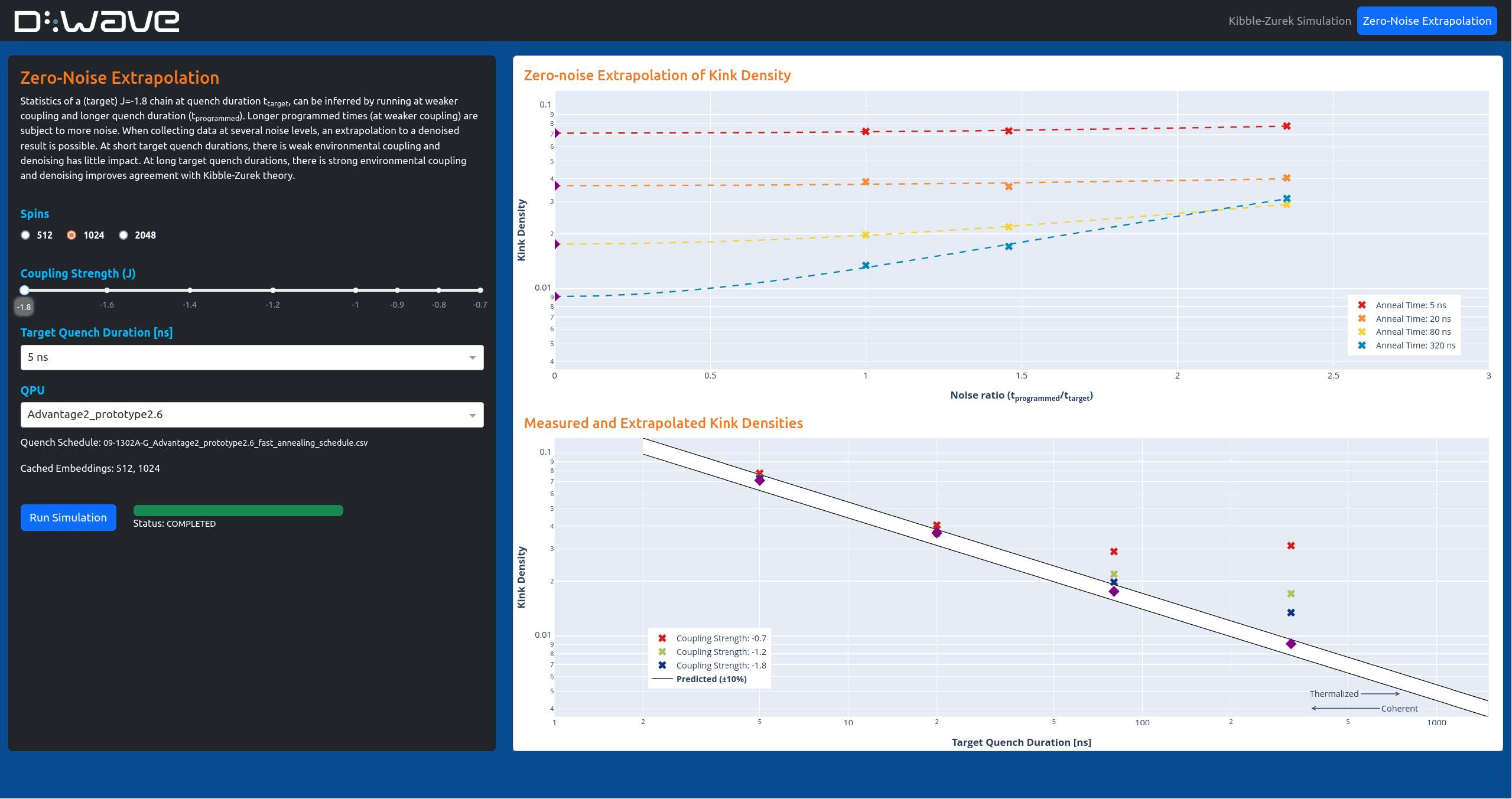
The demo is available here: https://github.com/dwave-examples/kibble-zurek
An elegant (Jordan-Wigner) transformation allows the 1D model to be understood in terms of independent fermion pairs. This means it is (at least in principle) simple to study the model by classical methods, with lots of room for intuition. For each pair of fermions independently excited through the annealing process, there is a pair of defects. It is straightforward to check that phase errors on these fermion pairs have no impact on the defect rate, an interesting example of statistic-specific robustness to one class of noise, similar to the robustness of adiabatic quantum computation to phase errors. However, sensitivity to thermal noise was verified in the paper: both energy-time rescaling and temperature rescaling were able to correct for defects. Neither energy-time nor temperature rescaling can correct for all control errors; the fact that both succeed shows that these are not dominant sources of noise with respect to defect rates.
However, other statistics, such as correlations in the positions of defects along chains, are sensitive to non-thermal sources of noise, particularly in the post-critical portion of the annealing that is not described by the Kibble-Zurek mechanism. A theory developed by Prof. Jacek Dziarmaga (Jagiellonian University), after our initial preprint but included in this final version, provides a detailed description of this phenomenon. Temperature rescaling and energy-time rescaling methods are less effective in this regime; our energy-time rescaling method produced results consistent with a model of reduced post-critical dynamics.
D-Wave recently demonstrated beyond-classical computation in quantum simulation in a Science article. Furthermore, we have since proposed a blockchain architecture leveraging this capability, which we hope is just one of many extensions to come. Kibble-Zurek dynamics in the context of our quantum simulations are consistent with improved scaling (relative to classical dynamics) of mixing dynamics in spin-glasses (models with multi-modal energy landscapes), which can potentially be employed to improve performance in optimization either directly or by hybridization with classical methods. Developing our method further to understand the consequences of reduced noise in applications like these represents a great opportunity to guide choices in quantum processor development and may allow analysis outside the bounds set by current noise.

Follow the Topic
-
npj Quantum Information
The scope of this journal spans across all relevant disciplines, fields, approaches and levels and so considers outstanding work ranging from fundamental research to applications and technologies.

Related Collections
With Collections, you can get published faster and increase your visibility.
Foundations and Advances in HPC/AI-Quantum Co-Design
Publishing Model: Open Access
Deadline: Dec 20, 2026
Quantum-Enabled Bioimaging
Publishing Model: Open Access
Deadline: Nov 04, 2026