September Highlights from Mathematics, Physical and Applied Sciences Communities
Published in Earth & Environment, Materials, and Physics




It’s been another busy month across our Mathematics, Physical and Applied Sciences Communities, with lots of interesting research and stories to explore. A few pieces in particular caught my eye this month, including research looking at how tiny particle movements can reveal changes in soft materials, how heatwaves can alter the chemistry of forests, and what trust and Earth’s rotation can tell us about the systems around us.
I’ve brought together some of my favourites below. Hope you enjoy reading them!
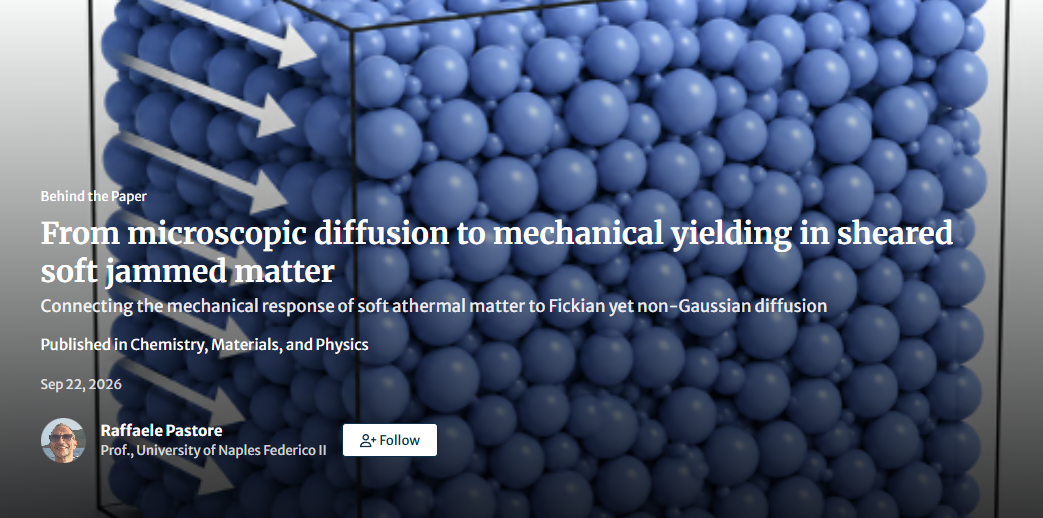
The smallest movements can reveal the biggest changes
Soft materials can sit between solid and liquid states, resisting deformation until they eventually yield and flow. @Raffaele Pastore found that this transition is closely linked to an unusual form of particle diffusion, offering a new way to connect microscopic dynamics with the mechanical response of the material as a whole. The study is published in Communications Physics.
From numerical simulations to a new theoretical model developed along the way, the study shows how a puzzling microscopic phenomenon can open up a much bigger question about soft matter.
Read the Behind the Paper post to explore the story behind these findings.
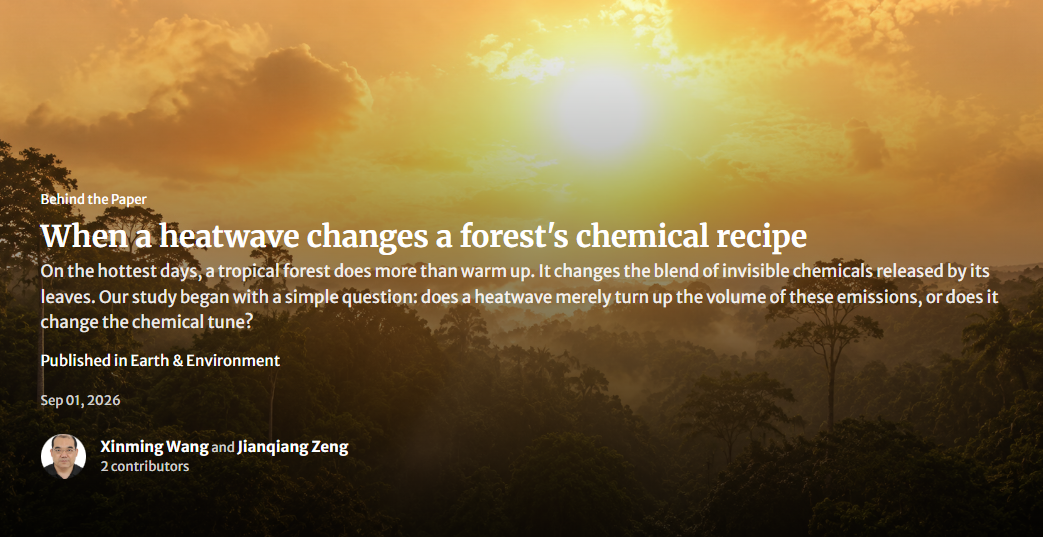
What if a heatwave changes what forests emit?
That’s the question behind the research from @Xinming Wang and @Jianqiang Zeng . Their observations in a South China forest show that extreme heat can dramatically increase the share of acyclic monoterpenes in the air, changing both the chemical composition and reactivity of the forest’s emissions. A similar shift has also been observed in the Amazon. Published in Nature Communications, the study reveals how heat can favour a different group of monoterpenes, potentially changing how the forest interacts chemically with the atmosphere.
It’s a reminder that forests and the atmosphere are connected in more subtle ways than total emissions alone can reveal.
Read the Behind the Paper post to discover how the team combined leaf experiments, field observations and atmospheric measurements to uncover this hidden response to heat.
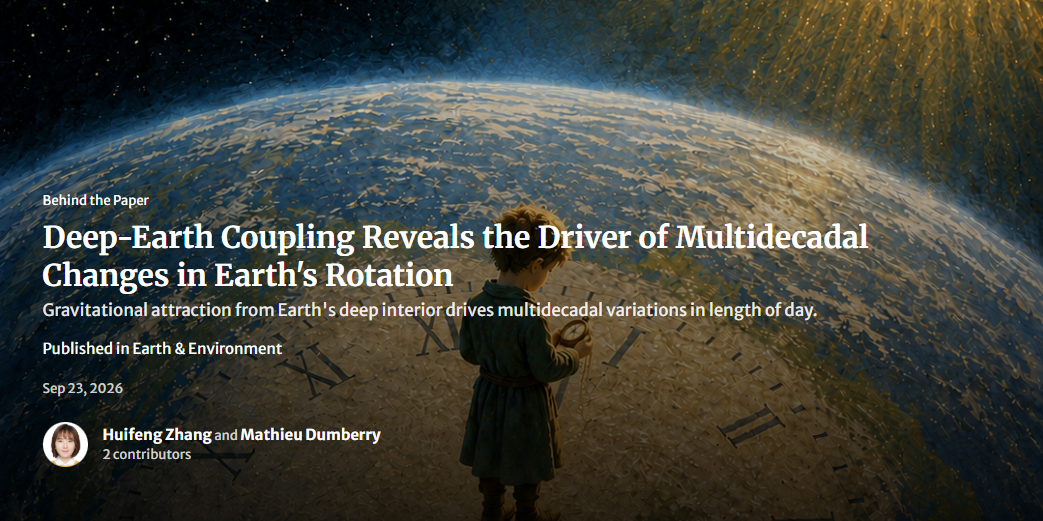
Did you know that the length of a day can change over decades?
The difference may be tiny, but the story behind it reaches thousands of kilometres beneath the surface. @Huifeng Zhang and her colleagues investigate the hidden forces connecting Earth’s inner core, outer core and mantle, finding evidence that gravitational coupling plays a key role in these long-term changes in Earth’s rotation. Published in Nature, the study offers a fascinating glimpse into the dynamics of the deep Earth that we can’t observe directly.It’s a fascinating example of how something as familiar as the length of a day can reveal what is happening deep inside our planet.
Read this Behind the Paper post to discover more about the research and the journey behind it.
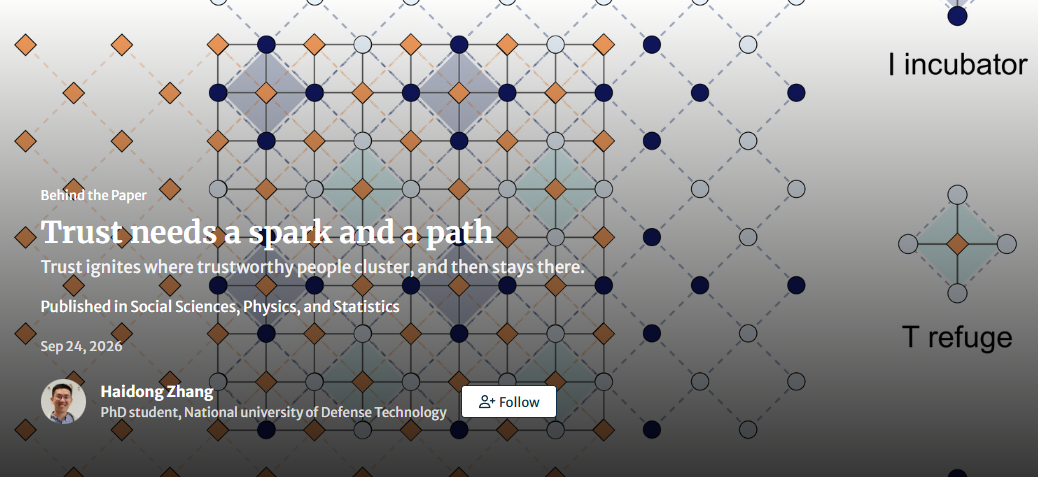
If trust takes root in one place, can it find its way somewhere else?
It turns out that trust is a little more complicated than simply putting trustworthy people together. @Haidong Zhang found that clustering can help trust emerge, while mixing different behaviours can help it spread, revealing a fascinating tension between creating trust and keeping it moving. Published in Communications Physics, the study shows how something as subtle as spatial arrangement can shape the dynamics of cooperation.
And the story behind the research is just as intriguing, from hand-drawn patterns on a chessboard to waiting 40 minutes at a Nanjing metro station to keep a simulation running. Take a closer look at the research and the story behind it in this Behind the Paper post.
More to explore
Here are a few more highlights from Research Communities that you might enjoy exploring, including a podcast on AI agents, a celebration of Biomedical Materials Science, and a creative take on the intersection of art and science.
Podcast:
Podcast: Asking Dr. James Zou about AI agents | Research Communities by Springer Nature @Vivien Marx
Community highlights:
I became a Scientartist! @Claudia Rosa
Happy Birthday Biomedical Materials Science! @Sara Ceci
Upcoming event:
Virtual Event | 13 October 2026 Protecting Food Systems: Sustainable Pest Control, Water Resources, and Livelihoods @Valeriana Ramondo
Editor stories:
Editor story: Dr. Elizabeth A Silber @Vijay Kumar Malesu
Meet the Editor: Zhanghua Han from Shandong Normal University, Jinan, China @Joshua Bayliss
I hope you’ve enjoyed this month’s highlights! I always love seeing the range of ideas and stories shared across our Communities, and I’m looking forward to discovering what the next month brings. If you’ve come across a story that you think deserves a shout-out, I’d love to hear about it too!
Explore more research breakthroughs:
Passionate about connecting researchers and amplifying their voices through digital engagement. As Manager for the Research Communities by Springer Nature, I work with researchers to showcase their discoveries and experiences.
With a strong interest in public engagement and creative science communication, I’m dedicated to making research more accessible and inspiring wider conversations around scientific discovery and innovation.
Follow the Topic
-
Nature
A weekly international journal publishing the finest peer-reviewed research in all fields of science and technology on the basis of its originality, importance, interdisciplinary interest, timeliness, accessibility, elegance and surprising conclusions.
-
Nature Communications
An open access, multidisciplinary journal dedicated to publishing high-quality research in all areas of the biological, health, physical, chemical and Earth sciences.
-
Communications Physics
An open access journal from Nature Portfolio publishing high-quality research, reviews and commentary in all areas of the physical sciences.



Related Collections
With Collections, you can get published faster and increase your visibility.
Women's Health
Publishing Model: Hybrid
Deadline: Ongoing
Physical Machines for Energy-Based Computation
Publishing Model: Open Access
Deadline: Dec 20, 2026