Subsecond optically controlled domain switching : The Backstory
Published in Materials



Back in 2021, a fascinating research paper was published by Prof. Ignasi Fina and Prof. Josep Fontcuberta’s team from the Institut de Ciència de Materials de Barcelona titled "Non-volatile Optical Switch of Resistance in Photoferroelectric Tunnel Junctions". Their work instantly captured my curiosity! At the time, I was wrapping up my PhD at IIT Madras and was so inspired that I immediately reached out to Prof. Fina, hoping to pursue postdoctoral research in this exciting field. But things didn’t go as planned—funding constraints and an unsuccessful fellowship application meant I couldn’t join their research group. It felt like the end of the road. Or so I thought! Turns out, this idea wasn’t abandoned—it was just waiting for the right moment.
In December 2021, I joined Prof. Joe Briscoe's group at Queen Mary University of London and began working on his ERC Consolidator grant, FENCES. This project explores the photovoltaic (PV) effect in ferroelectric/semiconductor nanocomposite systems. As part of this work, I had the exciting opportunity to collaborate with Prof. Vasant Sathe from UGC-DAE, Indore, India. His group was eager to study the PV effect in ferroelectric BaTiO3 crystals with in-plane a1 and a2 domains, and together, we planned to investigate how strain gradients influence the PV effect.
However, challenges arose—the opaque nature of the material and sample drift during local PV measurements under the AFM tip made it difficult to obtain clear results. Around the same time, Prof. Yuefeng Nie’s group at Nanjing University published a groundbreaking paper on non-volatile ferroelectric domain wall memory using a BaTiO3 membrane—a system with a similar domain structure, making it a perfect fit for our study. Seeing this opportunity, Vivek, a PhD student from Prof. Sathe's group, reached out to Prof. Nie, who generously agreed to collaborate and sent us samples to Queen Mary University of London.
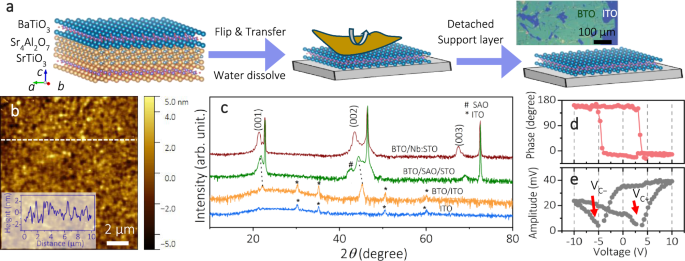
I quickly got to work, using FENCES-funded AFM microscopy to measure the local PV effect in these freestanding BaTiO3 samples. Unfortunately, the results were disappointing. But then—like a sudden flash of inspiration—I recalled the concept of optical control for domain switching. That very day, I couldn't resist testing it. To my amazement, the domains switched instantly upon light illumination—something that, at the time, no one had ever reported such fast response in ferroelectric oxides. It was a thrilling moment, like watching a discovery unfold before my eyes!
I shared my findings with Joe, and together, we started developing a structured workflow to validate and build upon our results. Around the same time, Vivek moved to a postdoc position in Prof. S. S. Prabhu’s group at the Tata Institute of Fundamental Research, India, and discussions between our groups became even more intense. Determined to verify our observations, I conducted further experiments on the freestanding BaTiO3 membrane, testing various approaches to confirm our results. I also extended my research to examine the optical control of domain switching in different ferroelectric samples available in the lab. Excitingly, we observed the same fast optical response in multiple BaTiO3 membranes.
After months of rigorous experimentation, we gathered conclusive evidence supporting subsecond optical control of domains in freestanding BaTiO3 membranes—with domain switching observed in under 500 milliseconds. This was a remarkable discovery! But a crucial question remained: why did this system respond to light so much faster than previously reported materials?
Around this time, Joe attended the European Materials Research Society (EMRS) conference, where he met Prof. Dr Anna Grünebohm from Ruhr-University Bochum, Germany, who was presenting her work on domain and domain wall dynamics using molecular dynamics (MD) simulations. Seeing a perfect opportunity, we reached out to her team for help in uncovering the mechanism behind this ultrafast optical domain switching. Two of her team members, Lan-Tien and Sheng-Han, enthusiastically joined the effort, combining MD and density functional theory (DFT) simulations to analyse our system. To ensure our simulations matched real-world conditions, we designed a model structure replicating our experimental setup. The results were astonishing! Everything aligned so well that we couldn't wait to write up our findings and submit them for peer review.
We are incredibly grateful to the European Research Council for funding the FENCES project, and we sincerely thank the reviewers whose insightful comments helped improve our manuscript. Special thanks to EMRS—their conference unknowingly played a pivotal role in connecting us with the right collaborators! I also extend my deepest appreciation to all my co-authors for their dedication and contributions. Lastly, a huge thanks to Joe, who provided invaluable guidance in supervising the work and shaping our manuscript.
If there’s one key takeaway from this research, it's this: the coupled effect of reduced energy barriers for domain wall motion under optical excitation and the presence of imprint bias voltage in freestanding films enables fast optical polarisation reversal in a subsecond time scale. This phenomenon opens exciting possibilities for designing next-generation optical memory devices, with our ferroelectric BaTiO3 membrane serving as an inspirational model for future studies.
One final note—take a moment to glance at the author affiliations in this paper. Our collaboration spans four different countries across two continents, highlighting the ever-expanding scientific ecosystem that fuels innovation. Global collaboration is the key to groundbreaking discoveries, and this work is a testament to that.

Follow the Topic
-
Nature Communications
An open access, multidisciplinary journal dedicated to publishing high-quality research in all areas of the biological, health, physical, chemical and Earth sciences.

Related Collections
With Collections, you can get published faster and increase your visibility.
Women's Health
Publishing Model: Hybrid
Deadline: Ongoing
Tumor Microenvironment Crosstalk and Therapeutic Implications
Publishing Model: Hybrid
Deadline: Nov 02, 2026