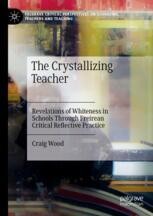
The Crystallizing Teacher
Published in Education



Explore the Research
 Springer Nature Switzerland
The Crystallizing Teacher
This book advocates for teacher professional development via a process the author introduces as ‘crystallizing conscientização’.
I was compelled to write the The Crystallizing Teacher because I my professional needs and interests were not being met by hierarchical others, who wouldn't know a lesson plan from the duty roster, making judgements that were based on formulaic templates and stripped of teacher voice and classroom contexts. My process of crystallizing conscientização reimagines ways of interpreting and understanding teacher praxis through the use of story and voice rather than soulless bar graphs, pie charts, and spreadsheets. The Crystallizing Teacher recognizes both professionalism and human qualities as integral to understandings of the teacher, and the impact that their personal identity and wider socio-political contexts has on the teacher. To that end, more than one teacher’s professional development, The Crystallizing Teacher is a call to the profession to engage in solidarity work that seeks out and resists oppression.
The Crystallizing Teacher is professional development done differently. The process of crystallizing conscientização, combines Paulo Freire's conceptual framework with Laura Ellingson's method, and it places teachers’ knowledge, experiences, stories, and voice at its core. The Crystallizing Teacher looks both inwards at the teacher as a person and outwards at their place in the wider socio-political world. The Crystallizing Teacher restores teacher voice, embraces creativity, curiosity, and criticality, and develops rich understandings of professional praxis, which pursue transformations of self, and that calls to others to undertake solidarity work that enlivens hope.
In my own crystallizing conscientização, I applied three phases and five steps of research to generate mystories. This revealed whiteness and neoliberalism in my educational experiences at school as a child-student and later as an adult-teacher. The revelations are shown through five chapters that include
- Silencing voices,
- Listening to agentic and activist acts,
- Remembering critical stories,
- Practising teaching, and
- Teaching as solidarity work.
The book concludes with an epilogue 'Conversations with myself' which is the title of Nelson Mandela’s 2010 literary album as well as Bill Evans’ 1963 Grammy Award winning jazz record. As a fan of both, I am using their title for my epilogue. The literary work of Nelson Mandela is a curation of his private thoughts and experiences which are collected in excerpts from his diaries, journals, letters, and such, and that reveal insights into the shaping of Mandela’s thinking and his public works. On Bill Evans’ record, I hear the performance of a solo artist who creates themes, deconstructs those themes, then playfully interrogates the components of his deconstruction to generate new layers of the work. My ' Conversations with myself' are represented as a duologue, in which I assume the identity of two characters; I am both the Researcher, the subject of this research, and the Teacher, whose teaching praxis is often the object of the research. My own 'Conversations with myself' are a representation of creativity, curiosity, and criticality, and emerges from my collection and curation of artefacts and experiences.
Most chapters finish with provocations for the reader. More broadly, The Crystallizing Teacher and the provocations aim to build community. I welcome your crystallizing insights.

Craig Wood is a teacher, researcher, writer and unionist, and has worked in public schools for over two decades.
I am currently the Researcher Officer for the Queensland Teachers’ Union of Employees, Australia. In my role, my interests include school funding; education policy and legislation; curriculum and pedagogy; initial teacher education and continuing professional development; and behaviour and occupational violence.
My publications include The Crystallizing Teacher (Palgrave) that applies Freirean conscientization and critical praxis research to inquire into the impact of neoliberalism and whiteness on curriculum, pedagogy, and teacher training in Australia. The Crystallizing Teacher embraces curiosity, creativity and criticality, and is a performative and critical autoethnographic investigations into praxis, drawn from the use of mystories. I have also published in International Journal of Multicultural Education and Departures in Critical Qualitative Research. My ten letters to Paulo Freire, co-written with Jennifer Martin, PhD, are published in Radically Dreaming (DIO Press).