The greenery beyond cities quietly shapes their rainfall
Published in Social Sciences, Earth & Environment, and Ecology & Evolution






![]() Where does city rainfall really come from?
Where does city rainfall really come from?
On a humid afternoon in a rapidly expanding city, rain begins to fall. Most of us would attribute this to large-scale atmospheric circulation, weather fronts, or perhaps the urban heat island effect. But what if part of that rainfall story begins outside the city, with surrounding vegetation contributing additional moisture to the atmosphere?
This question has long loomed in the periphery of our research. Cities are often treated as systems whose climate is shaped primarily by buildings, emissions, and internal energy fluxes. In reality, however, cities are embedded within dynamic landscapes. Around them, peri-urban areas, including farmland, forests, and transitional ecosystems, are undergoing rapid and often substantial vegetation changes.
We began to wonder whether these surrounding landscapes, through their influence on evapotranspiration and atmospheric moisture, could play a hidden role in shaping rainfall within cities.
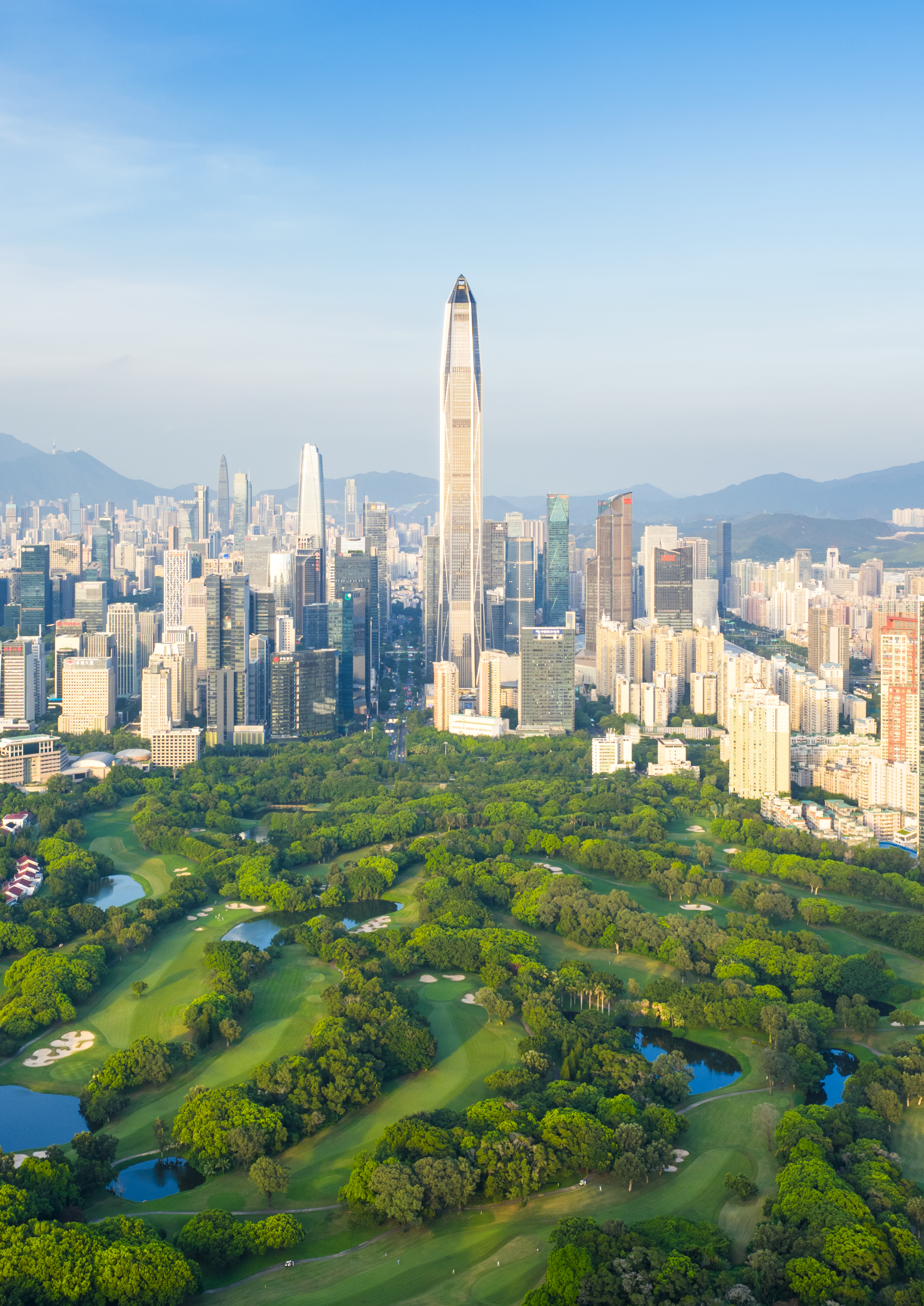
Photograph of Shenzhen, China, where a dense urban core is surrounded by extensive vegetation, highlighting how landscapes beyond cities can modulate rainfall within them.
Looking beyond the city boundary
Most studies of urban precipitation focus on processes within the city itself, such as how heat, aerosols, and surface roughness alter atmospheric dynamics. While these mechanisms are important, they overlook a key fact: water moves freely across landscapes.
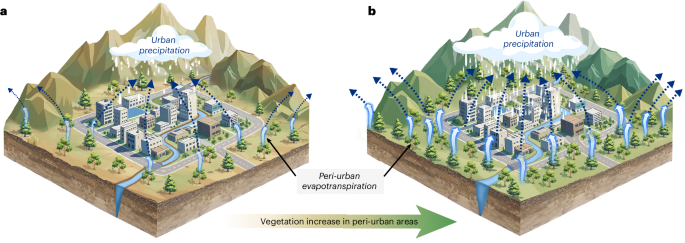
Vegetation releases water vapor into the atmosphere through evapotranspiration. This moisture can then be transported by winds and may contribute to precipitation elsewhere, including over nearby urban areas. In other words, some of the rain that falls over a city may originate from the landscapes that surround it.
To explore this idea, we assembled a global dataset covering more than 1,000 cities and their peri-urban regions. We tracked changes in vegetation, evapotranspiration, and precipitation from 2000 to 2021. Our goal was not only to determine whether such connections exist, but also to quantify how strong they are and under what conditions they matter most.
A hidden and asymmetric influence
What we found was both clear and surprisingly complex.
Peri-urban vegetation change does influence urban precipitation, but not in a uniform way. In some regions, increases in vegetation enhance evapotranspiration, which supplies additional atmospheric moisture and can lead to increased rainfall over cities. In other regions, the effect is weaker or even reversed.
This asymmetry arises because vegetation is only one part of a larger coupled system. Its influence on rainfall depends on whether vegetation contributes meaningfully to atmospheric moisture supply, whether synoptic conditions support efficient moisture transport, and whether local climate and geography enhance the ability of the urban environment to convert that moisture into precipitation.
Vegetation can supply moisture, but it cannot guarantee rainfall.
This finding suggests that cities should not be viewed as isolated endpoints of atmospheric processes. Instead, they function as components within a larger, interconnected system, where land surface changes outside the city can influence climatic conditions within it.
Behind the scenes: defining the “peri-urban”
One of the most challenging parts of this work was defining what “peri-urban” actually means.
Cities are not static. Their boundaries expand over time, often unevenly, and areas that are considered rural today may become urban in the near future. We tested several definitions, ranging from fixed spatial buffers to dynamically evolving boundaries, before identifying a framework that could be applied consistently across continents.
Separating the effects of vegetation change from urban expansion was also difficult. In many regions, these processes occur simultaneously. Vegetation may decline due to urbanization or increase due to ecological restoration or greening initiatives. Distinguishing these overlapping influences required careful experimental design and multiple validation steps.
As the analysis progressed, our expectations also evolved. We initially anticipated that vegetation change would produce a strong direct signal in urban precipitation. Instead, we found that its overall effect size was often modest, yet its influence on long-term trends was disproportionately large. This suggests that vegetation does not necessarily dominate rainfall variability at any given moment, but can subtly reshape how precipitation evolves over time, especially when interacting with atmospheric processes.
Why it matters
Understanding the origin of urban rainfall is not only a scientific question but also a practical one.
Cities worldwide are facing increasing water stress and more frequent extreme weather events. At the same time, peri-urban regions are undergoing rapid land-use changes driven by agriculture, ecological restoration, and urban expansion.
Our findings suggest that these changes may have unintended consequences for long-term trends in urban climate and water availability. Managing vegetation in peri-urban areas could influence how rainfall evolves over time, either enhancing or reducing water supply depending on regional conditions.
This raises important questions for urban planning and climate adaptation. Should peri-urban vegetation be considered as part of urban water management strategies? Could coordinated land-use planning across urban and surrounding regions help stabilize local hydrological cycles?
A broader perspective
The main message of this work is conceptual.
Cities do not exist in isolation. Their climate is shaped not only by processes within their boundaries but also by the surrounding landscapes and the continuous exchange of energy and moisture between them.
As urbanization and land-use change continue to accelerate, recognizing these connections becomes increasingly important. It challenges conventional definitions of urban systems and calls for more integrated approaches to managing cities under climate change, with the potential to enhance urban adaptation and resilience.
The next time rain falls over a city, it may be worth considering that part of that water began its journey somewhere just beyond the skyline.

Follow the Topic
-
Nature Cities
This journal aims to deepen and integrate basic and applied understanding of the character and dynamics of cities, including their roles, impacts and influences — past, present and future.