The Microbial Signals Shaping Coral Responses to Extreme Heat
Published in Earth & Environment, Ecology & Evolution, and Microbiology

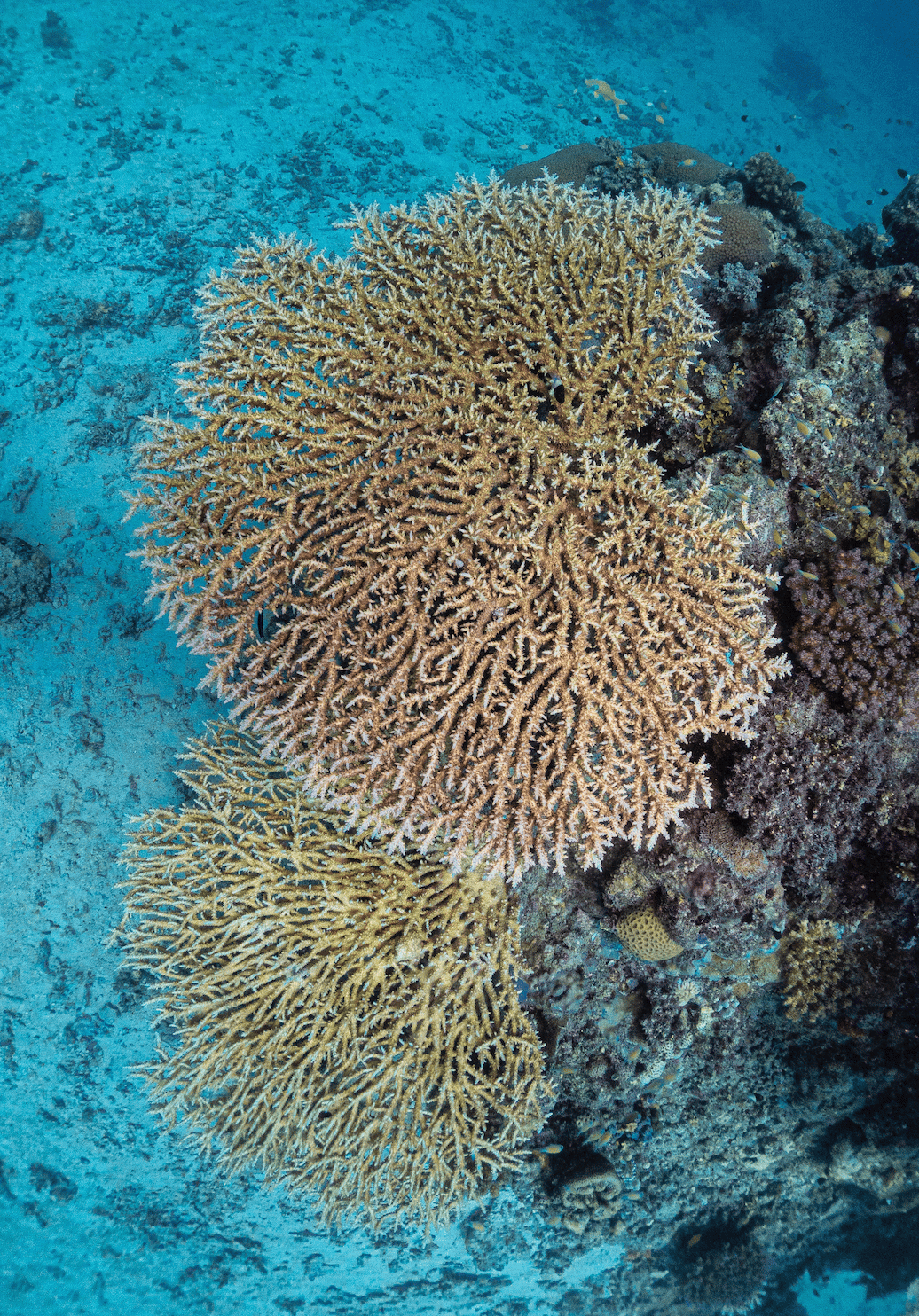

For decades, scientists have focused primarily on the coral itself and the microscopic algae living inside its tissues. But there is another important partner whose role has remained much less understood: the coral microbiome. Among these microbial partners, one bacterium stands out. Endozoicomonas (referred to here as Endoz.) is one of the most abundant bacteria associated with healthy corals around the world. Despite the extensive genomic data available for Endoz., a fundamental question remained unanswered for almost two decades: What exactly is this bacterium doing inside coral tissues?
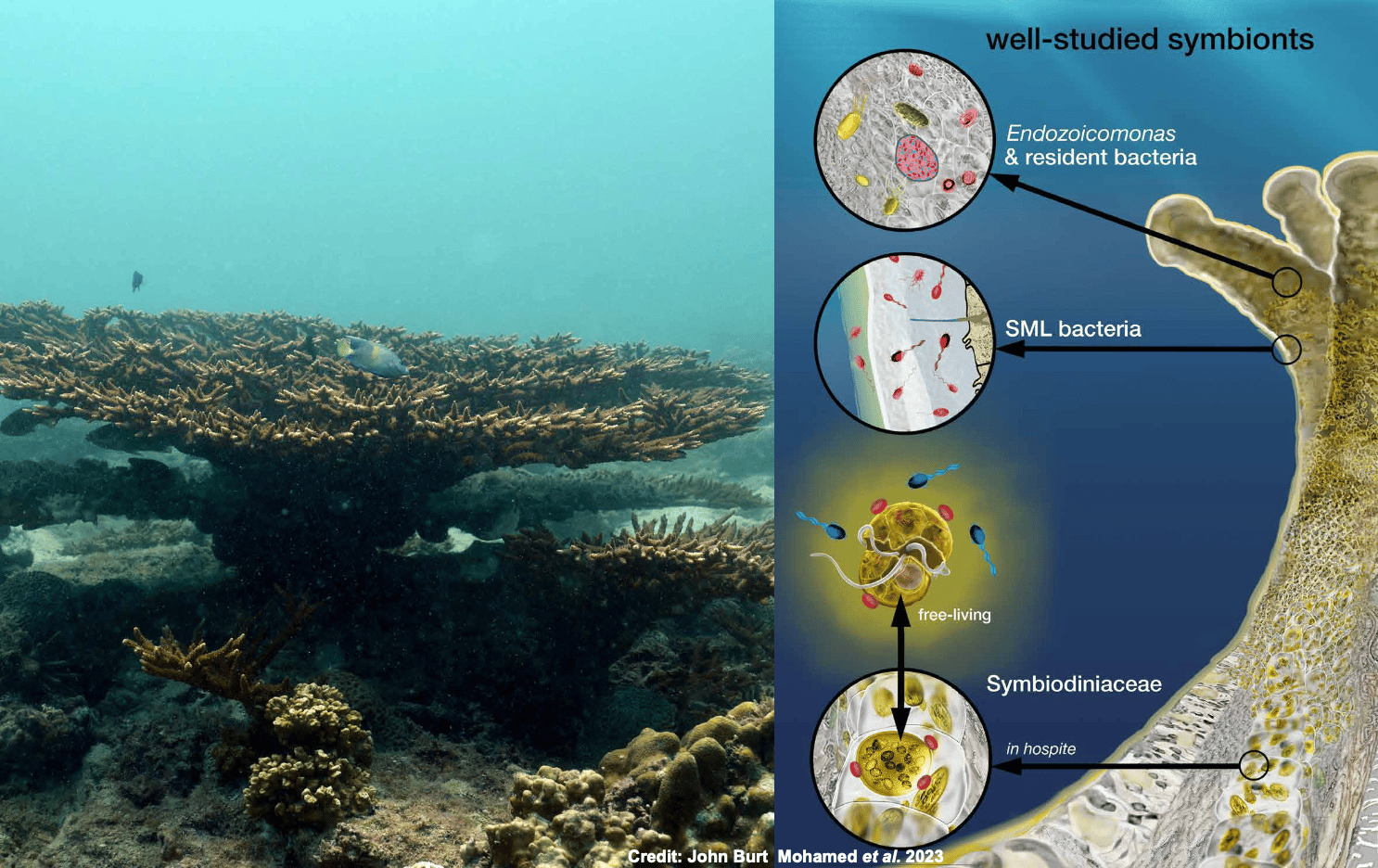 Acropora corals in the Arabian Gulf (left) and a depiction of the most-studied members of the coral microbiome, including bacteria of the genus Endozoicomonas.
Searching for a Hidden Chemical Signal in the Arabian Gulf
The Arabian Gulf offers an ideal natural laboratory to search for an answer. It is the hottest sea on Earth, where corals experience extremely high temperatures. It offers a unique opportunity to understand how corals adapt to a warming ocean. Our central question was simple: Could Endoz. communicate chemically with its coral host, and could this interaction help the coral cope with heat stress?
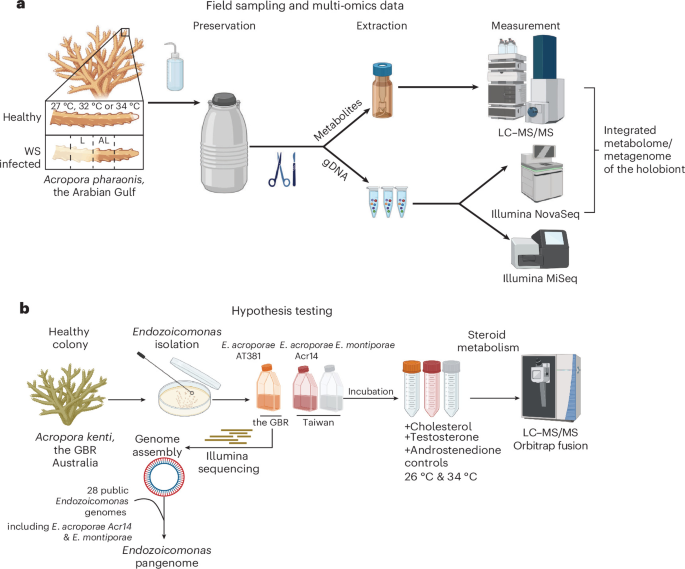
To investigate this, we combined untargeted metabolomics, microbiome analysis (16S amplicons and shotgun metagenomics), comparative microbial genomics, and laboratory experiments involving both bacteria and corals. We followed colonies of the coral Acropora pharonis across a natural temperature gradient in the Arabian Gulf, where temperatures reached 34°C. Interestingly, some colonies remained healthy at these extreme temperatures, while others showed signs of white syndrome. We then compared their microbial communities and chemical profiles. One result immediately caught our attention: Endoz. remained abundant inside some healthy coral tissues even at 34°C. This was particularly striking because in other reef environments, including the Great Barrier Reef and the Red Sea, these bacteria can disappear at temperatures around 32°C or even lower.
We then examined hundreds of chemical compounds found inside the corals. Among the most prominent groups were steroid compounds. Most steroid compounds decreased as heat stress increased. But at 34°C, the highest temperature examined, we found something unexpected: two well-known steroid hormones, testosterone and progesterone, increased. Corals, like other animals, can produce these compounds and use them in processes related to reproduction. However, our samples were collected in August, well outside the coral spawning season in the Arabian Gulf, which normally occurs around April and May. This raised a new question: Who was producing these hormones? The coral itself, or one of its microbial partners?
To answer these questions, we took a closer look at the genomes hidden within these samples by directly reconstructing bacterial genomes from the recovered gDNA. The journey was far from straightforward, as recovering high-quality metagenome-assembled genomes (MAGs) proved very challenging. But then came one of the eureka moments, when we successfully assembled a high-quality MAG for Endoz. Among all the microbiome members, genes associated with steroid metabolism were found uniquely in the Endoz. MAG. This unexpected discovery opened a new window into the potential role of Endoz. in steroid metabolism and provided an important clue toward understanding its contribution to the holobiont.
Are steroid hormone metabolism genes common in coral-associated Endoz.?
A few bacteria are known to use steroid compounds as sources of energy, but the possibility that these bacteria could actively produce steroid hormones was much more intriguing.
One major challenge was that we could not isolate Endoz. directly from our Arabian Gulf coral, despite multiple attempts. Fortunately, our colleagues Trent Haydon and Jean-Baptiste (JB) Raina had successfully isolated a strain of Endoz. from Acropora from the Great Barrier Reef (GBR) in Australia. We obtained the culture and sequenced its complete genome, and later acquired additional Endoz. isolates from Taiwan. Comparative genomic analysis showed that the steroid-metabolizing genes were widespread among Endoz. strains associated with corals from different parts of the world. This suggested that we were not dealing with a unique feature of one bacterial strain or one coral species in one geographical location, but potentially a broader mechanism within coral-associated Endoz.
The next questions were so crucial: Do Endoz. actually produce these hormones, and if so, can the coral host actually respond to them?
Finding the genes does not necessarily mean that those genes are active. We therefore needed experimental evidence beyond genomic prediction. We cultured three different Endoz. isolates in the laboratory and supplied them with cholesterol, an important starting material for steroid production at ambient and high temperatures. The result was striking; all three strains were able to convert cholesterol into testosterone and progesterone. Even more interesting was the effect of temperature. Different strains responded differently to heat. One strain produced both testosterone and progesterone at 26°C and 34°C. Another produced progesterone only at 34°C. A third changed its steroid production as temperature increased, producing testosterone under moderate conditions and shifting toward progesterone at 34°C. These bacteria were not simply passive residents of coral tissues. They appeared capable of changing the chemical environment of their host in response to environmental conditions.
But one major question remained: in humans and many other vertebrates, steroid hormones such as testosterone and progesterone are strongly associated with reproduction and sexual development. However, their functions extend beyond reproduction. Steroid signaling can also influence immune activity, inflammation, and responses to physiological stress. This raised an intriguing evolutionary possibility. Could similar molecules play a role in regulating stress responses in animals as evolutionarily distant from vertebrates as corals?
To test this, we exposed corals to testosterone and progesterone during acute heat stress and examined changes in gene expression. Under normal conditions, the corals showed little response to the hormones. Under heat stress, however, the picture changed dramatically. Both hormones altered pathways associated with innate immunity—the coral’s primary line of defense. They enhanced pathways linked to cell survival and maintenance while reducing certain components of prolonged inflammatory responses that could become harmful under severe or sustained stress. These findings suggest that steroid hormones may have a much older biological role than their well-known reproductive functions in vertebrates. They may represent ancient chemical signals involved in helping animals respond to environmental stress.
A new chemical language between coral and Endoz.; a game-changer for coral-microbiome interactions
Our findings reveal an unexpected form of communication between coral and bacteria. Rather than simply providing nutrients/vitamins, coral-associated bacteria may produce molecules commonly associated with animal physiology and use them to influence the host’s immune response. This expands our understanding of the chemical language that shapes symbiotic relationships between animals and microbes. It also raises a deeper evolutionary question. Corals belong to one of the earliest branches of the animal tree.
Could the use of microbial steroid signals date back to the early evolution of animals themselves?
The most difficult part was designing an experiment to be able to detect the effect of steroid hormones in corals during heat stress. We had to first establish the realistic hormone concentrations based on their natural levels in coral tissues. We used isotope-labelled testosterone to confirm that corals could actually take up the added hormone. After that came a long series of optimization experiments: How long should the corals be exposed? When should the temperature be increased? When should samples be collected for transcriptome analysis?
The significance of this work lies not simply in showing that bacteria can produce hormones. It lies in connecting multiple lines of evidence: steroid compounds detected naturally inside corals, genes for steroid metabolism found in Endoz., laboratory confirmation that these bacteria can produce steroid hormones, and evidence that these hormones can alter the coral’s response to heat stress.
Together, this work suggests that the coral microbiome may do more than provision and/or recycling of nutrients. It may also serve as a source of chemical signals that can influence its animal host's physiology. The discovery also offers a new evolutionary perspective. If steroid molecules can regulate stress and immune responses in corals, their role may be far older than their familiar association with reproduction in vertebrates. Ultimately, this research points to a new chemical language between microbes and corals, and potentially to one more piece of the puzzle behind why some coral reefs can survive in a warming ocean. Understanding the natural mechanisms that allow some corals to withstand extreme environments could eventually help us develop new strategies to conserve reefs for future generations.
Follow the Topic
-
Nature Microbiology
An online-only monthly journal interested in all aspects of microorganisms, be it their evolution, physiology and cell biology; their interactions with each other, with a host or with an environment; or their societal significance.