The Misperception (and Realities) of Asian subgroup representation in STEM
Published in Social Sciences and Behavioural Sciences & Psychology

I entered my social psychology graduate program with a list of fellowships and grants I wanted to apply for. In my first year, I decided to apply for a Graduate Fellowship aimed at increasing racial diversity among students and faculty in universities. I told my advisor about my plan, but she asked whether I should apply for the Fellowship. I paused and stared at her. What did she mean?
She must have noticed my confusion, because she quickly followed up: “I mean, this fellowship is meant for students who are underrepresented in STEM fields. Are you eligible?” I paused again and stared at her again. I started to question whether I was part of an underrepresented racial group in STEM.
I want to be clear that my advisor’s comment didn’t come from bad intentions or a desire to discourage me. She was consistently supportive whenever I applied for anything during graduate school. Her concern was practical—she wanted to make sure that, before I put in the time and effort to apply, the funding institution would actually review my application rather than dismiss it outright due to ineligibility.
I questioned if I was a part of an underrepresented racial group in STEM because I am Filipino American, and my graduate school experiences suggested that I was underrepresented. No one else in my program was Filipino, so I couldn’t ask peers whether they had applied for this fellowship or knew someone who had. At the time, I only knew of one prominent Filipino psychology professor, and they worked in a different subfield than I did. As a result, Filipino role models in social psychology were essentially nonexistent for me. On top of that, the articles assigned in my social psychology seminars never included Filipino participants, which meant my experiences were absent from the literature. Taken together, these experiences made me feel like I was underrepresented in STEM.
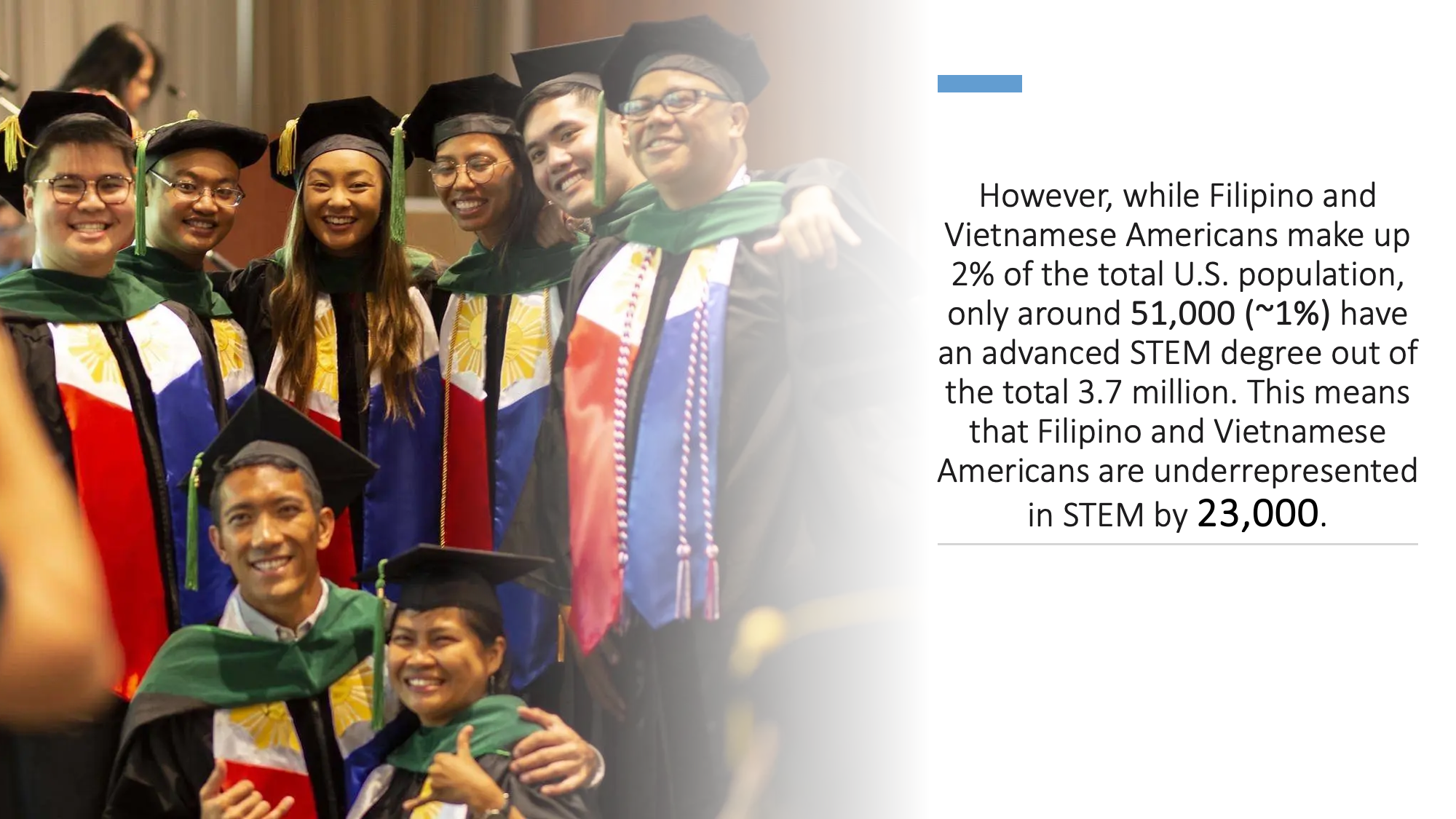
So why did my advisor question my eligibility? Well, in the U.S., Filipino Americans are categorized as Asian Americans—a racial group that is widely considered overrepresented in STEM. That meant that, on paper, I was classified as overrepresented. Because of how grant-funding institutions racially categorized me, these institutions made assumptions that didn’t align with my lived experiences. But why was that the case?
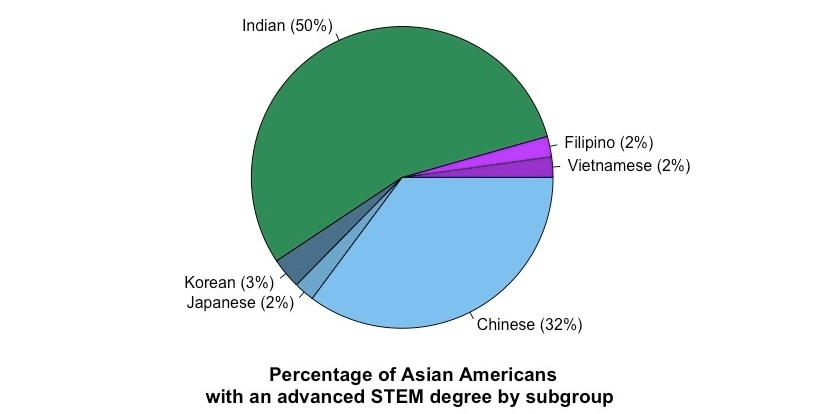
My current paper with Dr. Michael Kraus provides some insight. People assume that all Asian Americans, regardless of the ethnic subgroup they belong to (e.g., Chinese, Japanese, Korean, Indian, Filipino, and Vietnamese), are the same. In other words, all Asian Americans are assumed to have the same experiences, like all Asian Americans excel at STEM and are represented in STEM fields. Our findings provide evidence of this. Specifically, a racially diverse sample of U.S. participants misestimated the number of Asian individuals who have an advanced STEM degree by ethnic subgroup. Moreover, even participants who identified as Asian or had an advanced STEM degree themselves made these errors. When people do not know that there are differences in the representation of Asian subgroups in STEM and instead assume that representation is similar across all subgroups, it denies the unique experiences of Asian Americans.
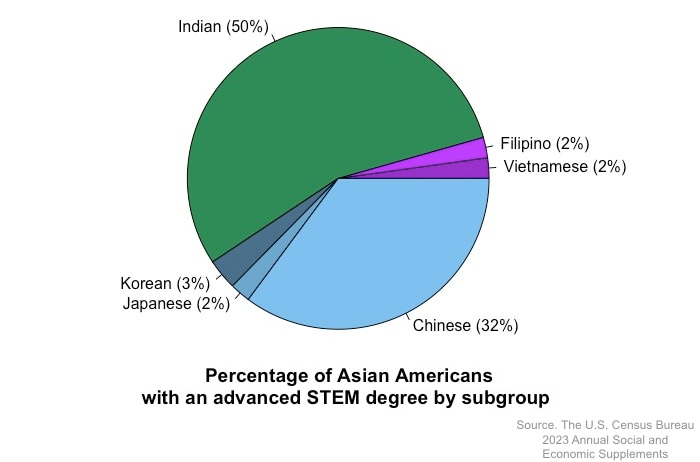
Our paper also explains why these misperceptions are happening. Despite the Asian American category consisting of many different subgroups, people tend to think of East Asian subgroups (e.g., Chinese, Japanese, Korean) when they are prompted to think of Asian Americans. In other words, East Asian Americans are perceived as typical Asian Americans, while South (e.g., Indian) and Southeast Asian Americans (e.g., Filipino, Vietnamese) are perceived as atypical Asian Americans. We find that these perceptions of Asian typicality predict the extent to which Asian subgroups are represented in STEM. Our participants were more likely to consider East Asian subgroups to be overrepresented in STEM and consider Southeast Asian subgroups to be underrepresented in STEM.
Now the question becomes, what do we do? How can we address Asian Americans whose experiences are being denied, particularly in the context of STEM? To start, we need to be mindful of the racial categorization process - categorizing people into one group essentially erases or ignores the unique experiences and unequal representation of Asian subgroups. Our findings suggest that disaggregation may help address these misrepresentations. Disaggregation is the collection and presentation of data at the Asian subgroup level rather than at the aggregated, overall Asian American level. When our participants were informed that Southeast Asian subgroups are underrepresented in STEM, support for government and institutions to implement the disaggregation of Asian American data increased relative to a control condition.
I wish I could say that the experience I described at the beginning, where an advisor questioned my eligibility for fellowships meant for underrepresented students in STEM, happened only once. But it happened again when I was applying for a Postdoctoral Fellowship with a different professor. Therefore, I encourage institutions to begin collecting and presenting disaggregated data to determine if all Asian subgroups are equally represented in a given context, or if there are certain Asian subgroups that are underrepresented. I also encourage social science researchers to consider collecting Asian subgroup identities to ensure that all Asian subgroups are represented in their research (I also have relevant work on this topic). Institutions and researchers can use the U.S. Census questionnaire to collect Asian subgroups as a reference. This practice can help uncover additional inequalities within the Asian American category that I expect exist beyond representation in STEM. Only when the inequalities are revealed and acknowledged can work be done to help address these issues.
Follow the Topic
-
Communications Psychology
An open-access journal from Nature Portfolio publishing high-quality research, reviews and commentary. The scope of the journal includes all of the psychological sciences.

Related Collections
With Collections, you can get published faster and increase your visibility.
Replication and generalization
Publishing Model: Open Access
Deadline: Dec 31, 2026
Stress and Health
Publishing Model: Open Access
Deadline: Nov 30, 2026