Three-dimensional mapping of the altermagnetic spin splitting in CrSb





What Make Altermagnets Important?
A novel type of collinear magnetism, dubbed altermagnetism, has attracted significant attention recently. Proposed in the nonrelativistic regime, altermagnets retain the zero net magnetization, similar to a conventional antiferromagnet, but their spin degeneracy is lifted in the momentum space [1,2]. According to the spin space group theory, the spin-opposite sublattices in altermagnets cannot be mapped onto each other through translation or inversion symmetry, which breaks both Parity-time (PT) and translation-time (τT) symmetries. Thus, the electronic bands in momentum space exhibit spin polarization, and the spin textures are alternated or staggered according to rotation or mirror symmetries.
While the zero-magnetization character of altermagnets allows for ultrafast spin manipulation with low stray field, the time reversal symmetry breaking and momentum-dependent spin polarization in altermagnets can give rise to a range of rich physical phenomena, including anomalous Hall effect, spin currents, spin Seebeck effect, giant/tunneling magnetoresistance, and even novel superconducting states with exotic pairings. Since the altermagnetic splitting does not arise from spin-orbit coupling, its magnitude can be very large. For enhanced physical properties and real applications, it is critical to identify strong altermagnets with large spin splittings near the Fermi level and with high magnetic ordering temperatures.
Why Focus on CrSb?
CrSb stands out as one of the most promising altermagnetic candidates, supported by theoretical calculations [2]: It is predicted to host large spin splitting (~1 eV) at the Fermi energy and has high Néel temperature (705 K), well above room temperature. Indeed, a previous study using soft-ray ARPES measurements has provided evidence of large altermagnetic splitting in CrSb thin films grown on GaAs(110) substrates [3]. CrSb also shows other merits particularly promising for real applications: it is made of earth-abundant elements (Cr and Sb) with weak spin-orbit coupling, and it is compatible with thin-film growth and stable under ambient conditions. Indeed, a recent study has demonstrated the field-free manipulation of altermagnetic domains in CrSb films through distorted crystal symmetry [4].
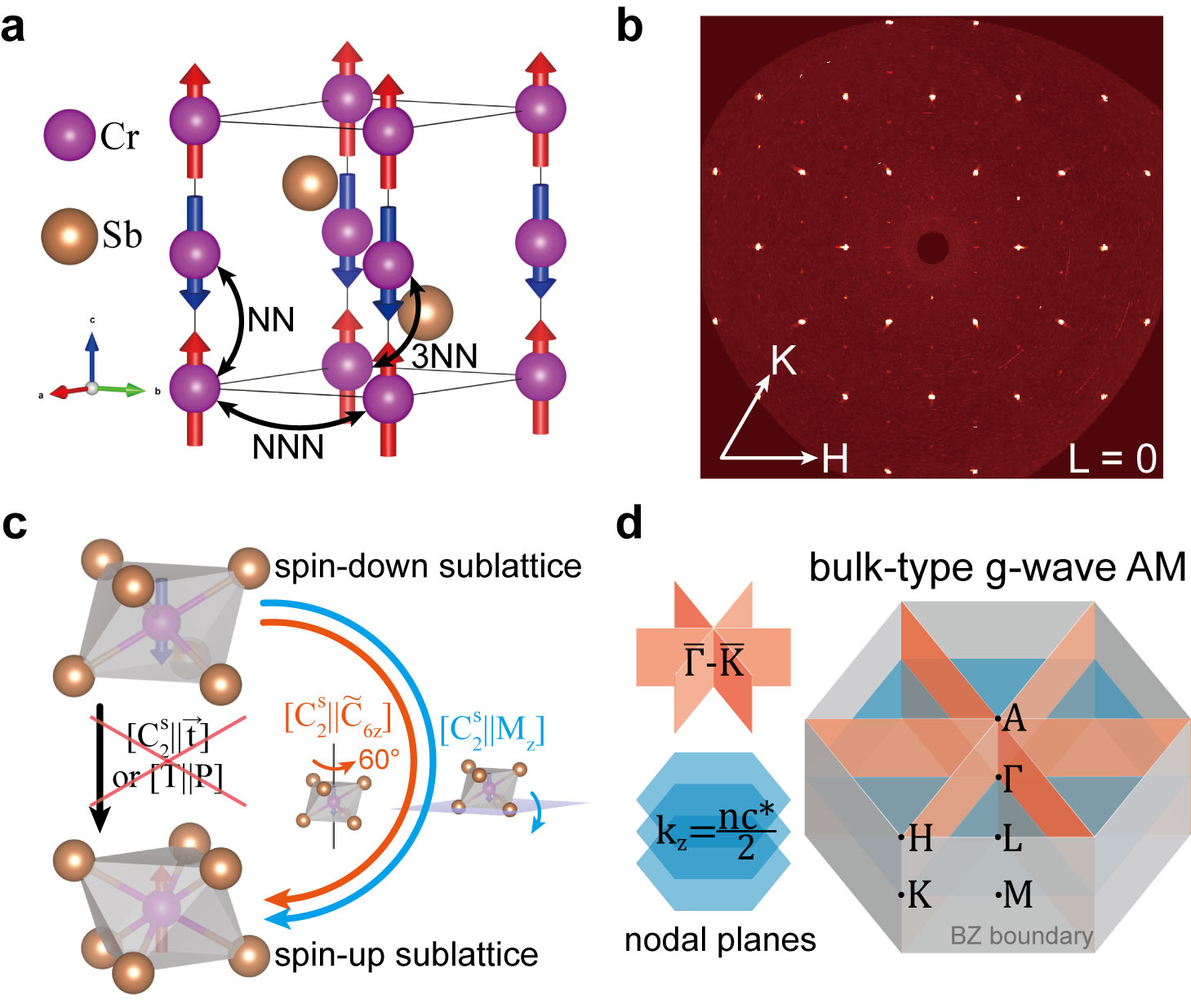 Figure 1 Spin/lattice structure and characterization of CrSb. a Spin and lattice structure of CrSb. b H-K map (L=0) of a (001)-oriented CrSb crystal from XRD. c Symmetry operations connecting opposite-spin sublattices. d Three-dimensional Brillouin zone with nodal planes corresponding to symmetries in (c).
Main results from This Study
In this study [5], we chose to study bulk CrSb single crystals. We presented direct evidence of the largest altermagnetic band splitting reported so far, up to ~1.0 eV near EF, in CrSb using synchrotron-based angle-resolved photoemission spectroscopy (ARPES) and Spin ARPES measurements. We systematically characterized its bulk-type g-wave altermagnetism through three-dimensional momentum-space mapping: the spin splitting exhibits periodic modulation along the c-axis (reflecting its "bulk-type" characteristic); within the ab-plane, we observed “flower-like” Fermi surface with 6-fold nodal lines (reflecting its "g-wave" nature). Moreover, the alternating spin polarization is directly verified by spin-resolved ARPES measurements, consistent with theoretical calculations.
Our tight-binding (TB) models and symmetry analysis further revealed that the large spin band splitting in CrSb primarily originates from the third-nearest-neighbor hopping of Cr 3d electrons, which simultaneously breaks both [T||P] and [C2S||τ] symmetries. Such process mainly originates from second-order hoppings mediated by the Sb 5p orbitals.
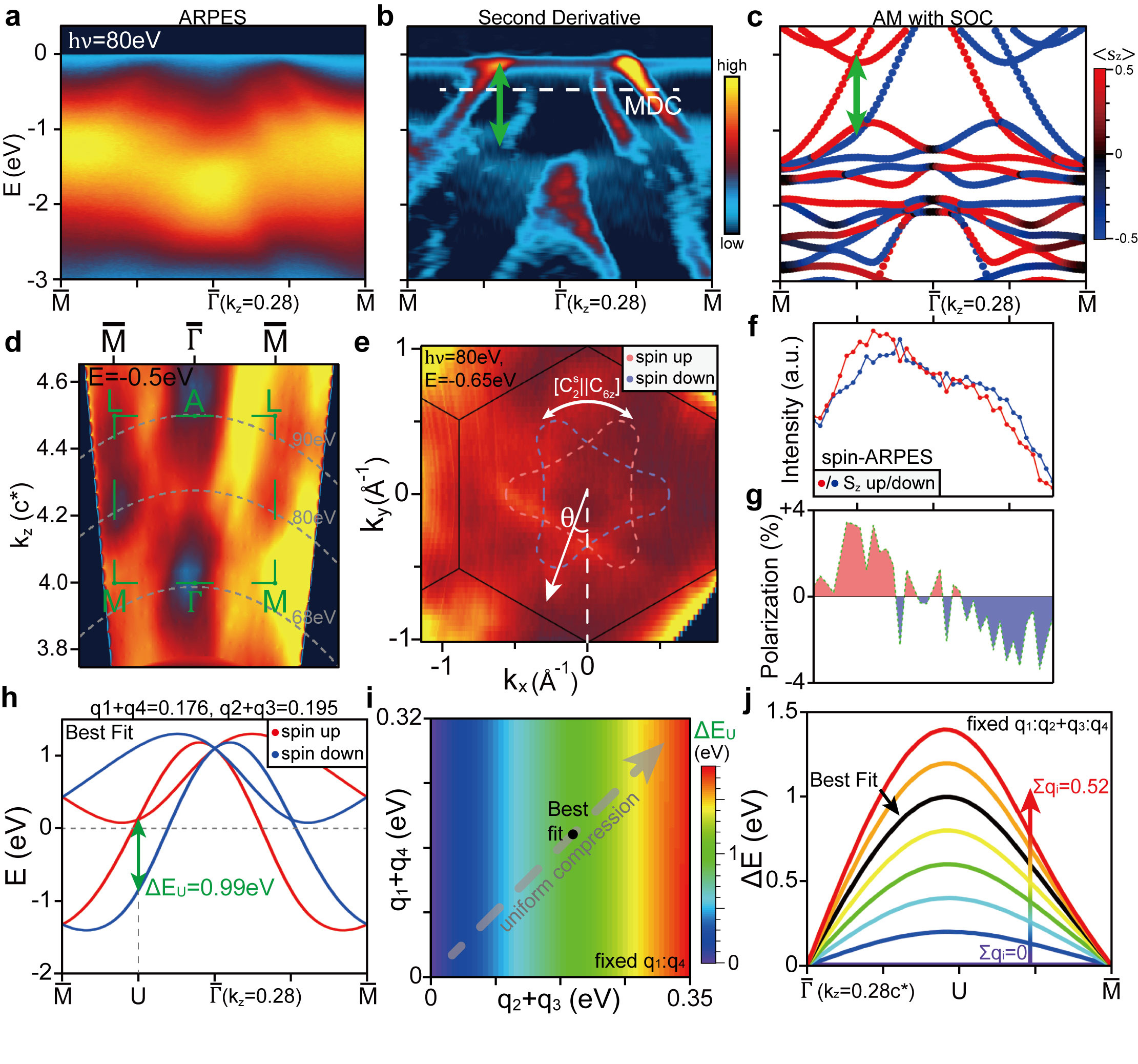
Figure 2 Experiment observation and analysis of altermagentic splitting in CrSb. a Spin-split bands near Fermi level. b The second derivative of (a). c DFT calculation corresponding to (a). d The constant-energy contour in the kx-kz plane, reflecting the bulk-type altermagentism. e Six-fold band structure in the ab-plane, reflecting the g-wave altermagnetism. f Spin-resolved momentum distribution curves along the white dashed cut in (b). g Spin polarization extracted from (f). h Band dispersions obtained from the TB model fit to DFT calculation. i Altermagnetic splitting ΔEU as a function of hopping parameters. j Altermagnetic splitting along Γ-M at kz = 0.28c* as a function of hopping parameters.
Implications and Future Directions
The aim of this study on CrSb is twofold: to experimentally verify the large spin splitting in CrSb, and to uncover the mechanism behind its large spin splitting. The favorable characteristics found in CrSb paves the way for exploring emergent phenomena and practical applications based on altermagnets. Furthermore, our analysis highlights the important role of electronic coupling between magnetic and nonmagnetic ions, which effectively determines the altermagnetic splitting.
References
[1] Šmejkal, L., Sinova, J. & Jungwirth, T. Beyond conventional ferromagnetism and antiferromagnetism: A phase with nonrelativistic spin and crystal rotation symmetry. Physical Review X 12, 031042 (2022).
[2] Šmejkal, L., Sinova, J. & Jungwirth, T. Emerging research landscape of altermagnetism. Physical Review X 12, 040501 (2022).
[3] Zhou, Z., Cheng, X., Hu, M. et al. Manipulation of the altermagnetic order in CrSb via crystal symmetry. Nature 638, 645 (2025).
[4] S. Reimers et al., Direct observation of altermagnetic band splitting in CrSb thin films. Nature Communications 15, 2116 (2024).
[5] Yang, G., Li, Z., Yang, S. et al. Three-dimensional mapping of the altermagnetic spin splitting in CrSb. Nature Communications 16, 1442 (2025).
Follow the Topic
-
Nature Communications
An open access, multidisciplinary journal dedicated to publishing high-quality research in all areas of the biological, health, physical, chemical and Earth sciences.

Related Collections
With Collections, you can get published faster and increase your visibility.
Women's Health
Publishing Model: Hybrid
Deadline: Ongoing
Tumor Microenvironment Crosstalk and Therapeutic Implications
Publishing Model: Hybrid
Deadline: Nov 02, 2026