Trapping and detecting nanoplastics by MXene-derived oxide microrobots
Published in Materials


The increasing production and use of plastics have led to the uncontrollable accumulation of plastic waste in water bodies, such as oceans, seas, lakes, and rivers. There, plastics slowly fragment into smaller pieces, called microplastics (<5 mm) and nanoplastics (<1000 nm), which tend to become more hazardous by adsorbing other toxic water contaminants, such as persistent organic pollutants (POPs) and heavy metals, and serving as a scaffold for bacterial biofilm growth. Then, they can be ingested by fish and propagate through the food chain or directly contaminate drinking water systems, posing a severe hazard to the health of all living beings. Indeed, due to their tiny size and low weight, nanoplastics can be particularly dangerous as they can diffuse rapidly and easily penetrate tissues. Moreover, conventional water remediation treatments, such as filtration, and water quality tests, may fail due to the nanoplastics’ elusive nature, suggesting how timely and vital the development of a practical strategy to identify and purify nanoplastics-polluted waters is.
Self-propelled micro/nanorobots have emerged in environmental remediation, sensing, and biomedical applications being innovative micro/nanomachines able to combine the unique physicochemical properties of micro/nanoscale materials with the active motion dimension. Due to their enhanced diffusion, micro/nanomotors and micro/nanorobots enhance catalytic reactions, promote interactions with target pollutants or analytes, and navigate the human body to cure diseases. Additionally, they can be programmed to perform tailored tasks, manifest adaptive responses (“taxis”), and cooperate (“swarming”). Their movement can be powered by chemical fuels (e.g., H2O2) or external energy sources, such as light and magnetic fields. A typical light-driven micro/nanorobot consists of a photoresponsive material (e.g., a photocatalytic semiconductor), eventually half-coated by a noble metal layer to break its symmetry and improve the separation of the photogenerated carrier, unlocking the self-propulsion ability. MXenes, a class of 2D materials, are promising building blocks for formulating novel microrobots thanks to their accordion-like structure and peculiar properties (high conductivity, chemical stability, thermal conductivity, hydrophilicity, surface functionality, and environmental compatibility).
In this work, we presented light-powered magnetic MXene-derived oxide microrobots showing the ability to move in water with six degrees of freedom under light irradiation, trap nanoplastics and detect them by an electrochemical method (Fig. 1). The microrobots were prepared from multi-layered Ti3C2 MXene by a thermal annealing process, inducing its oxidation into photocatalytic TiO2, followed by Pt sputtering to break the symmetry of the material and surface decoration with superparamagnetic nanoparticles to unlock magnetic properties. When shined with UV-light from the bottom of the vessel, a significant fraction of microrobots manifested an intriguing self-propulsion in the upward direction (3D motion), i.e., a form of taxis referred to as negative photogravitactic behavior. Instead, the other microrobots moved on the bottom of the vessel (2D motion). This phenomenon originated from the multi-layered structure of the MXene-derived TiO2, leading to a continuous or discontinuous Pt coating resulting in a stronger or weaker propulsive force and, thus, in the 3D or 2D motion.
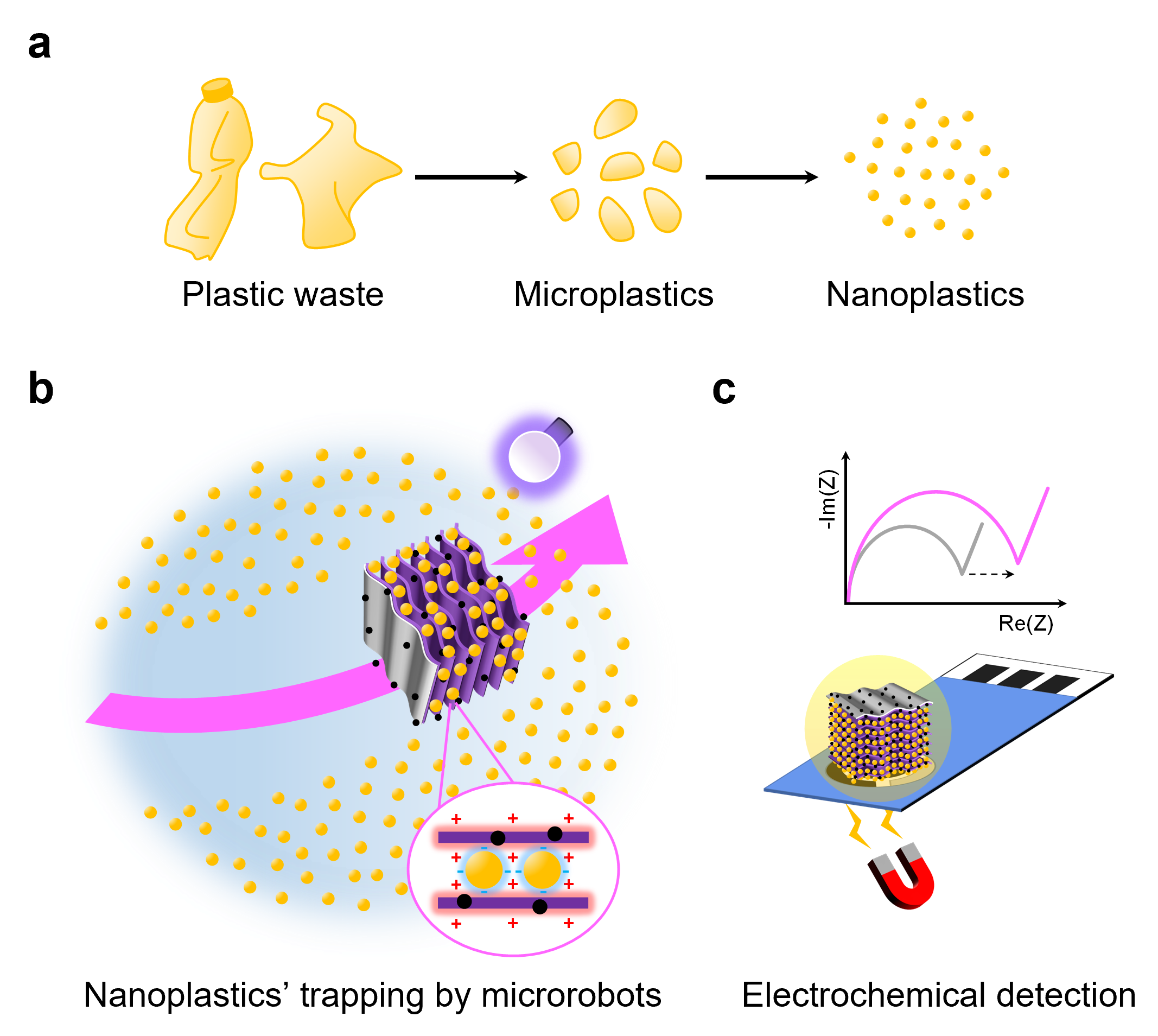
Figure 1. Light-powered magnetic MXene-derived γ-Fe2O3/Pt/TiO2 microrobots trap and detect nanoplastics. a Plastic waste in water fragments into micro- and nanoplastics. b Microrobots accelerate the removal of microplastics from water by trapping them b Microrobots accelerate the removal of microplastics from water by trapping them on their surface, including the slits between multi-layer stacks, due to the combination of a powerful motion and a programmable electrostatic attraction. c Acting as self-propelled platforms for preconcentration, microrobots allow nanoplastics’ detection by electrochemical impedance spectroscopy (EIS) using low-cost and portable electrodes in an electrolyte solution (yellow shading). The curves represent the impedance real (Re(Z)) and imaginary (-Im(Z)) parts as a function of the frequency (Nyquist plots) of microrobots before (gray) and after capturing nanoplastics (pink).
The microrobots were applied for “on-the-fly” trapping of nanoplastics on their surface, including the slits between the formerly MXene multi-layer stacks. Before the experiments, microrobots’ surface was programmed by pH adjustment to be oppositely charged to the nanoplastics, intensifying their electrostatic attraction. In this way, microrobots efficiently and rapidly collected polystyrene nanospheres (50 nm in size) from a suspension containing more than 109 nanoplastics ml-1 (97% removal efficiency within 1 min), serving as a model for nanoplastics in water. Several analyses, among which scanning electron microscopy (SEM), confirmed the presence of captured nanoplastics on microrobots’ surface. Besides, after the trapping experiments, the microrobots were magnetically transferred onto commercial screen-printed electrodes to perform nanoplastics detection by electrochemical impedance spectroscopy. Using a redox probe, this technique allowed estimating the occurrence of nanoplastics (106-1014 nanoplastics ml-1) due to the increased charge transfer resistance at the electrode/electrolyte interface.
This work shows the great potential of self-motile microrobots in screening nanoplastics-contaminated waters and their successive remediation. Furthermore, the application of the proposed MXene-derived oxide microrobots can be extended to the removal and degradation of other water contaminants, including POPs, heavy metals, and pathogenic microbes, exploiting the photogenerated reactive oxygen species (ROS) by TiO2 under UV-light irradiation.
For further information, please read our published article in Nature Communications, https://www.nature.com/articles/s41467-022-31161-2.

Follow the Topic
-
Nature Communications
An open access, multidisciplinary journal dedicated to publishing high-quality research in all areas of the biological, health, physical, chemical and Earth sciences.

Related Collections
With Collections, you can get published faster and increase your visibility.
Women's Health
Publishing Model: Hybrid
Deadline: Ongoing
Tumor Microenvironment Crosstalk and Therapeutic Implications
Publishing Model: Hybrid
Deadline: Nov 02, 2026