

.jpg) As the world races towards a green hydrogen economy, the challenge of storing this clean energy carrier efficiently and affordably is becoming increasingly crucial. Traditionally, hydrogen storage has relied on geological formations like salt caverns and depleted gas reservoirs. However, these storage solutions are geographically limited and not universally available. To address this, our research team has explored an innovative approach: utilizing lakes, hydropower, and pumped hydro storage reservoirs as potential sites for hydrogen storage.
As the world races towards a green hydrogen economy, the challenge of storing this clean energy carrier efficiently and affordably is becoming increasingly crucial. Traditionally, hydrogen storage has relied on geological formations like salt caverns and depleted gas reservoirs. However, these storage solutions are geographically limited and not universally available. To address this, our research team has explored an innovative approach: utilizing lakes, hydropower, and pumped hydro storage reservoirs as potential sites for hydrogen storage.
The Concept: Hydrogen Storage in Aquatic Environments
Hydrogen, produced from renewable energy sources such as wind, solar, and hydropower, is a promising candidate for addressing global energy storage needs. However, the high costs associated with hydrogen production, storage, and transportation present significant barriers to its widespread adoption. Our research proposes a novel solution: storing hydrogen in high-density polyethylene (HDPE) pipelines filled with gravel, submerged in lakes and reservoirs. This method offers several advantages, including flexibility in storage location and reduced costs.
The concept of storing hydrogen underwater is not entirely new. Previous studies have explored the potential of underwater compressed gas storage in the deep ocean. However, our approach shifts the focus to more accessible and controlled environments—lakes and reservoirs. This shift not only broadens the geographical possibilities for hydrogen storage but also leverages existing hydropower infrastructure, which can produce hydrogen and store it in situ, reducing transmission losses and improving overall system efficiency.
Analyzing the Feasibility
One of the key design parameters in our research was the selection of materials for the storage system. Gravel, specifically clean gravel from mine waste, was chosen as the ballast to ensure the hydrogen tanks remain at the bottom of the reservoir. Unlike finer materials like sand, which could be dispersed by underwater currents, gravel is stable and contributes positively to the system's overall cost-effectiveness. Moreover, using mine waste as gravel not only reduces costs but also offers an environmentally friendly solution for repurposing industrial byproducts.
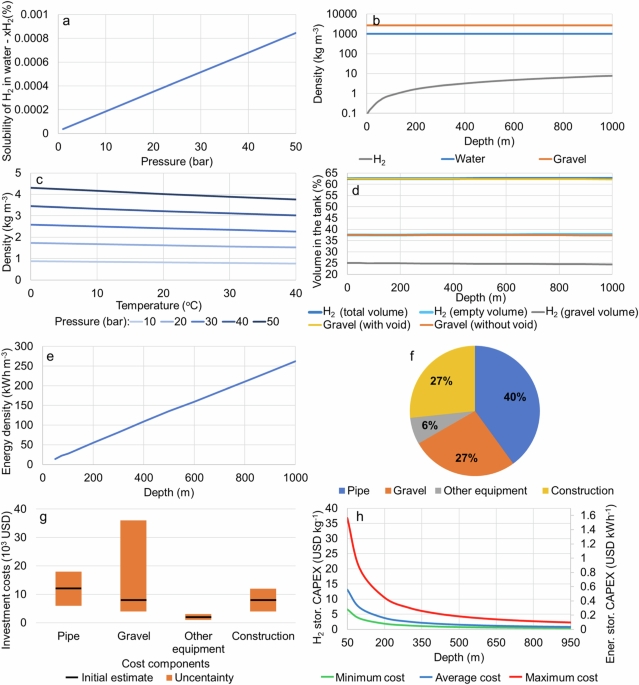
Our research indicates that the levelized cost of hydrogen storage (LCOS) in lakes and reservoirs is highly competitive with other large-scale storage options. For instance, at a depth of 200 meters, the estimated LCOS is approximately 0.17 USD per kilogram, making it a viable alternative to traditional storage methods like salt caverns. Additionally, the deeper the storage site, the more cost-effective the system becomes, as deeper tanks can store more hydrogen and energy due to the increased pressure.
Case Study: Oroville Lake, California
To illustrate the practical application of our proposed method, we conducted a case study on Oroville Lake in California. This hydroelectric reservoir, with a maximum depth of 210 meters and a vast surface area, presents an ideal location for hydrogen storage. Our simulations showed that Oroville Lake could store up to 86 GWh of electricity in hydrogen form, with a competitive LCOS of 0.17 USD per kilogram.
Interestingly, our analysis also revealed that hydrogen storage in such reservoirs could be seamlessly integrated with solar power generation. By using the reservoir's stored water for hydropower during periods of high solar generation, the system could achieve greater energy efficiency and minimize the curtailment of solar energy. This dual use of the reservoir for both hydropower and hydrogen storage represents a significant step towards a more resilient and integrated renewable energy grid.
Global Implications and Future Directions
The global potential for hydrogen storage in lakes and reservoirs is immense. Our research identified over 1,760 lakes worldwide that meet the necessary criteria, with a total storage capacity of 12 PWh. Notably, the Caspian Sea alone accounts for more than half of this potential, highlighting the strategic importance of such large bodies of water in the future hydrogen economy.
However, the practical implementation of this technology requires careful consideration of environmental and logistical factors. Ensuring the structural integrity of hydrogen storage tanks, managing the interaction between hydrogen and aquatic ecosystems, and developing the necessary regulatory frameworks are all critical steps that need to be addressed.
Our research opens up exciting new possibilities for the future of hydrogen storage. By harnessing the natural properties of lakes and reservoirs, we can create a scalable, cost-effective solution that supports the global transition to a clean energy future. As we continue to refine our methods and expand our understanding of this technology, the potential for hydrogen to play a central role in the world's energy landscape becomes increasingly clear.
Conclusion
Hydrogen storage in lakes and reservoirs offers a promising alternative to traditional storage methods. With the potential to significantly lower costs and increase storage capacity, this approach could be a game-changer in the global push towards a hydrogen-based energy economy. As research progresses, it will be crucial to explore the full range of applications and address the challenges associated with this innovative storage solution. The future of hydrogen is bright, and lakes and reservoirs could be key to unlocking its full potential.

Follow the Topic
-
Nature Communications
An open access, multidisciplinary journal dedicated to publishing high-quality research in all areas of the biological, health, physical, chemical and Earth sciences.

Related Collections
With Collections, you can get published faster and increase your visibility.
Women's Health
Publishing Model: Hybrid
Deadline: Ongoing
Tumor Microenvironment Crosstalk and Therapeutic Implications
Publishing Model: Hybrid
Deadline: Nov 02, 2026