When an archive becomes an instrument: reading solar history in tree rings
Published in Earth & Environment






Some research questions can be answered with a single field season or a short laboratory experiment. Others require something that looks less like a project and more like long-term stewardship: carefully built archives, maintained over decades, that allow us to ask new questions long after the original samples were collected.
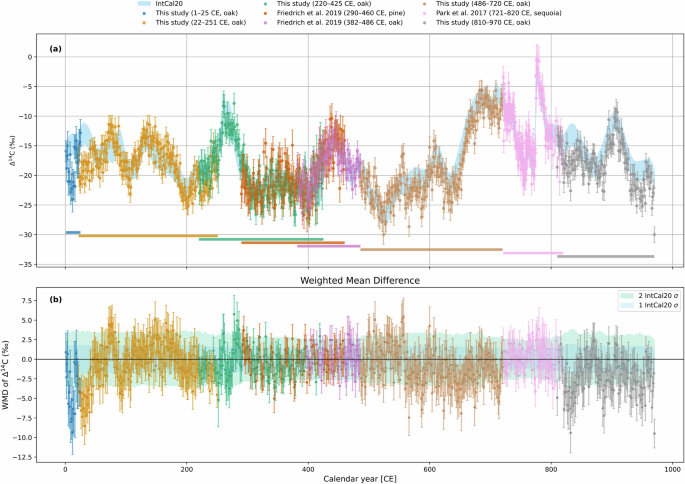
Our recent paper, Patterns in solar activity over the first millennium CE, belongs to that second category. It builds on a simple principle: trees record the atmosphere year by year. Cosmic rays interacting with the upper atmosphere produce radiocarbon (14C). The Sun modulates how many cosmic rays reach Earth, so changes in solar activity are imprinted in atmospheric 14C. Trees incorporate this carbon during photosynthesis and lock it into annual growth rings. If 14C is measured in precisely dated single rings, it becomes an annually resolved record of past solar behavior—long before telescopes or systematic sunspot observations.
Why archives matter more than people think
Someone said, that “headline” discoveries often depend on quiet, long-term decisions—proper conservation, careful cataloguing, and the ability to return to materials when methods improve.
That lesson generalises. High-precision annual 14C science or stable isotope research increasingly depends on access to exactly dated material with reliable provenance. When an archive is curated well, it becomes a scientific instrument: it can be re-measured, re-analysed, and tested against new questions with new analytical approaches. Conversely, if samples degrade or provenance is lost, those future analyses are irretrievable, independent of how advanced the measurement technology becomes.
The hidden foundation: a tree-ring archive built for continuity
The enabling resource for our study is the Hohenheim tree-ring collection, curated at the Curt-Engelhorn-Center Archaeometry (CEZA). It is one of the longest continuous tree-ring archives, spanning back to ~13,000 years before present and comprising tens of thousands of individual samples.
“Continuous archive” has a specific meaning: for many time periods, wood can be selected that covers every calendar year without gaps and with replication across multiple trees. That continuity is what turns tree rings into a high-resolution environmental recorder. It also reflects long-term work that is rarely visible or obvious: climate-stable storage, documentation of sampling history, preservation of sample integrity, and the maintenance of robust chronologies so that new measurements can be anchored to an existing absolute dating framework.
The results of the paper
In the paper we present an annually resolved 14C record spanning 1–970 CE. It combines five newly measured single-year series with three existing series, achieving near-continuous annual coverage across the millennium.
The main outcomes can be summarized to:
- Sharper structure than smoothed references: In intervals where IntCal20 is lower resolution, the annual data show offsets and finer structure relative to the reference curve. This is relevant for high-precision radiocarbon applications that increasingly depend on short-term features in atmospheric 14C.
- Direct access to solar variability: The annual record supports reconstructions of solar modulation (a measure of how strongly the Sun shields Earth from cosmic rays) and enables quantitative assessment of solar variability using time-series methods. We identify four major intervals of reduced solar activity (Grand Solar Minima candidates) during the first millennium CE. Understanding why and how often Grand Solar Minima occur is extremely important for understanding Sun-Earth interactions; long-term climatic trends; and the detailed internal mechanics of this star. We also describe how the ~11-year cycle weakens and recovers across these intervals, which may prove important to their origin. In addition, we performed a systematic “spike scan” to search for rapid annual 14C increases. These features appear to represent extreme solar storms, the likes of which have never been instrumentally witnessed. Understanding how these mega-storms arise and to what extent they emit highly energetic, and potentially hazardous, particles toward the Earth is also the focus of a considerable amount of current research. These two main results along provide new details and impose finer constraints on solar variability well beyond the instrumental era.
The work behind the data
Annual 14C datasets are built from many repeated steps. We begin with dendrochronology: selecting suitable wood from the archive and cross-dating it against established chronologies so each ring is assigned an independent calendar year. We then sample wood material at annual resolution.
For radiocarbon analysis, we isolate α-cellulose, a chemically robust wood fraction. The resulting material is converted to graphite and measured by accelerator mass spectrometry (AMS) at CEZA and at Universtity of Groningen. Inter-laboratory replicate measurements between our two radiocarbon laboratories show excellent agreement, strengthening confidence that the observed patterns reflect atmospheric signals rather than laboratory effects.
Finally, the data are put through new algorithms and software tools by the wizards at the Macquarie University and University of Groningen. These methods are specifically designed to reconstruct signals and patterns of solar activity with a robust uncertainty estimation. Many thousands of lines of code and new ideas about building an adaptive algorithm were needed to extract solar cycles the data. These codes are open source and will be continually updated for broader use by the community.
Why long-term archiving is an enormous benefit
Continuous, well-documented tree-ring archives convert rare material into reproducible science. They enable replication across trees, cross-checks between laboratories, and re-analysis as methods evolve. Independent, precisely dated archives can be accessed to determine whether a feature in a dataset is a local variability, analytical artefact, or a genuinely global atmospheric event.
The deeper driver is continuity—of samples, chronologies, metadata, and expertise. Long-term conservation may seem mundane, but it is exactly what allows future advances to be applied to existing material rather than requiring new samples that may be impossible to get.
A call to support long-term curation
If our study has one message beyond the specific results, it is that archives are not passive storage; they are active scientific infrastructure. The Hohenheim tree-ring collection and all other similar archives did not become globally valuable by accident: it became valuable through sustained investment in sampling strategies, documentation, conservation, and chronology-building, together with institutional commitment to keep the collection accessible and usable.
These elements rarely look like “breakthrough science” in a grant headline, yet they are frequently the prerequisite for it. Tree-ring archives, in particular, underpin annual-resolution reconstructions that inform solar physics, carbon-cycle research and improve radiocarbon calibration.
Supporting long-term curation is therefore one of the most effective ways to multiply the value of scientific investment. The next research question may not require a new sample—it may require the ability to return, with better methods and better questions, to a well-preserved one.
Follow the Topic
-
Communications Earth & Environment
An open access journal from Nature Portfolio that publishes high-quality research, reviews and commentary in the Earth, environmental and planetary sciences.

Related Collections
With Collections, you can get published faster and increase your visibility.
Ecological resistance and resilience under global change
Publishing Model: Open Access
Deadline: Apr 07, 2027
Hazards in Mountain Regions
Publishing Model: Open Access
Deadline: Nov 02, 2026