Psychological Symptoms of Climate Change
Published in Earth & Environment, Behavioural Sciences & Psychology, and Education

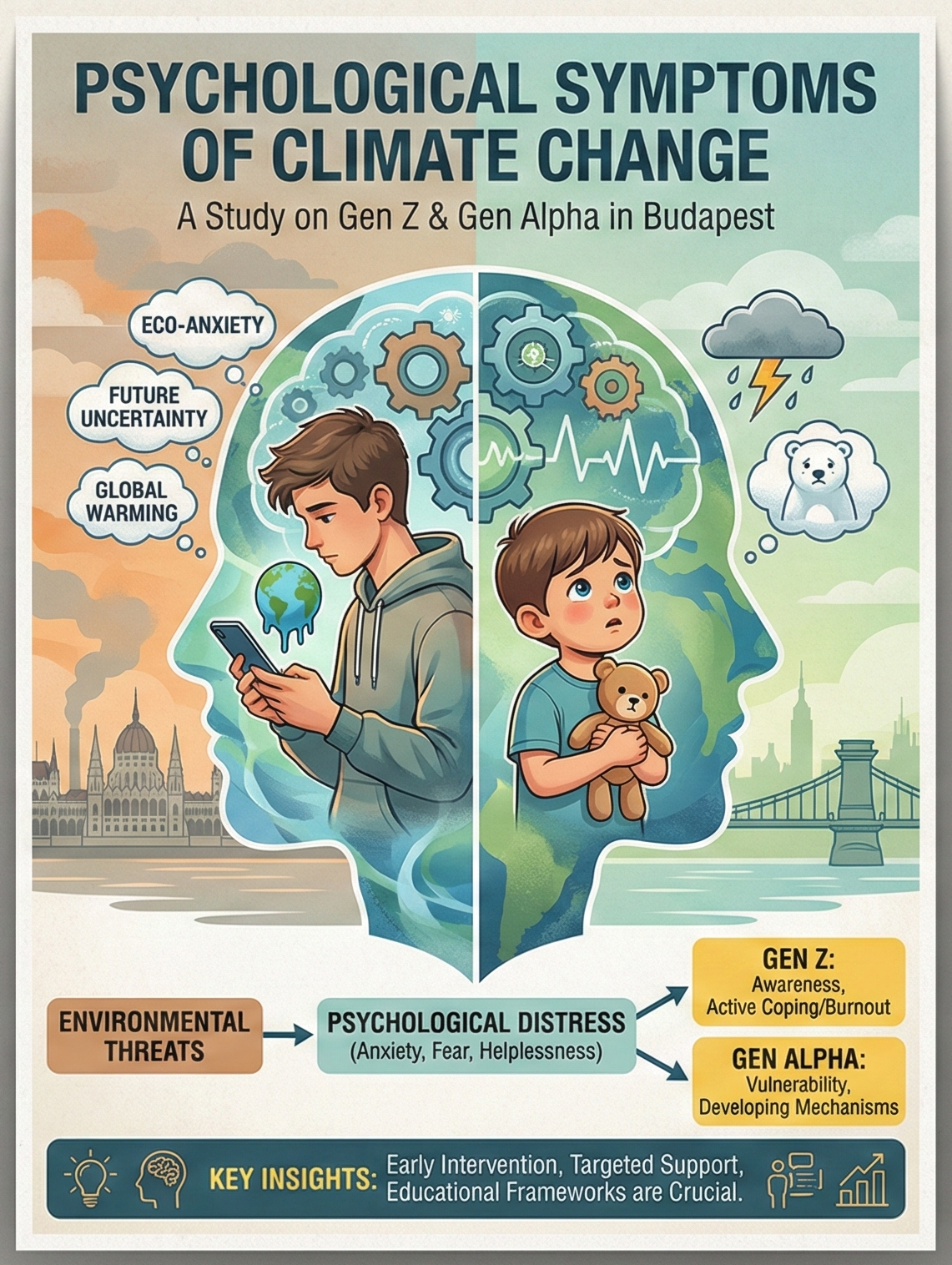


In this study, I examine the psychological footprint of climate change on Gen Z and Gen Alpha in Budapest. My research identifies distinct patterns of climate anxiety, revealing that while both generations experience significant environmental distress, their emotional processing and awareness levels differ.
I found that Gen Alpha, despite their young age, exhibits a profound vulnerability to climate-related fears, often mirroring the anxieties of older cohorts but with fewer developed coping mechanisms. I believe it is vital to research these two generations together because they are the first to grow up with the climate crisis as a constant, lived reality. By understanding these nuances, we can develop better-targeted mental health support and educational frameworks. I argue that addressing this distress now is crucial to preventing a long-term mental health crisis in the face of our changing planet.
I would be very curious to hear the perspectives of my fellow researchers on this matter. What have been your experiences or observations within your own professional or local environments regarding these generational shifts?
Follow the Topic
-
Discover Sustainability
A multi-disciplinary, open access, community-focussed journal publishing results from across all fields relevant to sustainability research whilst supporting policy developments that address all 17 of the United Nations Sustainable Development Goals (SDGs).

Related Collections
With Collections, you can get published faster and increase your visibility.
Economic Responses to Environmental Challenges: Evidence, Models, and Innovations
Environmental degradation, climate change, and resource scarcity have emerged as critical global challenges, posing significant threats to economic stability, public welfare, and sustainable development. These complex issues require not only technological innovation and policy reform but also a deep understanding of the economic mechanisms that drive environmental outcomes.
In response, this Collection focuses on how economies can effectively address these threats through data-driven research, advanced modeling, and strategic policy design. The issue brings together studies that apply econometric and statistical methods—such as time series analysis, panel regression, spatial econometrics, and simulation-based models like Integrated Assessment Models (IAMs) and Computable General Equilibrium (CGE) models—to assess environmental policies and measure their economic impacts. These analytical tools are used to quantify trade-offs, predict long-term outcomes, and guide decision-making under uncertainty. By bridging economics, environmental science, and public policy, this collection deepens the empirical and theoretical understanding needed to design effective responses. It strengthens the foundation for achieving environmental sustainability alongside economic resilience.
Publishing Model: Open Access
Deadline: Jun 30, 2026
Food, Societies and Sustainability: Contemporary Concerns around Local Food Production and Consumption
Food goes far beyond nutrition. It reflects sociocultural identities and territorial heritage, consumption dynamics, economic development, public policies, sustainability concerns, food production, distribution and consumption. Understanding food production and food products, practices and strategies offers key insights into both historical traditions and contemporary lifestyles. Around the world, food and drink serve as powerful symbols of identity and attract interest through diverse value chains, economic interests and cultural expressions. On the other hand, traditional and local food systems contribute to cultural heritage, biodiversity conservation and sustainability matters from environmental, sociocultural and economic concerns.
The Collection "Food, societies and sustainability: Contemporary concerns around local food production and consumption" explores how food is locally produced, promoted and protected through public and private initiatives, food-based experiences, media platforms, and sustainable dietary and productive practices. It encourages contributions that examine how food concerns are shaped in contemporary societies, how globalization is affecting local food cultures, emphasizing the role of food as both tangible and intangible cultural heritage. Food preferences, food stereotypes, and attitudes towards food sustainability, analysed through the lenses of generational gaps and gender differences are also welcomed. This Collection seeks original research and case studies using both qualitative and quantitative methods.
Keywords: Food Systems, Food culture, Food Production, Locality, Heritage, Tourism, Gastronomy, Agricultural Biodiversity, Livestock Biodiversity, Food Sustainability, Regenerative Tourism.
This Collection supports and amplifies research related to SDG 2, SDG 3, SDG 4, SDG 5, SDG 10, SDG 12, and SDG 17.
Publishing Model: Open Access
Deadline: Sep 30, 2026


Please sign in or register for FREE
If you are a registered user on Research Communities by Springer Nature, please sign in