When Floods Compound: Designing Ecosystems Beyond Black Swans
Published in Earth & Environment, Plant Science, and Mathematics
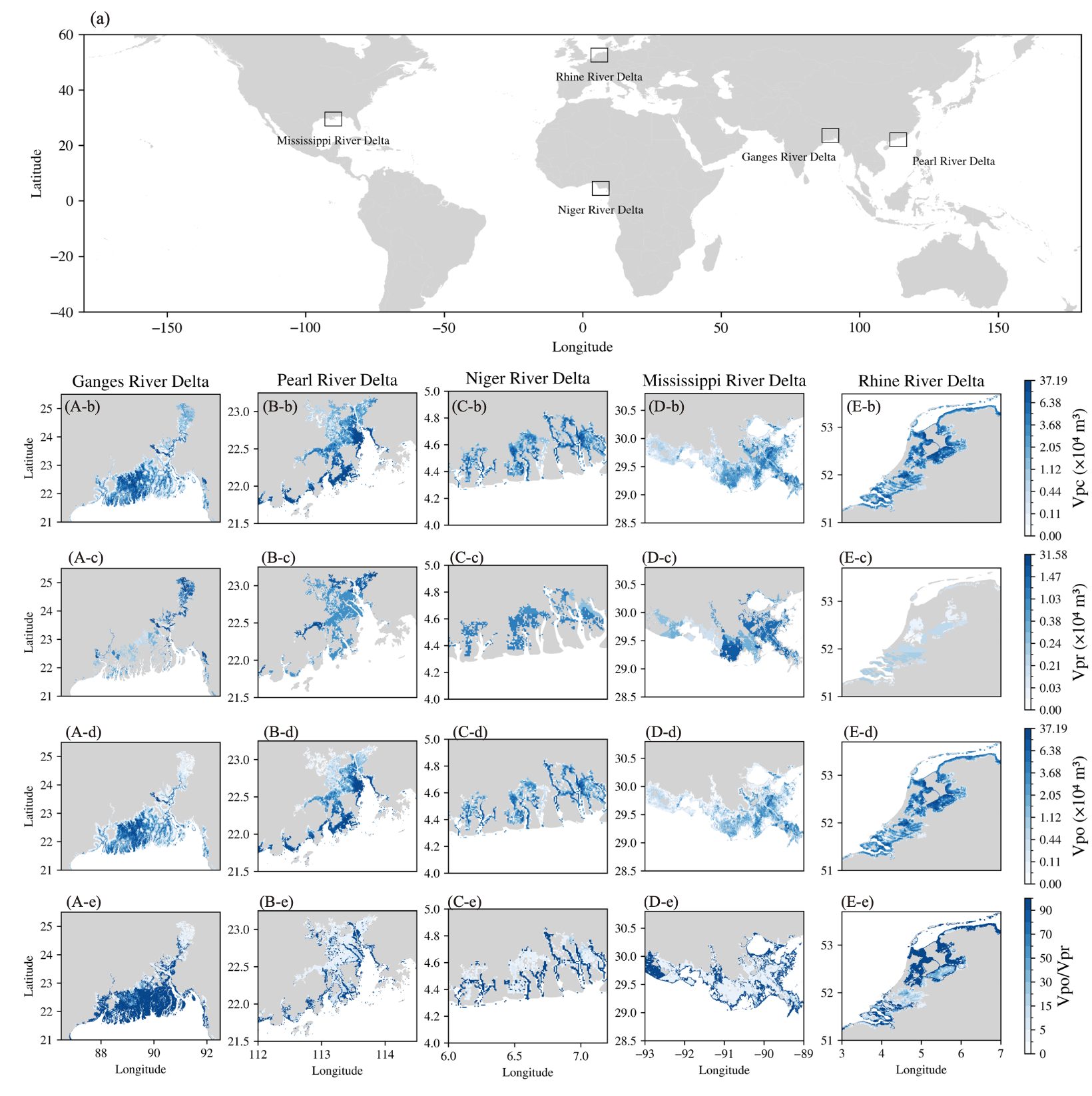

Most flood risk assessments still fail to account for the uncertainty and their co-occurrence, as well as their opportunity for ecosystem design that transforms systemic risk into value (hence the formulation of design nature value), such as GDP gain under ecosystemic investment. Current events are already beyond events expected to occur with an interarrival of 1000 years, therefore breaking the limit of traditional Black Swan events.
For these reasons, we quantify potential coastal compound flood risk at 0.1° resolution by integrating compounding flood hazard, population exposure, and empirical vulnerability that is not assuming risk aversion or seeking behavior. We introduce a compound flood metric, which aggregates riverine and oceanic flood volumes across multiple return periods and habitats (Figures 1 and 2). We further infer an empirical socio-economic vulnerability function based on the ratio between observed and maximum potential flood hazards, supporting Gross Ecosystem Productivity investments. Our results show that Asia presents the highest risk (35.22%), followed by Africa (20.21%), Europe (17.02%), South America (9.89%), and North America (2.31%), with river deltas and low-lying coasts emerging as global risk hotspots (Figure 1).
Global Mapping of Potential Coastal Compound Flood Risk at 0.1° Resolution! coming in #CommunicationsEarth&Environment #Nature. By Jiaqi Zhang and Matteo Convertino at Tsinghua SIGS Tsinghua University in Shenzhen! #TREESlab Institute of Environment and Ecology
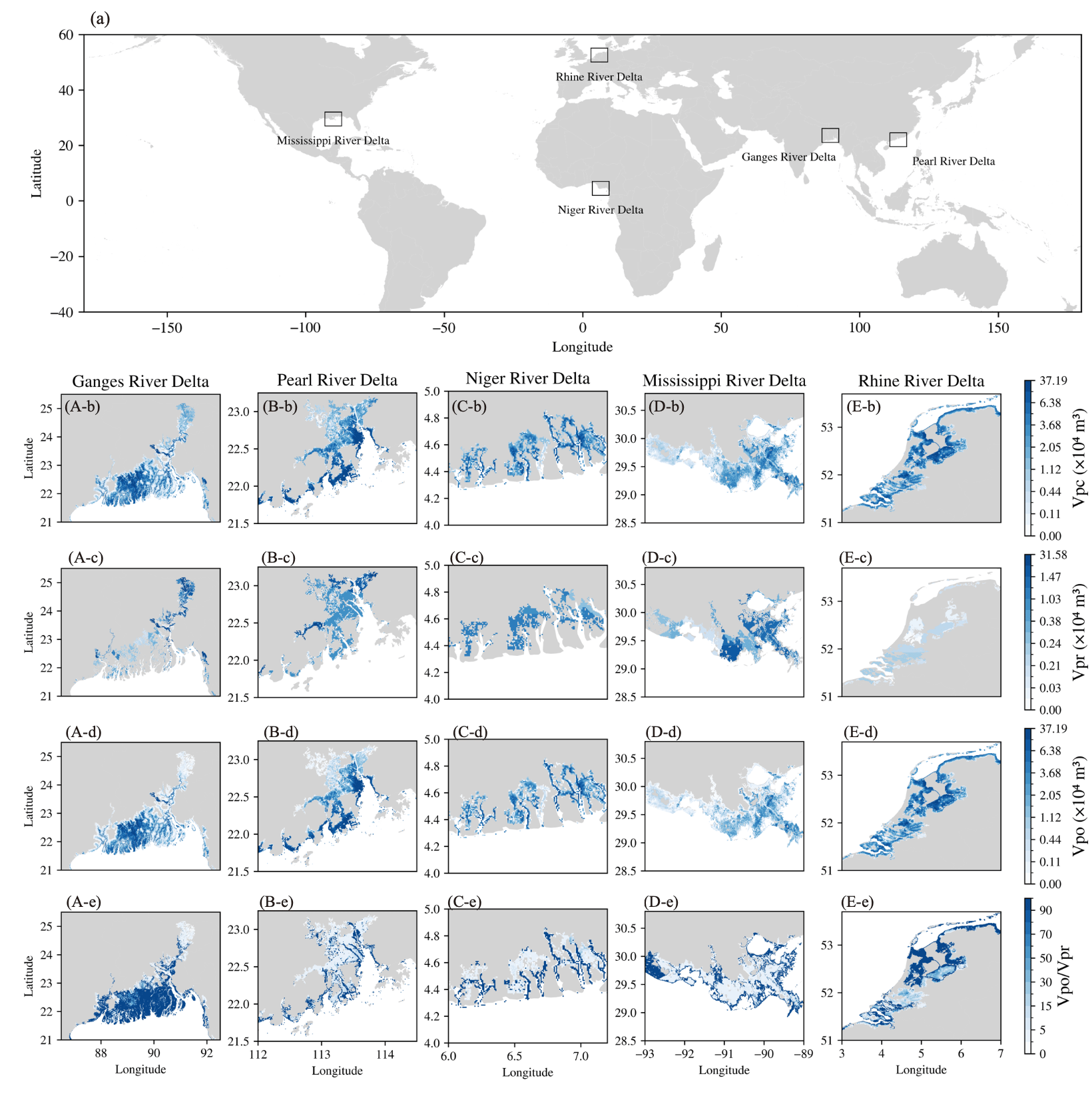 Figure 1. Spatial pattern of flood hazard in deltaic hotspots.
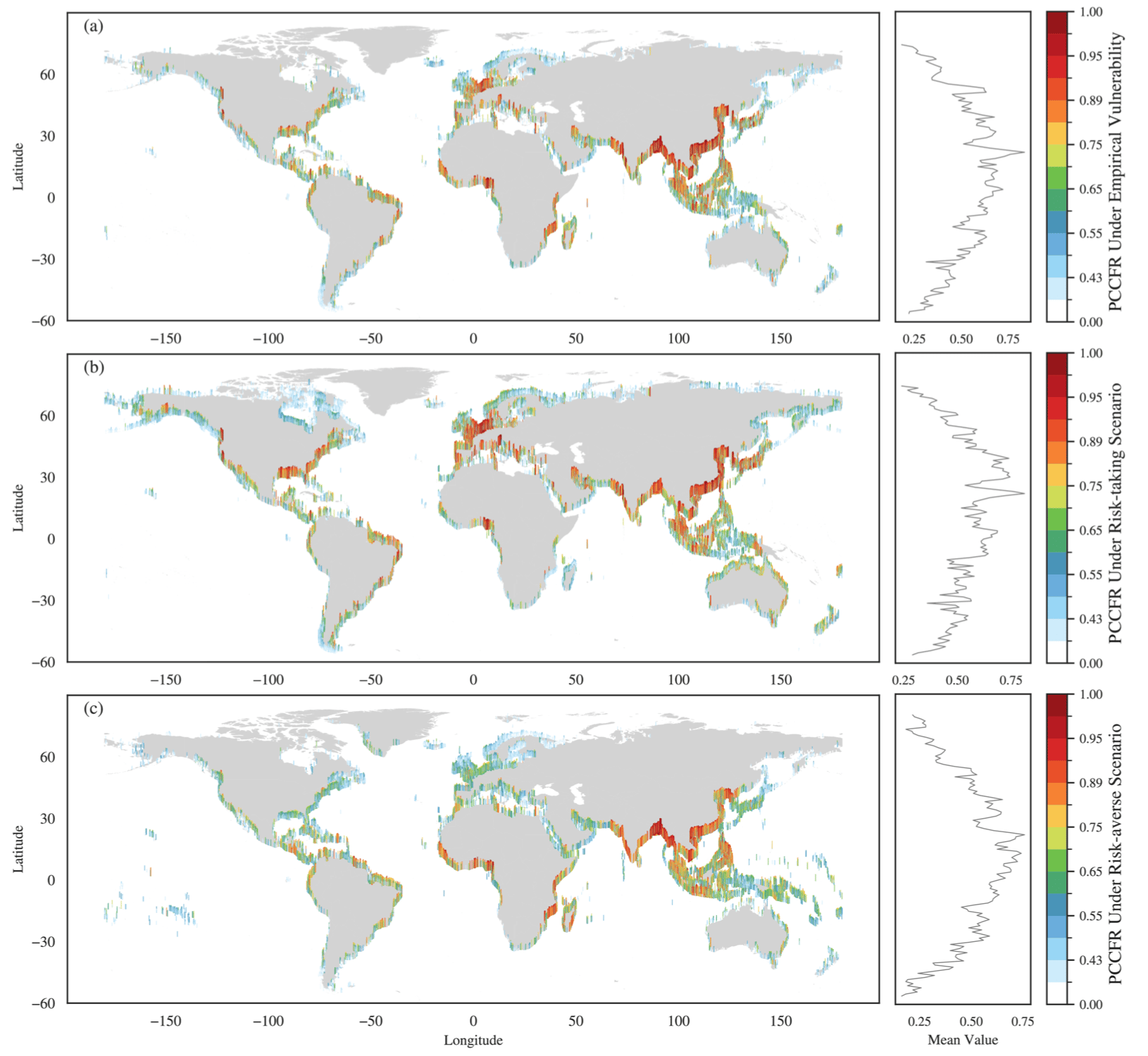
Figure 2. Global distribution of Potential Coastal Compound Flood Risk (PC-CFR) at 0.1 degree grid-scale.
As for my own personal story... I began my career designing bridges and buildings. Steel, concrete, precision. Structures meant to last.
Today, I design something different.
I design corridors and habitats: the invisible infrastructures that connect bridges, cities, waterbodies, species, and people into larger, coordinated ecosystems. Systems where life, products, and services move as flows by following water flows, continuously adapting to climate pressure, human demand, and deep uncertainty.
This shift did not come from theory alone. It came from experience.
I grew up loving nature, oceans and rivers, but I also learned that nature becomes dangerous when we change it without understanding it. I saw my home and my grandparents’ home flood. I saw people I cared about become seriously ill from environmental exposure. Those moments made one thing clear: nature is not passive. It responds, and it responds badly when we alter it in a way the very beneficial networks and flows are broken by breaking natural connections.
To understand those responses, I turned to networks, waves, and ecohydrology: languages that describe how water, species, energy, information, and risk move through complex ecosystems such as river deltas and any blue carbon ecotones. Risk and decision sciences then gave me the tools to measure danger and design solutions.
That is when ecology became my canvas. The weave to fabricate ecosystems.
I began to see ecosystems as the planetary fabric of life: systems we already engineer, often blindly, but that can be designed intentionally, together with nature’s capacity to self-organize. That realization led me to BioTerraformation: using ecological intelligence to transform climate stress into adaptive structure, resilience, and value.
Because without corridors and habitats, species have nowhere to move, climate has no pathways to adjust, and life loses its footing.
I still build. But now I build living infrastructures: ecosystems that help life, including ours, find its way forward.
And the reason is simple. Risks due to planetary alterations are affecting people massively. But above all, I love making environments where life, in all its forms, can flourish safely and beautifully.

Professor in EcoHydrological System Science and Engineering Design
Follow the Topic
-
Communications Earth & Environment
An open access journal from Nature Portfolio that publishes high-quality research, reviews and commentary in the Earth, environmental and planetary sciences.

Related Collections
With Collections, you can get published faster and increase your visibility.
Ecological resistance and resilience under global change
Publishing Model: Open Access
Deadline: Apr 07, 2027
Hazards in Mountain Regions
Publishing Model: Open Access
Deadline: Nov 02, 2026