When rules change: how the brain learns through mistakes
Published in Neuroscience
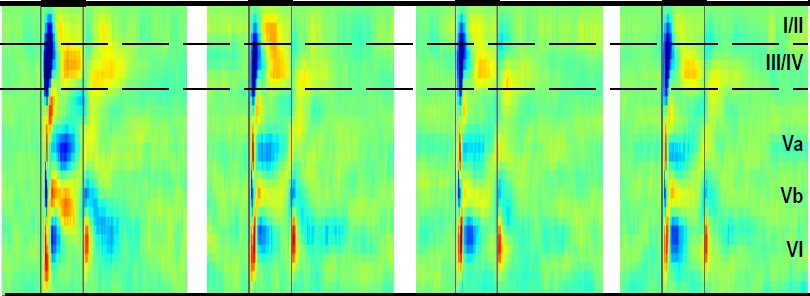



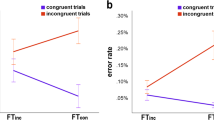

Learning is only useful if it remains flexible. In everyday life, previously reliable rules can suddenly fail, forcing us to update our decisions. While this ability is fundamental to adaptive behavior, the neural mechanisms that enable such rapid remapping are still poorly understood — especially at the level of individual cortical layers.
In our study, we combined a multi-stage reversal-learning task with chronic, high-resolution electrophysiological recordings in the primary auditory cortex of Mongolian gerbils. After the animals had learned to reliably discriminate between two tones, we repeatedly reversed the stimulus–reward contingencies. This allowed us to observe how neural processing reorganizes every time previously learned rules become invalid.
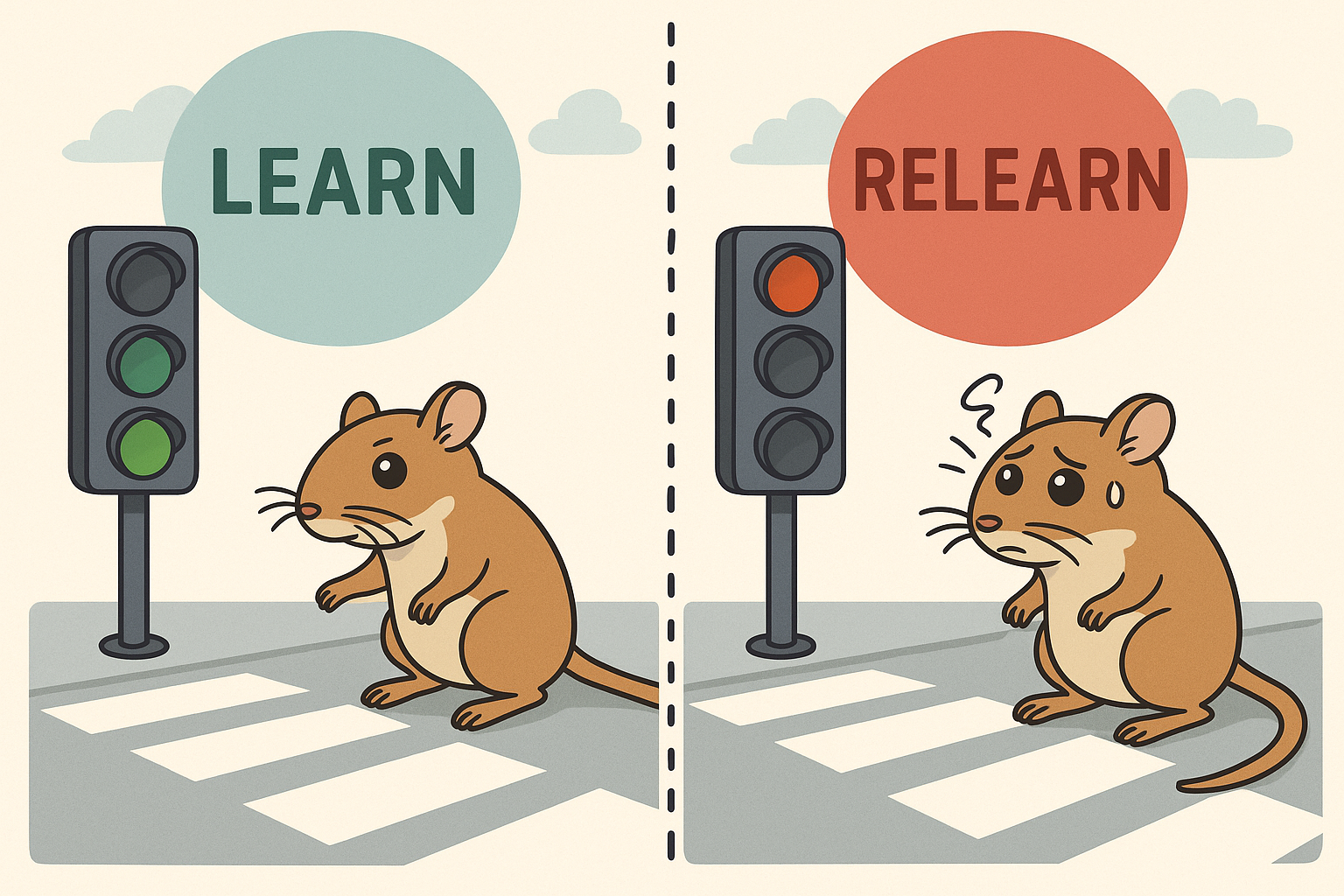
(generated with Google Gemini)
Deep layers detect errors and drive relearning through dopamine
What immediately stood out was the dominant role of deep cortical layers during early relearning. Right after a rule switch, neural activity in these layers was strongly driven by errors. This pattern is consistent with the well-established concept of the reward-prediction error — the mismatch between expected and actual outcomes — which is classically mediated by dopamine.
Previous work from our group had already shown that dopaminergic modulation is particularly effective in deep cortical layers. The present findings now demonstrate how this dopaminergic error signal functionally drives the reorganisation of cortical processing during active relearning. Errors therefore act as the biological trigger that initiates cortical remapping.
What immediately stood out was the dominant role of deep cortical layers during early relearning. Right after a rule switch, neural activity in these layers was strongly driven by errors. This pattern is consistent with the well-established concept of the reward-prediction error — the mismatch between expected and actual outcomes — which is classically mediated by dopamine.
Previous work from our group had already shown that dopaminergic modulation is particularly effective in deep cortical layers. The present findings now demonstrate how this dopaminergic error signal functionally drives the reorganisation of cortical processing during active relearning. Errors therefore act as the biological trigger that initiates cortical remapping.
“Our data show how the brain reorganizes itself during relearning – from error signals in deep cortical layers to stable decision networks in upper layers. Mistakes are not a disturbance, but the biological foundation of flexible adaptation.”
Stable decisions emerge in upper layers and over time
As performance improved and the animals regained reliable decisions, cortical dominance gradually shifted upward. Upper layers increasingly took over, forming the networks that supported stable, accurate decision-making. Learning, therefore, was not simply reflected in stronger or weaker responses, but in a layer-by-layer redistribution of functional responsibility within the cortex.
One particularly striking result was the temporal structure of decision formation. Patterns of neural activity allowed us to predict whether an upcoming decision would be correct or incorrect several seconds before the animal’s actual response. Decisions are therefore not formed instantaneously at the moment of action, but emerge through a prolonged process of neural buildup and evaluation.
Learning also reshapes the brain’s rhythms
We also observed a pronounced shift in the rhythmic organisation of cortical activity. During early, uncertain learning phases, oscillatory activity was broad and diffuse. As decisions stabilized, cortical networks transitioned into highly focused beta- and gamma-band dynamics, especially in upper layers. These rhythms are thought to support precise information routing and coordinated network communication, suggesting that stable learning is not only structural, but also temporally orchestrated.
Together, these findings challenge the classical view of the primary sensory cortex as a passive input stage. Instead, the auditory cortex actively participates in error evaluation, rule updating, and decision execution — dynamically and in a strictly layer-specific manner.
At the center of this process lies a simple but powerful principle: mistakes are not a failure of the system, they are its driving force. Dopamine-dependent error signals initiate the neural reorganisation required for flexible behavior, while upper cortical layers consolidate new rules once they prove reliable.
Beyond basic neuroscience, this layered view of adaptive learning may help explain why cognitive flexibility is impaired in various neurological and psychiatric conditions, and why rehabilitation often requires repeated, error-driven training. It may also offer inspiration for artificial learning systems, which still struggle with the biological efficiency of learning from failure.
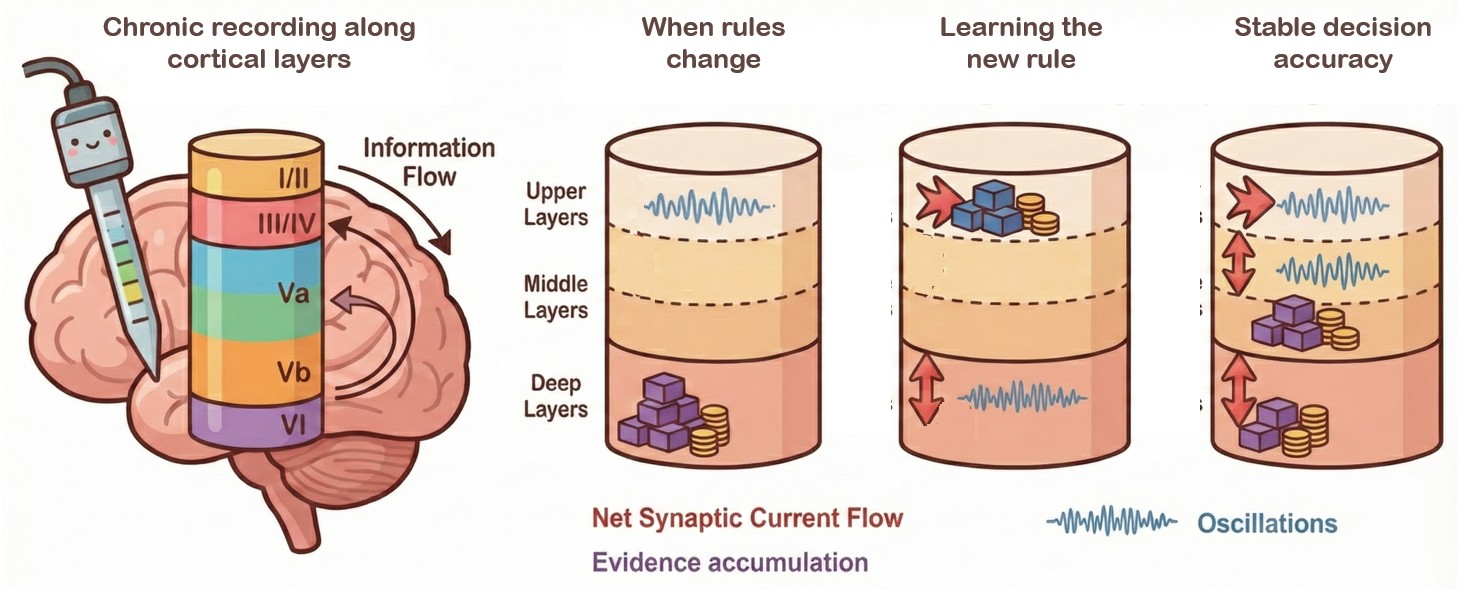
(generated with Google Gemini)
Figure | Layer-specific dynamics during flexible learning.
Continuous recordings across layers reveal how the brain moves from error-driven updating to stable decisions. Neural activity across cortical layers changes when rules are updated. After a rule change, errors dominate processing in deep cortical layers. During relearning, the information flow is actively reorganized. Once performance stabilizes, upper layers support accurate and reliable decision-making.
Cite this article:
Acun, E., Zempeltzi, M., Deane, K.E. et al. Layer-specific cortical dynamics during transitions from error monitoring to decision execution in reversal learning. Commun Biol (2025). https://doi.org/10.1038/s42003-025-09336-6

Follow the Topic
-
Communications Biology
An open access journal from Nature Portfolio publishing high-quality research, reviews and commentary in all areas of the biological sciences, representing significant advances and bringing new biological insight to a specialized area of research.

Your space to connect: The Psychedelics Hub
A new Communities’ space to connect, collaborate, and explore research on Psychotherapy, Clinical Psychology, and Neuroscience!
Continue reading announcementRelated Collections
With Collections, you can get published faster and increase your visibility.
Healthy Aging
Publishing Model: Open Access
Deadline: Dec 31, 2026
DNA repair and human disease
Publishing Model: Hybrid
Deadline: Oct 31, 2026




Please sign in or register for FREE
If you are a registered user on Research Communities by Springer Nature, please sign in