Scientists discover Bessel-Shi eigenstates in complex quantum systems
Published in Physics and Mathematics


Explore the Research
s10773-025-06172-6?utm_campaign=related_content&utm_source=HEALTH&utm_medium=communities
Quantum entanglement, famously exemplified by the Einstein-Podolsky-Rosen (EPR) paradox, is often described as "spooky action at a distance" [1, 2]. This phrase underscores the profound correlation between two entangled components, A and B, even when separated by large distances. Remarkably, a measurement or change in one component triggers an instantaneous correlation in the other, maintaining their entangled state. Such seemingly coordinated behavior among particles or photons has remained a mystery and a subject of debate in the scientific community for nearly a century.
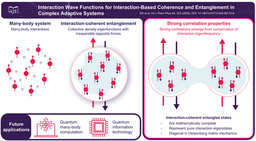
Although quantum-coherent entanglement was demonstrated through optical interference experiments in 1991 [3, 4], the precise mechanism underlying the phenomenon has remained elusive. In a recent study, a research team led by Leilei Shi at the University of Science and Technology of China (USTC) in Hefei, Anhui, has reported findings on what they termed Bessel-Shi eigenstates, a concept dating back to 2006 [5, 6]. Their research proposes how these states may underpin the strong correlations between entangled components, regardless of spatial separation. Notably, this interdisciplinary study draws upon concepts from quantum science, financial theory, and complexity science. The team’s findings are detailed in their paper, “Interaction Wave Functions for Interaction-Based Coherence and Entanglement in Complex Adaptive Systems,” published in the International Journal of Theoretical Physics [6].
Reference
- Einstein, Albert, Boris Podolsky, and Nathan Rosen (1935): “Can Quantum-Mechanical Description of Physical Reality Be Considered Complete?” Physical Review, 47 (May 15), 777–780.
- Schrödinger, Erwin (1935): “Discussion of Probability Relations between Separated Systems,” Mathematical Proceedings of the Cambridge Philosophical Society, 31(4), 555-563.
- Zou, Xing-Yu, Li-Jun Wang, and Leonard Mandel (1991): “Induced Coherence and Indistinguishability in Optical Interference,” Physical Review Letters, 67(3), 318-321.
- Wang, Li-Jun (Lijun), Xing-Yu Zou, and Leonard Mandel (1991): “Induced Coherence without Induced Emission,” Physical Review A, 44(7), 4614-4622.
- Shi, Leilei (2006): "Does Securities Transaction Volume-Price Behavior Resemble a Probability Wave?" Physica A, 366, 419-436.
- Shi, Leilei, Xinshuai Guo, Wei Zhang, and Bing-Hong Wang (2025): “Interaction Wave Functions for Interaction-Based Coherence and Entanglement in Complex Adaptive Systems,” International Journal of Theoretical Physics, 64 (12), 323. https://doi.org/10.1007/s10773-025-06172-6

Mr. Leilei Shi obtained a Bachelor of Science in physics from the University of Science and Technology of China (USTC) in Hefei in 1982. He later pursued studies in business management at the Asian Institute of Management (AIM) in the Philippines, supported by a scholarship from the Asian Development Bank — The Government of Japan during the 1992-1993 academic year. In 2006, he made a significant discovery in the financial markets, unveiling the cumulative trading volume-price probability wave equation published in Physica A. Since 2018, he has served as an industry advisor for the Master in Finance Program in School of Management at USTC, a three-year full-time course.
Mr. Shi founded Beijing Shangdafei (SDF) Science & Technology Co., Ltd. in 2024, which focuses on various high tech areas, including quantum information technology, artificial general intelligence (AGI), and wireless AGI entanglement communications (7G wireless communications), among others.
Beijing SDF Science & Technology Co. Ltd. welcomes private equity investment to realize 7G technology together in our life!
Follow the Topic
-
International Journal of Theoretical Physics

This is a single-blind peer-reviewed journal dedicated to the development and fostering of theoretical physics as an overarching and unifying conceptual, mathematical, methodological and computational framework for carrying out fundamental research in physics.
Ask the Editor – Space Physics, Quantum Physics, Atomic, Molecular and Chemical Physics
Got a question for the editor about Space Physics, Quantum Physics, Atomic, Molecular and Chemical Physics? Ask it here!
Continue reading announcementRelated Collections
With Collections, you can get published faster and increase your visibility.
IQSA 2025
The Intermediate IQSA 2025 Conference - held specifically at the occasion of International Year of Quantum Science and Technology - brings together researchers who disseminate, apply and advance quantum structures within and beyond physics, and carry forward the foundational spirit of the founding fathers of quantum mechanics by investigating the structures that underlie the quantum world and its mathematical representations.
This special issue collects selected papers presented at the conferences and expressly welcomes submissions from non-participants working in the field.
Topics covered include logico-algebraic structures, quantum logics, empirical logics, operational structures, mathematical foundations of quantum mechanics and quantum field theory, operator algebras and applications to quantum physics, quantum geometry, quantum probability, quantum topology, quantum space-time, quantum information, quantum communication, quantum computation, general probabilistic theories, phase space quantum mechanics, philosophy of quantum mechanics, quantum causal structures, application of quantum structures in cognitive and socio-economic domains.
Publishing Model: Hybrid
Deadline: Feb 28, 2026
Please sign in or register for FREE
If you are a registered user on Research Communities by Springer Nature, please sign in