A behind-the-scenes look at how a simple fermionic mode can reveal non-Abelian physics.


Recently, our team at Xi’an Jiaotong University published a paper in Communications Physics proposing a new, simpler way to unveil fusion rule of Majorana zero mode(MZM). We believe we have found a way to unveil their "nontrivial fusion rules" using a setup that might already exist in labs today.
Here is the story behind our work, "Unveiling nontrivial fusion rule of Majorana zero mode using a fermionic mode."
Why We Are Obsessed with MZMs
In the world of condensed matter physics, there is a ”holy grail” we have been chasing for over a decade: the Majorana Zero Mode (MZM). These are not your typical particles. Unlike electrons or protons, MZMs are their own antiparticles.
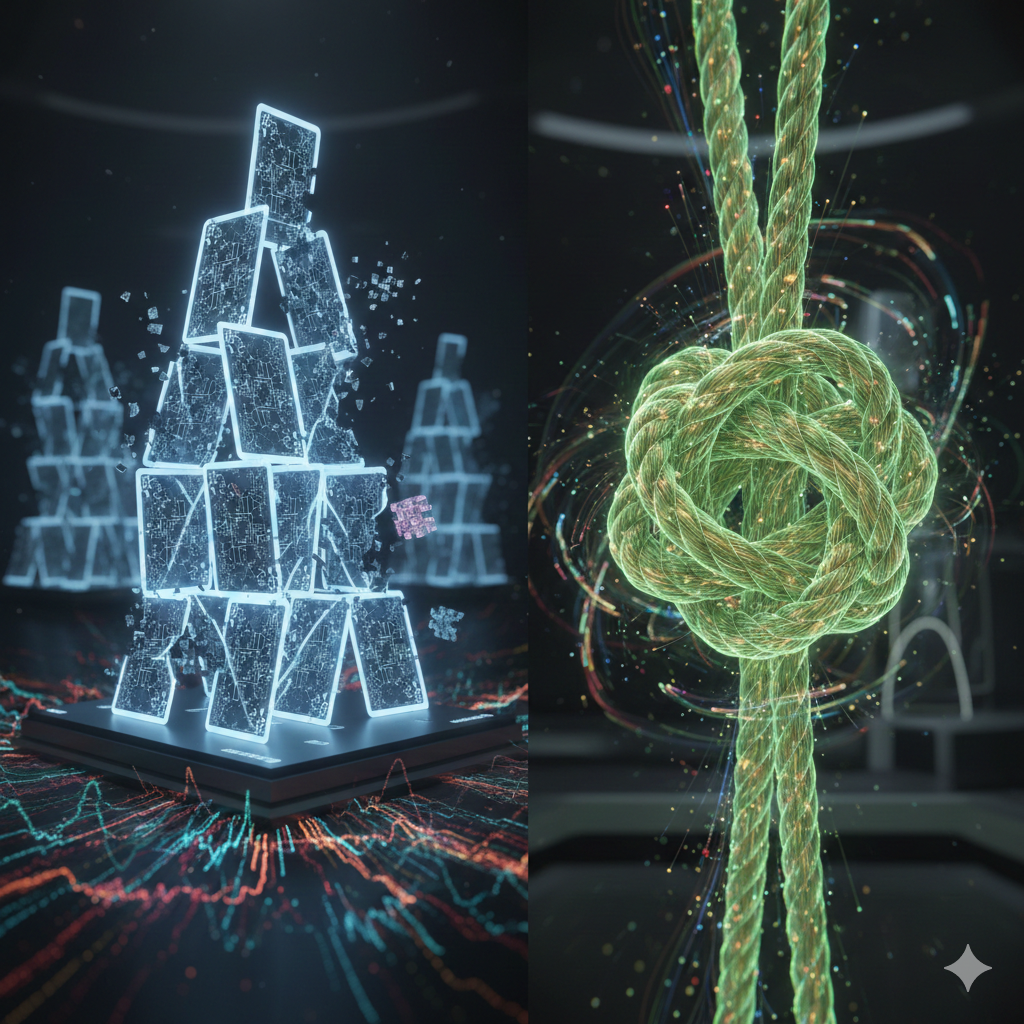
But what makes them truly special—and why companies like Microsoft are interested—is their potential to revolutionize quantum computing. Imagine you are building an exquisite castle (a quantum computer) with playing cards, but the ground beneath you is constantly shaking (environmental noise). Even the slightest tremor can cause your castle to collapse. This is the biggest dilemma facing current quantum computers—they are simply too fragile.
MZMs offer a completely new way to build quantum systems—one protected by topology.
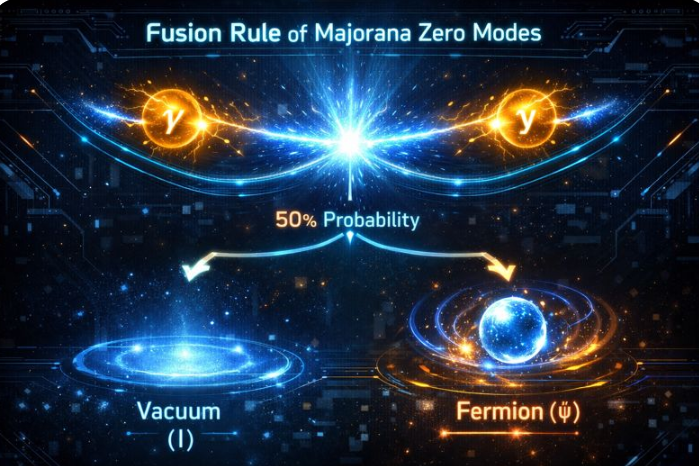
When two MZMs are brought together and fused, the outcome is not unique. Instead, there are multiple possible fusion channels, meaning the system can end up in different quantum states, a rule written as γ ×γ = I +Ψ. As long as the MZMs remain spatially separated, these possibilities coexist, giving rise to a set of degenerate ground states. Importantly, this information is not stored at any single location—it is shared nonlocally across the system.
Braiding takes this a step further. By slowly exchanging the positions of MZMs, one can transform the quantum state within this degenerate space. Crucially, the final state depends on the order of the exchanges. Different braiding sequences lead to different results, a property known as non-Abelian statistics.
An intuitive way to think about this is a network of paths: fusion defines the available routes, while braiding changes the order in which those routes are taken. Because the information depends on the global structure of the paths rather than any local detail, small local disturbances cannot easily disrupt it.
As mentioned above, braiding and fusion define the ”Non-Abelian” nature of MZM. Local noise may affect part of the system, but it cannot access or destroy the globally stored information. As a result, MZMs provide a promising route toward fault-tolerant quantum computation.
Our Motivation
Over the last decade, many experiments have reported signals that look like MZMs. Yet almost every time, an uncomfortable question follows:
Could something more ordinary be masquerading as a Majorana?
To truly confirm MZMs, physicists must demonstrate not just that they exist, but that they obey non-Abelian rules.
In 2021, Professor Jie Liu proposed a pioneering method to achieve the effective braiding of MZM in 1D nanowires by utilizing an auxiliary quantum dot. By treating the quantum dot as two coupled MZMs and tuning its energy levels via gate voltage, one could effectively control their fusion and separation—a strategy that quickly gained widespread recognition. Building on this framework, our team extended the study to the braiding of Andreev Bound States. This naturally led us to a compelling new question: “could quantum dot also serve as a window to explore the fusion rules of MZMs?”. This curiosity became the driving force behind our current research.
Our Approach
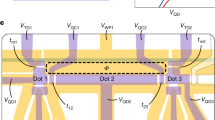
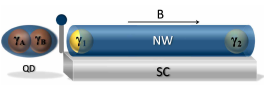
Setting the Stage: We designed a minimalist stage: a superconducting nanowire capable of generating MZMs, coupled to a simple Quantum Dot.
The Trick: The beauty of this method is that we don’t need to tune the superconducting wire at all. We just need to turn a knob—specifically, the gate voltage—to adjust the energy of the quantum dot and open or close the ”door” (coupling strength) between it and the wire. We turned a complex fine tuning problem into a simple switch-flipping task.
Key Findings: Measurable charge pumping
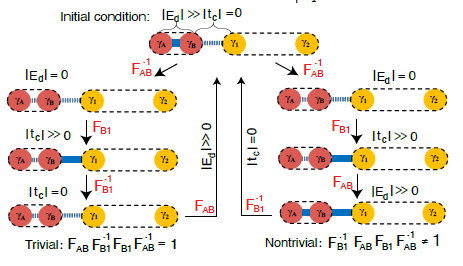
While simulating different fusion loops, we sought a way to make our findings experimentally observable. Inspired by pioneering research that connects MZM fusion to non-trivial charge transport, we analyzed the charge transfer across various fusion loops. This allowed us to bridge the gap between theoretical fusion rules and real-world electrical measurements.
We control fusion and splitting by tuning two parameters via gate voltage: the energy level of the quantum dot (Ed) and its coupling strength with MZMs (tc). When these parameters cross zero energy an odd number of times during a fusion loop, integer charge is pumped between the superconductor and the quantum dot. Crossings an even number of times result in zero charge transfer — a clear, robust signature of nontrivial fusion.
Outlook: From Blueprint to Reality
Fusion is not just a theoretical curiosity—it can be an experimental probe. By converting nontrivial fusion rule into charge pump, we provide a new way to verify the fusion rule of Majorana zero modes using tools already familiar to mesoscopic physics: quantum dots, gate voltages, and charge sensors. A key strength of our work is its system-independent nature. While we demonstrate this in 1D nanowires where a quantum dot provides the fermionic mode, the principle is universal. For instance, in a topologically nontrivial vortex, a molecule attached to a scanning probe microscopy tip can also act as the fermionic mode. Whether through quantum dots or molecules, providing a "fermionic mode" is a general and powerful way to probe the nontrivial fusion rule across different physical platforms.
Perhaps more importantly, this work highlights a recurring lesson in physics: Sometimes, solving the most complex problems doesn’t require more complex machinery—it requires looking at the world from a different angle.
Follow the Topic
-
Communications Physics
An open access journal from Nature Portfolio publishing high-quality research, reviews and commentary in all areas of the physical sciences.

Related Collections
With Collections, you can get published faster and increase your visibility.
Quantum machine learning: understanding capabilities, limitations, and perspectives for quantum advantage
Publishing Model: Open Access
Deadline: Dec 31, 2026
Nonlinear dynamics of living systems
Publishing Model: Open Access
Deadline: Nov 09, 2026