A new face for the first human ancestor to venture out of Africa
Published in Social Sciences and Ecology & Evolution


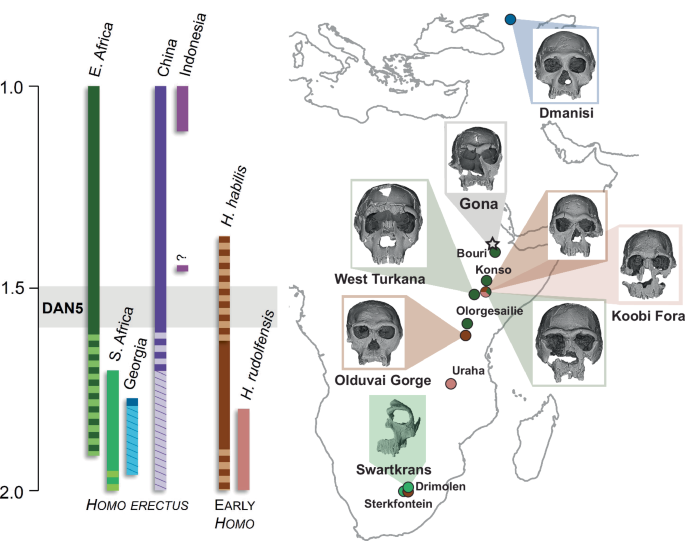

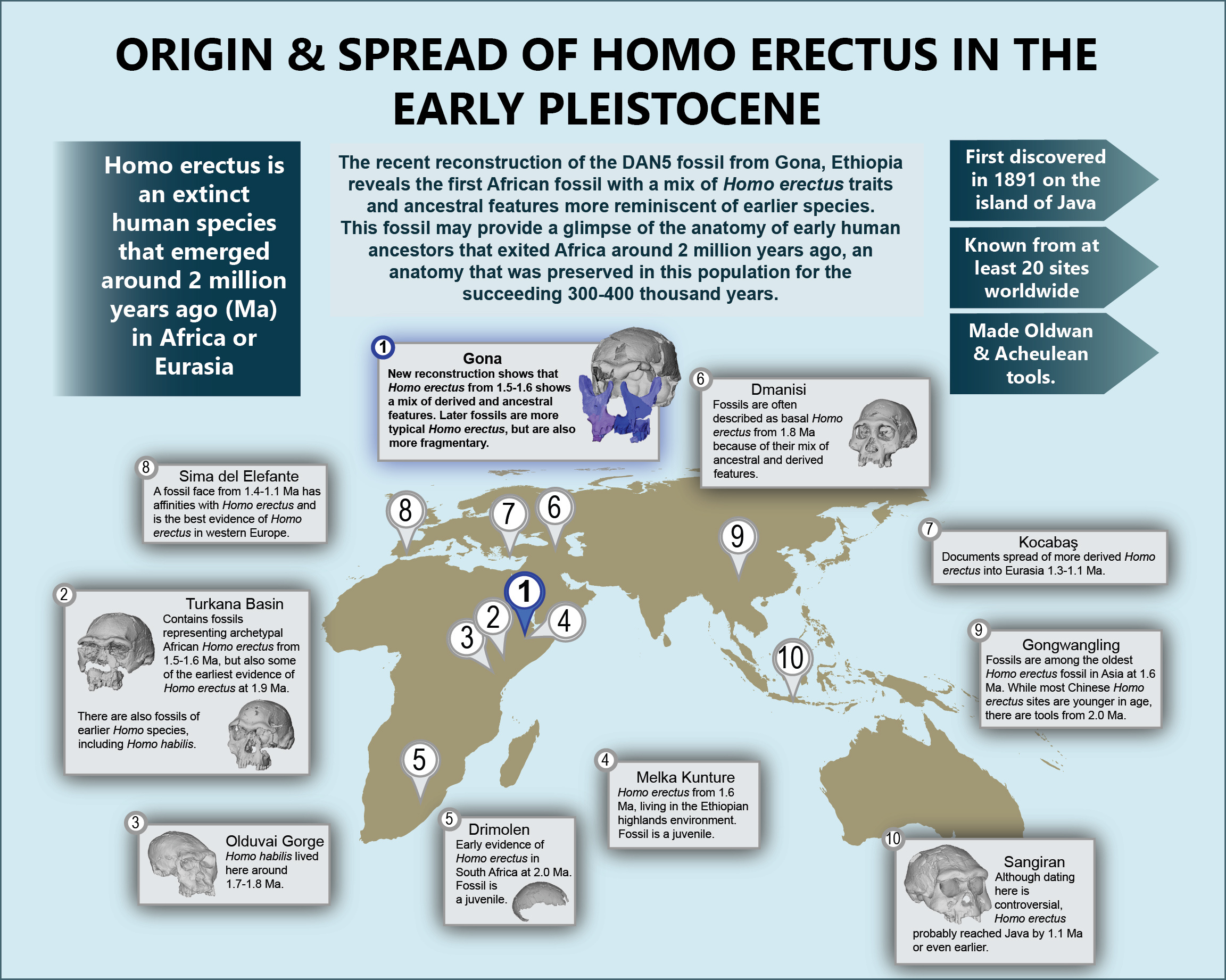
Traditionally, the origins of Homo erectus were thought to be eastern Africa based on both the oldest evidence of the species - a small fragment dated to 1.9 Ma - and the presence of a likely ancestor in the form of Homo habilis. Yet, the best evidence of fossils presenting a mix of ancestral (H. habilis-like) and derived (H. erectus-like) traits are from the 1.8 Ma site of Dmanisi, Georgia. This raised the possibility that H. erectus was not just the first human species to spread outside of Africa, but actually evolved outside of Africa. Our study in Nature Communications presents a virtual reconstruction of the 1.6-1.5 Ma DAN5/P1 fossil from Gona, Ethiopia that provides the first evidence of such intermediate morphology in Africa. The face and teeth are distinct from contemporaneous African Homo erectus fossils, and thus DAN5/P1 may provide a window into the anatomy of basal African Homo erectus.
GONA, ETHIOPIA
The site of Gona, Ethiopia has revealed millions of years of human evolution and technological innovation. This includes two fossils assigned to the first truly cosmopolitan human ancestor, Homo erectus, documented from sites stretching from South Africa to Southeast Asia spanning nearly 2 million years. These Homo erectus fossils were first announced in 2020. The current collaboration began the same year, when the co-directors of the Gona Paleoanthropological Research Project, Sileshi Semaw and Michael Rogers, shared the micro-CT scans of DAN5/P1 with paleoanthropologist Karen Baab, an expert in Homo erectus evolution. The international research team grew further with the addition of Yousuke Kaifu and Sarah Freidline, who brought additional expertise in dental and craniofacial anatomy to the team.
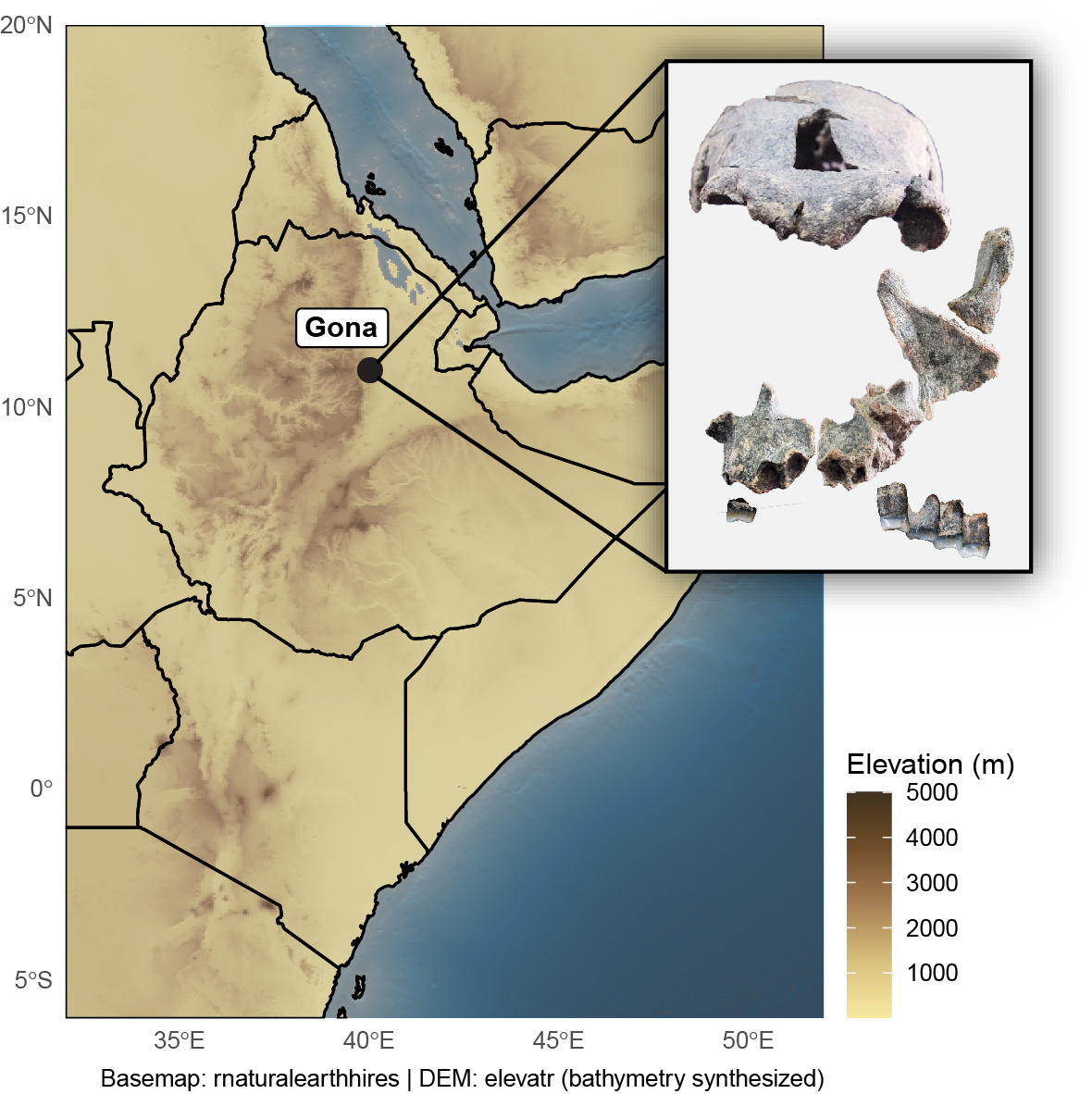
Photographs copyright Michael Rogers and Gen Suwa.
THE DAN5/P1 FOSSIL
The DAN5/P1 fossil, from the Dan Aoule North site at Gona, is estimated to date from 1.5-1.6 Ma, a time corresponding to the presence of archetypal African H. erectus in Kenya. The DAN5/P1 cranial reconstruction was a process, rather than an event. The first step was an analysis of the cranial vault reconstruction in 2022. The vault reconstruction was straightforward and shape analyses highlighted affinities of DAN5/P1 with Homo erectus from Georgia as well as Homo habilis. The vault also presents multiple Homo erectus characters - a protruding brow ridge, occipital and angular tori and midline keeling.
The face reconstruction went through many iterations between 2021 and 2024 due to its complexity. For the current study, surface renderings were generated from micro-CT scans of the craniodental fossils. The reconstruction was accomplished virtually, allowing for tools not available when working with the physical fossils themselves. For example, one half of the palate could be mirrored and superimposed with the other half to allow for repositioning of a piece that had broken off and shifted locations during the fossilization process. The process itself was iterative, with each alternative treated as a new hypothesis to be evaluated against the previous version until we were satisfied that we found the arrangement that best satisfied the various anatomical constraints.
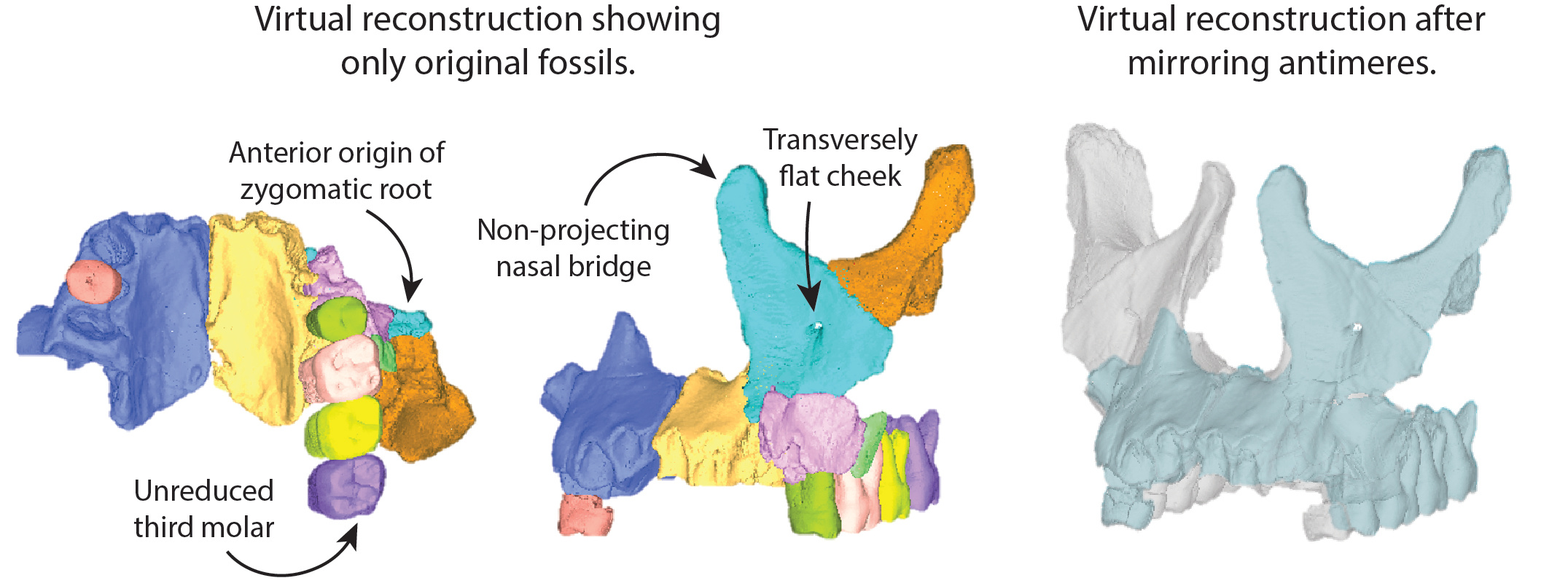
Scans courtesy of National Museum of Ethiopia.
Our study includes landmark-based shape analyses of the cranium and the face, as well as assessments of dental dimensions and occlusal outlines. In contrast to the vault, the face lacks features typically associated with Homo erectus, including a projecting nasal bridge and rounded infraorbital region (part of the cheek below the orbit). Other features seen in DAN5/P1 more typically found in early Homo rather than Homo erectus include the small brain, anterior position of the zygomatic root and tooth proportions, particularly the large third molar (wisdom tooth).
IMPLICATIONS
Thus, DAN5/P1 is the clearest evidence of transitional craniodental morphology between early Homo and Homo erectus, despite postdating the origins of Homo erectus by ~500 thousand years. Another notable result is the distinct face anatomy in DAN5/P1 compared to Kenyan fossils assigned to Homo erectus from the same time period (e.g., Koobi Fora, West Turkana). The pattern highlighted in our analyses is compatible with a number of interpretations.
- High between-population variation: Perhaps the Gona population preserved the cranial anatomy of the initial dispersing population from Africa whereas the Kenyan lineage showed greater evolutionary change. If confirmed, then DAN5/P1 may provide the best view of early African Homo erectus.
- High within-population variation: Homo erectus may be characterized by high within-population variation in Africa, as previously suggested for Georgia.
- Genetic admixture: Given evidence of genetic admixture among species of later hominins - modern humans, Neanderthals and 'Denisovans' - we cannot rule out the possibility that the DAN5/P1 anatomy is the consequence of interbreeding between different lineages of early Pleistocene Homo.
- Back migration from Eurasia: Similarities between DAN5/P1 and the Dmanisi population are also consistent with back migration of a Eurasian lineage into Africa.
Future fossil discoveries could provide support for one of these interpretations. For example, additional fossils from the Horn of Africa that preserve the distinctions from the Kenyan sample would support the first interpretation, while the discovery of fossils more like DAN5/P1 in Kenya would support the second.
Follow the Topic
-
Nature Communications
An open access, multidisciplinary journal dedicated to publishing high-quality research in all areas of the biological, health, physical, chemical and Earth sciences.

Related Collections
With Collections, you can get published faster and increase your visibility.
Women's Health
Publishing Model: Hybrid
Deadline: Ongoing
Data for AI, AI for Data: cross-disciplinary cleaning, processing and analysis approaches
Publishing Model: Open Access
Deadline: Dec 31, 2026