African green growth initiatives have a positive impact on agricultural productivity but not on fisheries
Published in Earth & Environment, Agricultural & Food Science, and Economics
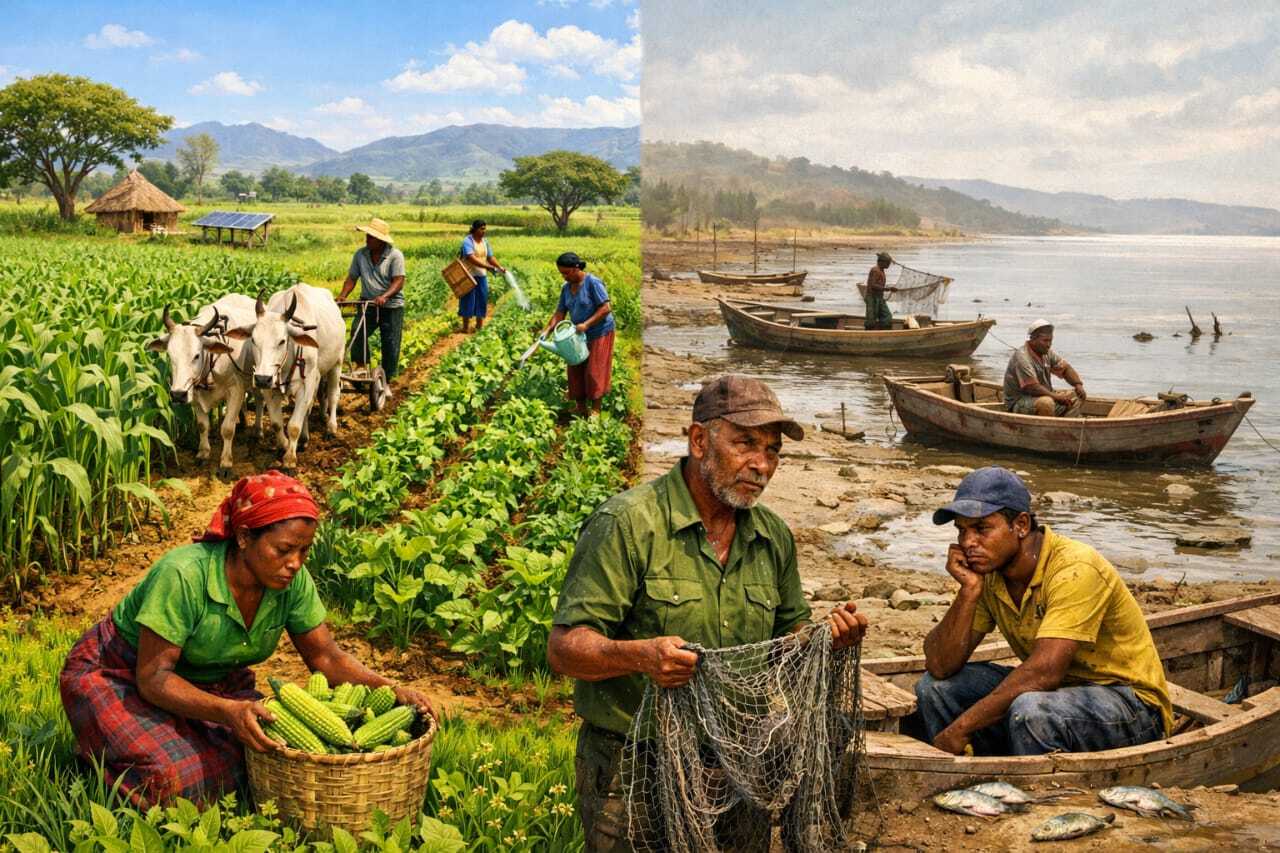
African green growth policies promise a triple win for food security, the environment, and livelihoods- but when we put the data to the test, the story turned out to be more nuanced than many policy narratives suggest. Our study shows that green growth initiatives are boosting crop productivity across Africa, yet they are simultaneously associated with declining total fisheries production, with very different outcomes across income groups and regions.
How the project started
This work began from a simple tension we kept encountering in policy documents and regional strategies: green growth was being promoted as a universal pathway to “win–win” outcomes for agriculture, environment, and inclusive development, yet the same countries were reporting worsening hunger, stressed ecosystems, and vulnerable smallholders. We wanted to know whether the numbers actually support the optimism around green growth in Africa’s agri-food systems, especially under the African Continental Free Trade Area (AfCFTA).
At the same time, hunger indicators were moving in the wrong direction: over 280 million Africans were undernourished in 2020, up by more than 25 million in just one year, with stark regional disparities from Eastern to Central and Western Africa. This disconnect between ambitious green narratives and stubborn food insecurity convinced us that a continent-wide, data-driven assessment was urgently needed.
What we actually did
We brought together three major data systems that are rarely combined in a single empirical framework: the World Bank’s World Development Indicators, IMF International Financial Statistics, and OECD green growth metrics. From these, we built a green growth index via principal component analysis, capturing environmental and resource productivity dimensions such as CO₂ productivity, energy productivity, and material use.
On the food systems side, we focused on Sustainable Development Goal 2 (Zero Hunger), using indicators such as agriculture, forestry and fishing value added per worker, cereal yield, total and aquaculture fisheries production, and a composite SDG2 index. Methodologically, we had to confront the realities of African data: strong cross-country linkages, serial correlation, and long-run relationships between variables. This led us to adopt a Prais–Winsten regression with panel-corrected standard errors and complementary Driscoll–Kraay estimates to account for cross-sectional dependence, heteroscedasticity and cointegration across 46 African countries over time.
What surprised us
The first surprise was encouraging: across the full African panel, stronger green growth performance is associated with higher agricultural productivity and cereal yields, and with improvements in the SDG2 index. This suggests that, at least for crops and on-farm productivity, green growth can support a more resilient and innovative agricultural sector.
The second surprise was less comfortable. The same green growth index is negatively associated with total fisheries production in Africa, even when aquaculture shows positive responses in several cases. When we disaggregated by income groups, the picture became even more complex:
- In low-income countries, green growth is linked to gains in fisheries, aquaculture, and cereal yields, but to a decline in agriculture, forestry and fishing value added per worker, hinting at short‑run costs and transition pressures for smallholders.
- In lower‑middle‑income countries, green growth worsens the SDG2 index and total fisheries production, even as it bolsters some productivity indicators.
- In upper‑middle‑income countries, green growth is strongly and systematically associated with declines across almost all SDG2 indicators; agriculture, forestry, fishing, fisheries, aquaculture, and cereal yield.
This asymmetry challenges the assumption that green growth is uniformly beneficial and underscores that transition and compliance costs, land and water reallocation, and stricter environmental policies can squeeze certain sectors and groups, especially fishers and rural workers, at least in the short to medium term.
Why this matters for policy
Our findings suggest that “green growth” is not a single lane highway to SDG2, but a network of paths with difficult trade-offs that differ by income group and region. Economic growth, renewable energy, financial development and population growth tend to support Zero Hunger outcomes overall, yet are counterbalanced by the negative influences of carbon emissions intensity, deforestation, trade openness and fossil fuel dependence on agri‑food system sustainability.
For West, East, Southern and North Africa, this means that regional strengths such as renewable energy in North Africa or agro‑industrial capacity in Southern Africa can be leveraged, but only if land, water, and fisheries are managed in an integrated way that recognises cross-border spillovers under AfCFTA. Policies that expand agricultural frontiers or intensify production without explicit safeguards for aquatic ecosystems risk eroding fisheries-based food security and livelihoods, particularly in coastal and in-land fishing communities.
Where we go next
Three gaps stood out as we completed this work. First, inclusivity: current green growth strategies still pay insufficient attention to equity and the differentiated impacts on smallholders, women, and marginalized communities. Second, finance: our results show that financial development supports sustainable agri-food outcomes in middle‑income settings but can be counterproductive in low‑income countries when credit is poorly structured or managed. Third, technology: digital tools and innovations are often celebrated in concept, but robust evidence on how they can concretely support green growth within the AfCFTA framework remains limited.
Going forward, we see a strong need for country‑ and basin‑level work that links hydrology, fisheries ecology, farming systems and trade, as well as longitudinal studies that track the long‑term impacts of green growth policies on urban agriculture, livestock systems and biodiversity. We also hope this paper catalyses more dialogue between trade negotiators, environmental ministries, finance institutions, and farmer and fisher organisations, so that Africa’s green growth does not only look good in aggregate indicators, but also feels fair and sustainable on the ground.

Eric Junior Bomdzele is a results-driven Agricultural Economist from Cameroon with over a decade of experience in multimillion-dollar international development finance projects in agricultural and rural development, agri-food systems, value chain & market systems development, agricultural investment appraisal, climate-smart agriculture, ESF compliance, project design, implementation, and evaluation of large-scale agricultural and rural development programs across sub-Saharan Africa.
He currently completed the World Bank Group through the Africa Fellowship Program, contributing to agriculture, food security, youth inclusion, and climate resilience initiatives in Benin and the wider West African region. Moreover, he has several professional experiences with international organizations including: Alliance Bioversity & International Center for Tropical Agriculture (CIAT) – CGIAR, Colombia, Swiss Agency for Development and Cooperation (SDC), African Economic Research Consortium (AERC), Conservation Action Research Network (CARN) ASPIRE Research Grant, Mission 21 (M21), WWF Cameroon, Centre for Independent Development Research (CIDR), Cameroon, and Sustainable Outreach Foundation (SOF) Cameroon.
He holds an MSc in Food Security and Development from the University of Reading, UK and an MSc in Agricultural Economics from the University of Buea,Cameroon, where he is currently completing a PhD focused on the macroeconomic impacts of climate change on Cameroon’s agrarian economy. In addition, he has other other certifications from Cambridge University, UK, United States Department of Agriculture (USDA), World Bank Group, and he is a Chevening Alumnus.
Eric has a track record of numerous research grants, and he has published widely in peer-reviewed journals and contributed to international policy dialogues, with a strong commitment to inclusive, evidence-based, and climate-resilient development.
Eric uniquely combines the roles of academic researcher and development practitioner, translating evidence-based research into scalable development interventions. He is fluent in English, with working knowledge of French.
Research Interests:
- Agriculture
- Food Security
- Climate Change
- Poverty and Inequality
- Green growth interventions
- Social Protection
- Environment and Natural Resource Management
- REDD+
- Impact Evaluation and Applied (Micro and Macroeconomic) Econometrics
Follow the Topic
-
Communications Earth & Environment

An open access journal from Nature Portfolio that publishes high-quality research, reviews and commentary in the Earth, environmental and planetary sciences.
Related Collections
With Collections, you can get published faster and increase your visibility.
Archaeology & Environment
Publishing Model: Hybrid
Deadline: Mar 31, 2026
Drought
Publishing Model: Hybrid
Deadline: Mar 31, 2026


Please sign in or register for FREE
If you are a registered user on Research Communities by Springer Nature, please sign in
It's good work Mr. Bomdzele Eric Junior