Anchoring the Interface: Building Stable 2D/3D Structures on Inorganic Perovskites
Published in Materials


Trying to Build on a Success Story
In hybrid perovskites, 2D/3D heterostructures are a well-established strategy: a thin 2D capping layer on a 3D perovskite surface passivates defects, repels moisture, and improves both efficiency and longevity. We asked: why not apply the same concept to all-inorganic CsPbI3, which faces similar surface defects and phase instability?
We were disappointed to find that this strategy did not translate. Commonly used spacer cations that reliably form 2D layers in hybrid systems showed little to no reactivity on CsPbI3; the surface remained essentially inert. The issue stemmed from the rigid inorganic lattice and the strong Cs+/[PbI6]4- interactions, which inhibited the necessary cation exchange for 2D layer formation. To make the strategy work, we had to rethink the chemistry, designing a system where 2D layers could grow on CsPbI3 rather than from it.
A Breakthrough from Fluorine
We attempted a range of parameters, including solvent systems, annealing protocols, and spin-coating dynamics, yet the formation of a 2D layer remained elusive. This led us to ask: was this due to insufficient spacer–framework interaction, and could introducing strong electron-withdrawing groups, such as fluorine, offer a solution?
Fluorinated tails, being strongly electron-withdrawing, were expected to enhance hydrogen bonding between the –NH3+ group and the [PbI6]4- octahedra. It worked. We finally observed a distinct photoluminescence peak from fluorinated cation-treated CsPbI3 surface, clear evidence that a 2D perovskite layer had formed on the CsPbI3 surface.
But Then the Layer Disappeared
Although the 2D layer initially formed successfully, subsequent thermal annealing led to its degradation, the emission peak disappeared, indicating a loss of interfacial integrity. This observation prompted a fundamental shift in our approach: formation alone was insufficient. To ensure long-term device operation, the 2D layer needed to be chemically, thermally, and structurally anchored.
Designing a Spacer That Stays
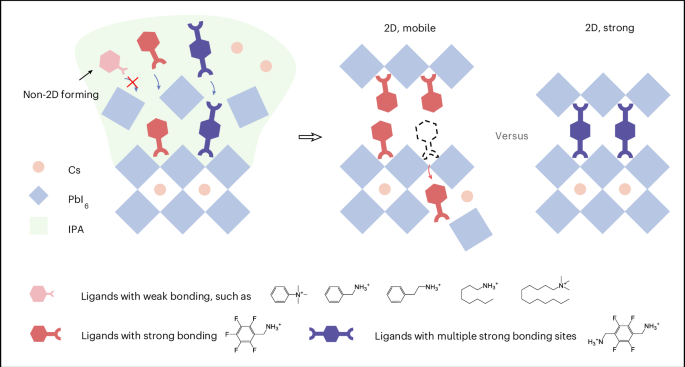
Recognizing the need for both formation and thermal stability, we developed a new molecular design strategy: retain the fluorinated tail to facilitate 2D layer formation, and introduce a second ammonium group to anchor both ends of the molecule to the perovskite lattice. The resulting spacer, (perfluoro-1,4-phenylene)dimethanammonium (tetra-FPDMA), more than doubled the cation desorption energy compared to conventional monoammonium cations. For the first time, we observed a 2D layer on CsPbI3 that not only formed but also remained stable under thermal stress (Fig. 1).
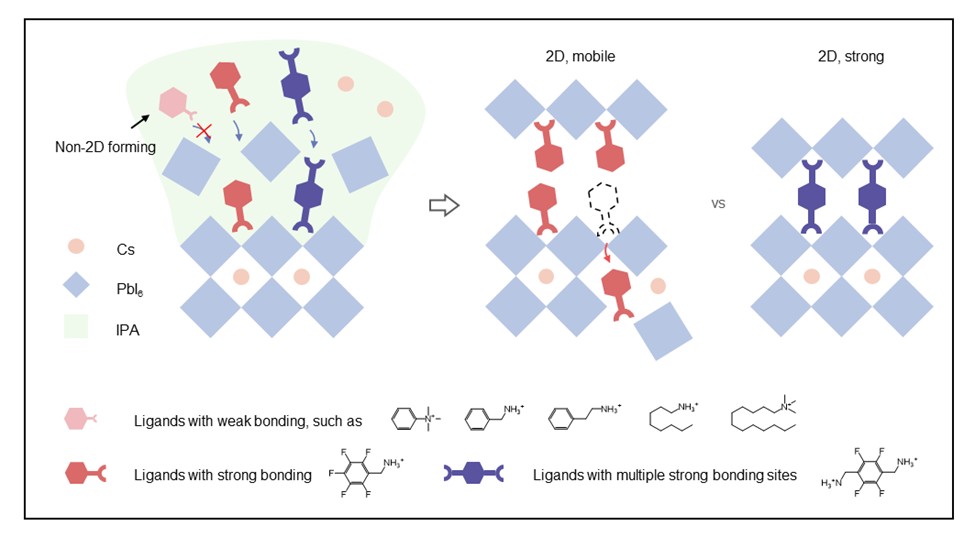
We tested stability through a range of techniques. Time-of-flight secondary ion mass spectrometry analyses showed that the fluorinated dual-anchor molecule remained intact after thermal stress, resisting the migration and breakdown typically seen in conventional 2D layers. Time-dependent photoluminescence further revealed stable surface structure. These offered direct evidence of chemical robustness.
From Devices to Durable Modules
When integrated into real devices, the heterostructure delivered a 21.6% solar power conversion efficiency and 950 hours of stable operation at 85°C under AM1.5G illumination. Even at the module level, 16 cm2 devices maintained 19.8% efficiency, among the highest reported for all-inorganic perovskites.
Looking Ahead
Our findings underscore the importance of molecular and structural anchoring in achieving stable perovskite interfaces. This principle extends to wide-bandgap perovskites, tandem solar cells, and a broad range of optoelectronic systems where effective interfacial passivation is essential for long-term operating stability.
Original link: https://www.nature.com/articles/s41560-025-01817-6
Follow the Topic
-
Nature Energy
Publishing monthly, this journal is dedicated to exploring all aspects of this on-going discussion, from the generation and storage of energy, to its distribution and management, the needs and demands of the different actors, and the impacts that energy technologies and policies have on societies.