Deep learning forecasts when and where microearthquakes do next during fluid injection
Published in Earth & Environment, Materials, and Protocols & Methods





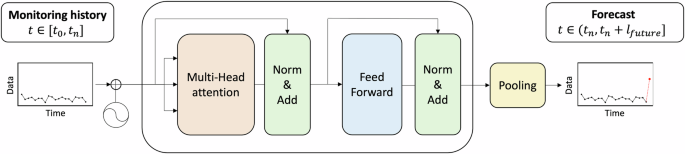

What happens in the 1–30 seconds after we start injecting fluid underground? We built a deep-learning model that uses stimulation history and monitoring data to forecast when and where microearthquakes (MEQs) move next.
Why inject fluids into the subsurface?
You may think this sounds weird—we deliberately inject fluids into the subsurface. But we have been doing this for a long time, and it is essential for sustainable and conventional energy production. For example, in enhanced geothermal systems (EGS), geothermal energy increases with depth, but to produce electricity we need to circulate water, and some geological settings lack sufficient permeability. So we inject water to (1) create fractures and (2) allow water to circulate and extract heat. In this context, MEQ analysis can be used to quantify fracture extent and characteristics, making it an effective tool for real-time monitoring of reservoir stimulation.
Why machine learning?
You may think we can simply run a physics-based simulation to infer when and where microearthquakes are generated. Scientists have developed powerful, sophisticated coupled multiphysics simulators, but field information is often uncertain; we cannot drill the entire subsurface, so knowledge of the domain of interest is limited. For example, only some pre-existing fractures are known, and geomaterials are heterogeneous and anisotropic. Thus, simulations require many assumptions and idealizations, which limit modeling. Meanwhile, we can leverage field monitoring data. A data-driven machine-learning model does not require explicit geological assumptions; it leverages the monitoring data and can complement physics-based simulators by forecasting when and where microearthquakes happen from learned relationships between monitoring data and microseismicity.
A transformer is not only for next-word tokens
Nowadays, we are familiar with large language models (LLMs) such as ChatGPT and Gemini. They are trained to forecast the most probable next word given partial sentences. We use the same intuition for fluid-injection problems: we have sequential data (injection history and MEQs) and we want to forecast future MEQ features. We trained a transformer (the family behind today’s language models) to forecast MEQ behavior 1, 15, and 30 seconds ahead. At each step, it ingests everything up to “now”—the injection history and the MEQ response—and forecasts four targets:
- Cumulative MEQ count
- Cumulative (log) seismic moment (released energy proxy)
- P50 distance (median distance of the MEQ cloud)
- P95 distance (far-edge distance of the MEQ cloud)
Why P50 and P95? P50 highlights where activity is densest—often where permeability is increasing. P95 tracks how far activity is spreading and serves as a boundary indicator. Together, they summarize “how much” and “how far” the cloud migrates. We trained and tested on EGS Collab Experiment 1 at the Sanford Underground Research Facility, a tightly instrumented field experiment with synchronized injection histories and microseismic catalogs.
What we found
We vary the forecasting horizon for our forecasting model to evaluate performance across forecasting lengths. The figure is one example of forecasting spatial MEQ distance for a test dataset (unseen during training).
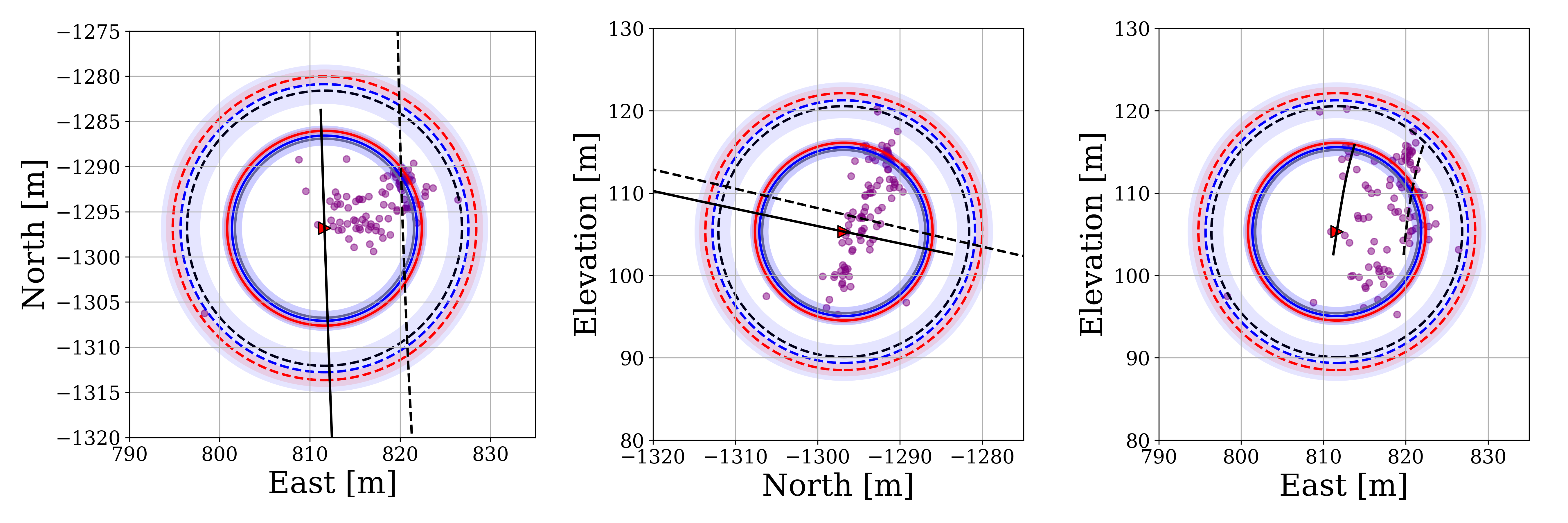
Figure. Spatial evolution of microearthquake (MEQ) clouds and forecast performance (The black solid line is the injection well; the red triangle is the injection point; the dotted line is the production well. Black solid circles are observations from monitoring data; blue and red solid circles are 1-second and 15-second forecasts, respectively. Black, blue, and red dotted circles denote P95 observation, 1-second forecast, and 15-second forecast.)
In short, the model is highly accurate for the next second and remains useful up to 15 seconds.
Why it matters for operations
- Real-time awareness: forecasts of counts and energy help anticipate escalations instead of reacting after the fact.
- Spatial risk analysis: watching P95 warns if activity approaches sensitive boundaries; P50 shows where stimulation is most effective.
Potential and challenges of deep-learning forecasting
In this study, we demonstrate that deep learning can forecast the spatiotemporal evolution of fluid-induced microearthquakes in mesoscale field experiments. Is this the end of the story? Can we apply this to real field-scale injections? We are optimistic, but not yet. This study is a stepping stone, but we need to prove scalability. At field scale, injections and MEQ responses are larger, and monitoring may be sparser. Thus, we need to scale up the architecture and fine-tune it for practical impact—an interesting challenge.
Follow the Topic
-
Communications Earth & Environment
An open access journal from Nature Portfolio that publishes high-quality research, reviews and commentary in the Earth, environmental and planetary sciences.

Related Collections
With Collections, you can get published faster and increase your visibility.
Ecological resistance and resilience under global change
Publishing Model: Open Access
Deadline: Apr 07, 2027
Hazards in Mountain Regions
Publishing Model: Open Access
Deadline: Nov 02, 2026