From “Weak” to “Tingling”: Measuring Just-Noticeable Differences in Whole-Body Vibration


When we design haptic feedback, whether for VR seats, vehicle interiors, simulators, or assistive interfaces, we usually tune physical knobs: vibration level, frequency, modulation rate, bandwidth, decay. But users don’t describe their experience in those units. They say things like “weak,” “tingling,” “up-and-down,” “repetitive,” “even,” or “fading.”
This gap is a practical problem: you can spend hours tuning a parameter and still end up with changes that are too small to notice (wasted effort), or too large (fatigue, annoyance, loss of realism). Our work set out to answer a simple question:
How large must a physical change be before people reliably perceive a change in a specific qualitative whole-body vibration (WBV) attribute?
In other words, we tried to estimate just-noticeable differences (JNDs) for six perceptual attributes of WBV and translate “word-level” sensations into quantitative design thresholds.
The core idea: a JND is the “minimum change that matters”
Think of your phone volume: if you raise it by a tiny amount, you may not notice. Raise it enough, and you clearly do. The smallest step that becomes noticeable is a JND.
We applied the same logic to WBV attributes:
-
For weak, the “knob” is vibration level (in dB sensation level, SL).
-
For tingling or up-and-down, the knob is frequency.
-
For repetitive, it’s modulation frequency (rhythm).
-
For even, it’s bandwidth (how “spread” the vibration energy is).
-
For fading, it’s the decay rate of an impulse-like vibration.
JNDs are not universal. A change that is noticeable for “weak” may be irrelevant for “repetitive.” That’s why we tested each attribute separately.
Experimental setup: one platform, two “engines” for vibration
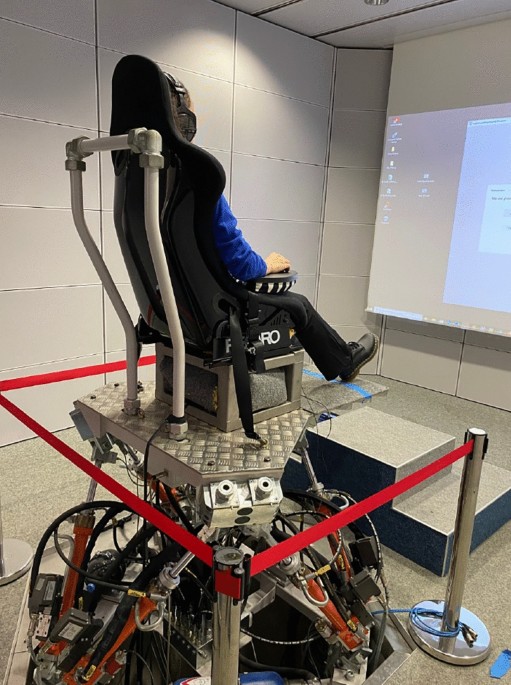
The measurements were performed in the Multimodal Measurement Laboratory (MMM) at TU Dresden, using:
-
A 6-degree-of-freedom hydraulic motion platform for low-frequency WBV (roughly 1–9 Hz).
-
An electrodynamic shaker for higher frequencies (> 9 Hz).
Participants sat in a Recaro racing seat and received vibration through the platform/shaker combination. The hardware matters because WBV spans a wide frequency range; you typically can’t cover 1 Hz to hundreds of Hz with one actuator without compromises.
A “slow heave” sensation around 2–5 Hz feels like whole-body movement, while 100–300 Hz can feel more like fine texture or buzzing. Treating both with the same actuator often changes the sensation in unintended ways.
Task design: magnitude estimation anchored to a reference
We used a magnitude estimation paradigm (classic psychophysics):
-
For each attribute, participants first experienced a reference stimulus and were told: “This is 100 points for this attribute.”
-
Then they experienced test stimuli where one physical parameter was changed stepwise around the reference.
-
They rated each test stimulus relative to the reference.
The study was run across six short sessions to keep attention stable. Each participant evaluated 66 distinct test stimuli, each compared to its reference, with two repetitions, totaling 1342 trials.
If the attribute is weak, and the reference is “18 dB SL = 100 points,” a test at 16 dB SL might feel weaker, so a participant might rate it “70.” A test at 22 dB SL might feel stronger, rated “140.”
How we estimated JND “regions” (not just single numbers)
Human ratings are noisy, so we didn’t assume normal distributions. Instead, we analyzed paired differences using the Wilcoxon signed-rank test.
-
Null hypothesis: the test stimulus is not perceptually different from the reference.
-
We defined the JND region as the range of stimulus values around the reference where the null hypothesis could not be rejected (p > 0.05).
-
The reported JND values are essentially bounds: the first stimulus step outside that region that became significantly different (p < 0.05).
In several cases, the “true” threshold may be smaller than the step sizes we tested, so the reported thresholds should be read as estimated ranges / upper limits given the tested grid.
What we found: six attributes, six distinct sensitivities
1) “Weak” → a consistent level threshold
Across tested reference levels, the JND in level for the weak attribute was consistently about ±2 dB (in SL).
If you want users to reliably perceive something as “weaker” or “stronger,” steps smaller than ~2 dB are likely to be subtle or inconsistent.In a VR driving seat, if you reduce the vibration level by 1 dB to represent “less road roughness,” many users may not notice. A 2–3 dB change is more defensible.
2) “Tingling” → frequency changes need to be fairly large (at high reference)
For tingling, tested with sinusoidal vibrations in the 100–300 Hz range, we found a lower frequency threshold of roughly 10–20 Hz around a 120 Hz reference.
To create a clearly different “tingling” sensation by frequency shift alone, you may need shifts on the order of tens of Hz in that region. If a haptic seat uses 120 Hz as a “tingling” cue, shifting to 125 Hz may not stand out. Shifting toward 140 Hz is more likely to be perceived as different.
3) “Up-and-down” → very low frequencies show high sensitivity
For up-and-down (sinusoidal WBV in 12–100 Hz), a notable result was a lower frequency threshold ≤ 5 Hz around a 30 Hz reference.
At some lower reference frequencies, users can detect relatively small frequency drops. If you use ~30 Hz to create a “bouncing” sensation, lowering to 26–25 Hz could be enough for many people to feel it as different (more “slow heave”-like).
4) “Repetitive” → rhythm sensitivity depends strongly on reference
For amplitude-modulated stimuli (carrier around 50 Hz), the key knob was modulation frequency (2–10 Hz). Around a 2.4 Hz reference, the lower modulation-frequency threshold was about 0.2–0.4 Hz.
If you are designing rhythmic tactons, the detectable step size in rhythm can be a few tenths of a Hz, but it’s not constant across references. Sensitivity changes with the base rhythm. A pulse-like “heartbeat” cue at 2.4 Hz (≈144 bpm) would need a change of ~0.3–0.4 Hz to reliably feel “faster/slower” as repetitive, rather than just “similar.”
5) “Even” → bandwidth thresholds around a narrowband reference
For even, we used narrowband noise centered around 50 Hz, varying the bandwidth. Around a 3 Hz bandwidth reference, the estimated lower bandwidth threshold was roughly 1–2 Hz.
If your goal is “evenness” (less tonal, more spread), you need meaningful bandwidth changes, tiny bandwidth tweaks may not be perceptually obvious. In a seat cue meant to feel “smooth/even,” widening the band from 3 Hz to 4 Hz might be marginal; 3 Hz to 5 Hz is more likely to matter.
6) “Fading” → decay-rate changes need to be sizable
For fading, based on impulse-like stimuli with variable decay rate δ, we found a threshold around Δδ ≤ 0.5 at a δ = 0.5 reference (and additional tested references).
To make “fading” perceptibly different, the decay envelope must change enough, especially if the reference already fades quickly. If a haptic “notification thump” fades with δ = 0.5, changing it to δ = 0.7 may be subtle; changing it to ~1.0 is more likely to be noticed as less “fading.”
Limitations and next steps
This study used N = 11 participants (with an imbalanced gender distribution). That’s enough to reveal clear trends, but it’s not the final word on population variability. Also, the thresholds are linked to the tested stimulus grid, finer parameter steps could refine several bounds.
Closing thought
If you build haptic experiences, you want changes that are perceptible, meaningful, and efficient. Estimating attribute, specific JND ranges is one way to stop guessing and start designing with human limits in mind, so that “weak,” “tingling,” or “fading” becomes something you can reliably dial in.

Follow the Topic
-
Scientific Reports
An open access journal publishing original research from across all areas of the natural sciences, psychology, medicine and engineering.

Related Collections
With Collections, you can get published faster and increase your visibility.
Cancer Prevention and Control
Publishing Model: Hybrid
Deadline: Feb 19, 2027
Healthy Aging
Publishing Model: Open Access
Deadline: Dec 31, 2026