Highlights from Humanities and Social Sciences Communities in April and May 2025
Published in Social Sciences, Behavioural Sciences & Psychology, and Arts & Humanities

Research Communities is where research meets real-world experience, sparks curiosity, and opens new conversations. This April and May, blog posts from the Behavioural Sciences & Psychology, and Arts & Humanities Communities explored everything from how chimpanzees learn to how children grieve online. Whether you're a researcher in related areas or simply curious about the human stories behind science, this round-up compiles fresh perspectives on human behaviour, societal challenges, and interdisciplinary insight.
A peek into chimpanzees' "schoolyards"
@Oscar Nodé-Langlois
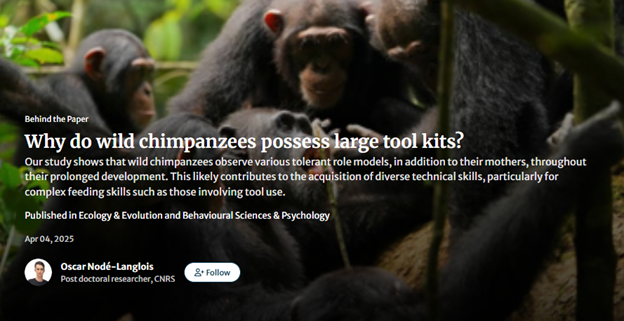
Oscar Nodé-Langlois highlights in a blog post that wild chimpanzees from the Taï forest develop complex tool-use skills, such as nut-cracking, through prolonged social learning – a finding published in Communications Biology. By tracking 35 chimpanzees aged 0 to 10 years, researchers found juveniles observe not only mothers but also tolerant older experts across a 10-year developmental window. This apprenticeship-like system, driven by social tolerance and access to diverse role models, mirrors human childhood learning. These elements may have played a crucial role in human evolution. Dive into the full blog post here.
“Honest liars” in Congress
@Stephan Lewandowsky
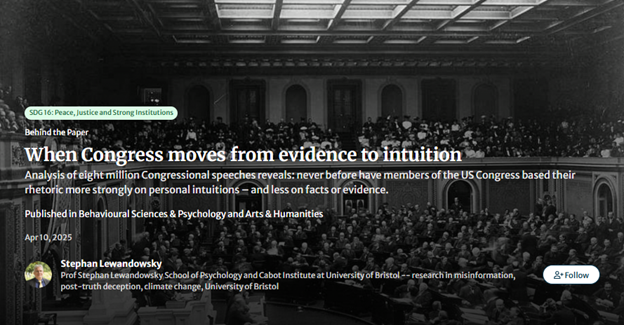
Did you know politicians can be “honest” while spreading misinformation? This Behind the Paper blog post based on a study recently published in Nature Human Behaviour dives into a paradox: despite making over 30,000 false claims, 75% of Republican voters considered Trump “honest.” Researchers analyzed 8 million Congressional speeches since 1879 and found politicians increasingly swap evidence for phrases like “I feel” or “I believe”. Politicians' reliance on instinct over evidence sparks a chain reaction: stalled legislation, deeper political divides, and a measurable rise in societal inequity. Explore the full blog post written by Stephan Lewandowsky.
What do envy and jealousy have to do with mass murder?
@Keith Minihane
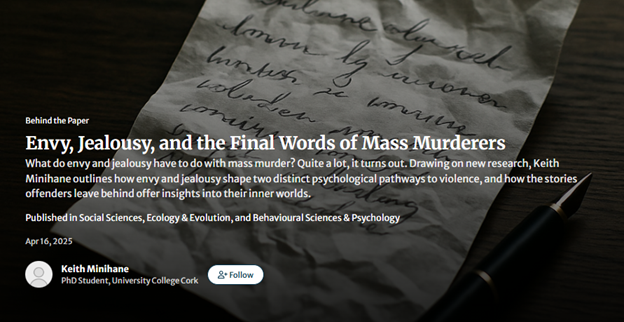
This Behind the Paper post explores the emotional and psychological roots of mass violence through the final writings – “legacy tokens” – left by offenders. Based on a recent study published in Journal of Police and Criminal Psychology, the blog post introduces two distinct profiles: “envy”-type offenders, often younger and status-deprived, who seek recognition and fame; and “jealousy”-type offenders, typically older and socially collapsing, who express regret and seek control. Their legacy tokens, from godlike manifestos to apologies, show their inner world – seeking for meaning, belonging, and attention. Read the full blog here written by Keith Minihane.
Supporting kids in loss
@Amy Joint
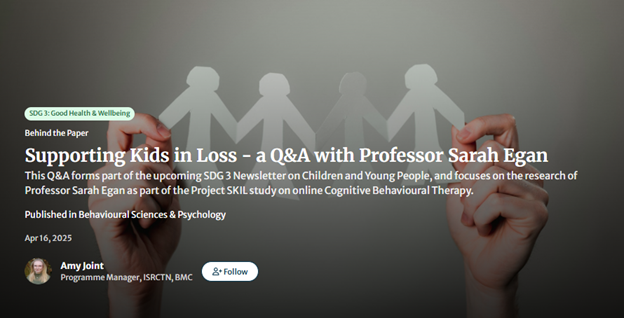
This Q&A highlights Project SKIL, a new study on online Cognitive Behavioural Therapy for grief in children, recently published in the ISRCTN registry. Professor Sarah Egan explains how the programme supports children aged 6–12 dealing with bereavement or other forms of loss such as divorce through engaging, self-guided modules designed with input from young people themselves. Read the full Q&A here to explore a valuable contribution to SDG3 on mental health and well-being. This blog aligns with Mental Health awareness week (12–18th May 2025). Find celebration of this week and blogs on this topic, and more relevant blogs in SDG 3: Good Health & Wellbeing page on the Communities.
Volcano Voices: Co-Creating Memory Through Art at Fuego
@Ailsa Katharine Naismith
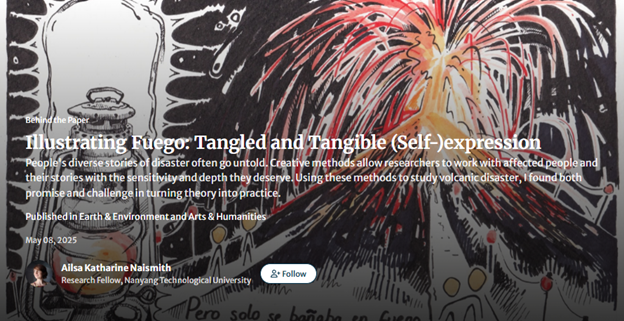
In this arts-based study published in the Journal of Applied Volcanology, researcher-artist Ailsa Katharine Naismith co-created a zine with Guatemalan communities affected by the Fuego volcano. In this blog, Ailsa introduced how illustration can sensitively express untold disaster experiences through interviews and participatory workshops. The project highlights both the power and complexity of combining creative methods with participatory research. Read the full blog.
When do babies start walking?
@Angelica Ronald
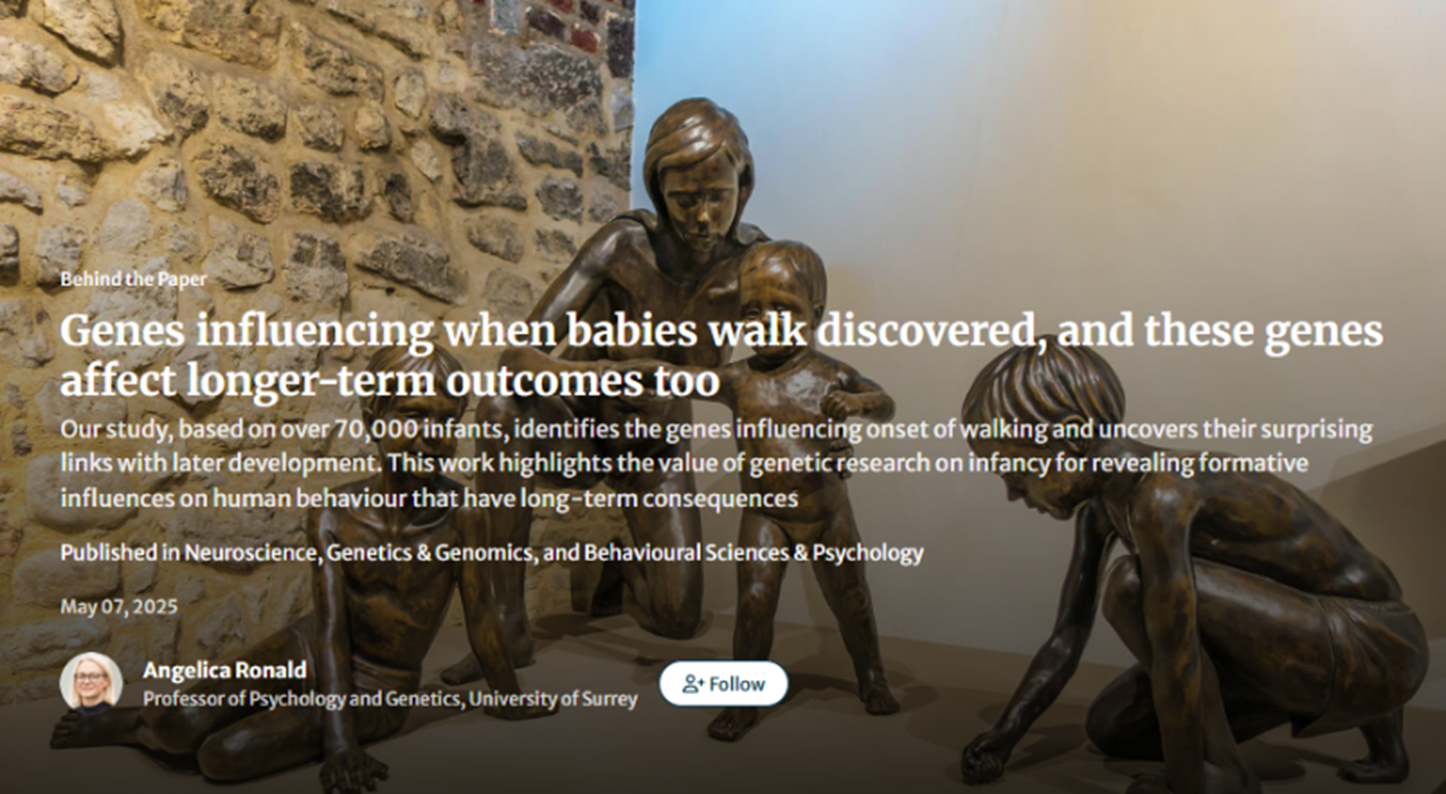
This blog post takes you behind the paper recently published in Nature Human Behaviour, exploring how genetics influence when infants begin to walk. The study reveals that genes active in brain regions controlling motor function are linked to the timing of walking and show a genetic correlation with ADHD risk. Interestingly, a genetic tendency toward later walking associates with a lower risk of ADHD, which in turn relates to better educational outcomes. Drawing on data from over 70,000 infants spanning nearly 80 years, this research uncovers complex genetic connections between early motor milestones and later development. Read the full blog to find a message for parents and what’s next for science.
We’d love to hear what inspired you — leave a comment, like your favourite posts, and share them with others who may be interested. You could also take the survey below to share your thoughts!
These blog posts offer just a glimpse into the thought-provoking research being shared across Research Communities. Explore more pieces, there’s always more to discover and discuss.
Further reading:
If you have any questions, get in touch with the team at communities@springernature.com

Supporting Humanities and Social Sciences research area on the Research Communities platform. I’d love to hear from you and connect!
Follow the Topic
-
Communications Biology
An open access journal from Nature Portfolio publishing high-quality research, reviews and commentary in all areas of the biological sciences, representing significant advances and bringing new biological insight to a specialized area of research.
-
Journal of Police and Criminal Psychology
The Journal of Police and Criminal Psychology covers the theory, practice and application of psychological principles in criminal justice, particularly law enforcement, courts, and corrections.
-
Nature Human Behaviour
Drawing from a broad spectrum of social, biological, health, and physical science disciplines, this journal publishes research of outstanding significance into any aspect of individual or collective human behaviour.
-
ISRCTN: The UK’s Clinical Study Registry
A primary clinical trial registry recognised by WHO and ICMJE that accepts studies involving human subjects or populations with outcome measures assessing effects on human health and well-being, including studies in healthcare, social care, education, workplace safety and economic development.
-
Journal of Applied Volcanology
This is an international journal with a focus on applied research relating to volcanism and particularly its societal impacts. Characterising volcanic impacts and associated risk relies on not only quantifying physical threat but also understanding social and physical vulnerability and resilience.





Related Collections
With Collections, you can get published faster and increase your visibility.
Data Visualization and Effective Communication in Volcanology: Cross-disciplinary Lessons from Research and Practice
Journal of Applied Volcanology is calling for submissions to our Collection on Data Visualization and Effective Communication in Volcanology: Cross-disciplinary Lessons from Research and Practice.
This collection will highlight effective approaches for visualising and communicating volcanic information: from monitoring data to hazard model outputs, through to risk, impact, vulnerability information, and more.
Effective communication of technical information is critical to enhance the understanding of a volcano’s history, status, or forecast, and is vital for effective risk management. However, it is important not just to consider the aesthetic qualities of visual displays, we must consider how our visualisation and communication choices impact people’s responses to information, including how it may affect their decision performance. The effective display of critical information also impacts trust in the information, and the source of the information, particularly when uncertainty is present. Lessons for effective communication and visualisation can be drawn from numerous fields, including design science, UX, psychology, communication studies, informatics, GIS, data science, etc. Factors that can influence interpretation and use of visualisations include aspects such as volume, colour, graphics, symbology, uncertainty, and integration of local and cultural knowledge. Additionally, with the growth of big data, both AI and deep learning present opportunities and risks in the visualisation and use of complex volcanic information.
In this special collection, we welcome submissions on a range of topics exploring effective information visualisation, considering the full spectrum of approaches to displaying complex science: ranging from effective maps and displays of spatial and three- or four-dimensional information, through to the use of symbology and information products for non-technical users, and beyond. We are interested in papers presenting research studies, case studies, and literature reviews, including evidence for best practice, techniques to identify and evaluate user needs and preferences, evaluation methods, software for visualisation and management of big data, and other topics that support effective communication.
Prior abstract submissions are not necessary, however the Guest Editors welcome authors to discuss ideas they may have for manuscripts prior to submission. Springer Nature offers several options for open access fee support, these include institutional open access agreements, reduced fees via waivers for corresponding authors based in lower income countries (as defined by the World Bank), and case-by-case waivers or discounts based on financial need. The Journal of Applied Volcanology also has a limited number of partial and full fee waivers that can be assessed on a case-by-case basis based on need. If you are interested in applying, please indicate your interest at the point of manuscript submission and outline your case in your submission letter. More information can be found here.
We also invite applications to join the guest editor team for this special collection. If interested, please contact the Editor-in-Chief, Emma Hudson-Doyle.
This Collection supports and amplifies research related to SDG 11: Sustainable Cities & Communities and SDG 13: Climate Action.
Publishing Model: Open Access
Deadline: Ongoing
Hazard Maps
Publishing Model: Open Access
Deadline: Ongoing