 SpringerLink
How Good Are Drought Forecasts? Skill of multi-model Seasonal Forecast of Meteorological Droughts in a semi-arid Mediterranean Basin - Earth Systems and Environment
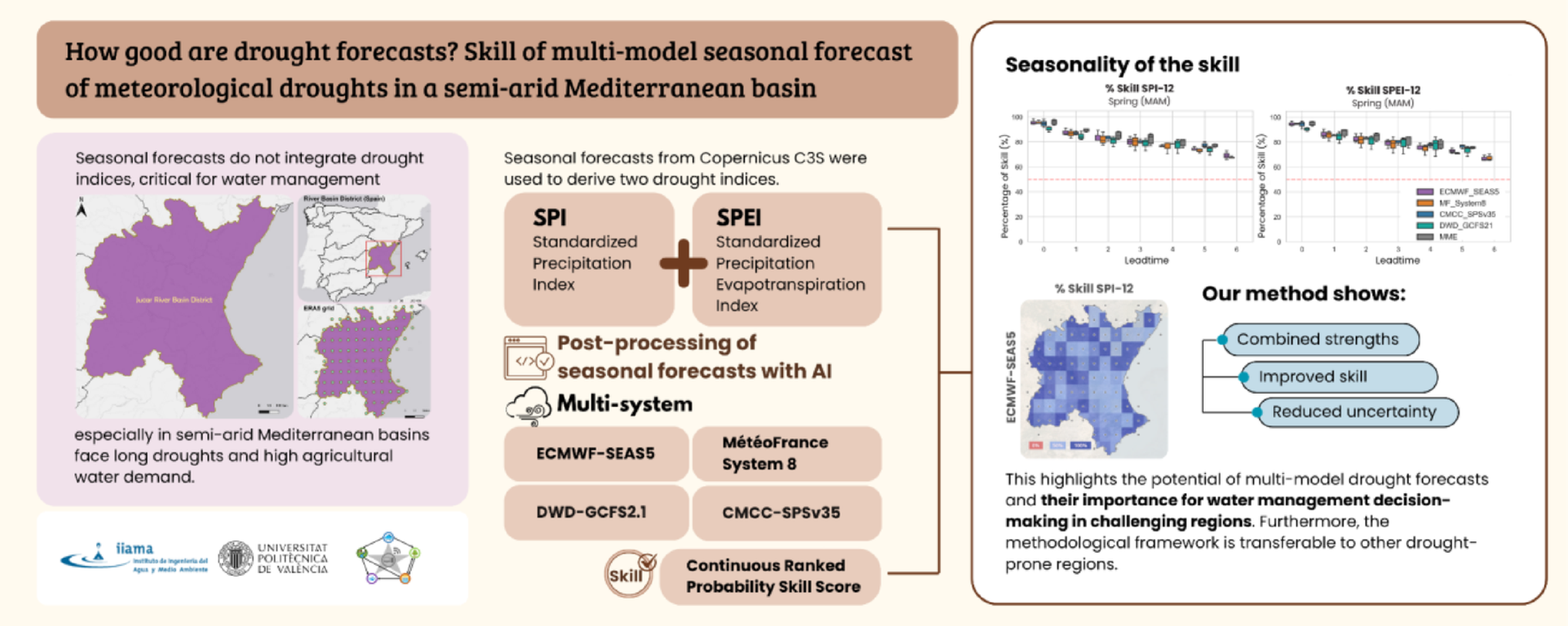
Droughts pose a significant challenge to water management, particularly in semi-arid regions with high water demand. In this context, drought indices have proven to be valuable tools for enhancing drought awareness and decision-making, as they provide critical information for water resource management. However, their integration with seasonal forecasts remains underexplored. Most currently operational drought forecasting and early warning services either do not incorporate indices or are limited to using a small subset of them. In this study, we present a multi-model seasonal forecasting system for meteorological drought indices, integrating forecasts from four systems (ECMWF-SEAS5, Météo-France System8, DWD-GCFS2.1, and CMCC-SPSv3.5) available through the Copernicus Climate Change Service (C3S) with ERA5 reanalysis for post-processing with artificial intelligence. Evaluated over the 1995–2014 hindcasts period. The system computes two widely used drought indices, SPI and SPEI, at multiple aggregation scales (6, 12, 18, and 24 months). Forecast skill is evaluated using the Continuous Ranked Probability Skill Score (CRPSS), shows high skill, with values around 90% at one lead month and remaining above 64% and 67% at three lead months for SPI-6 and SPEI-6, respectively. Longer aggregations retain useful skill up to five lead months. The methodology is applied to the Jucar River Basin (Spain), a representative semi-arid Mediterranean basin characterized by recurrent and severe droughts. Results highlight the potential of multi-model seasonal forecasts for supporting drought early warning and water management. An operational web-based implementation further demonstrates the system’s applicability for decision-making, although the methodological framework is transferable to other drought-prone regions. Graphical Abstract Graphical abstract description The graphical abstract provides an overview of the study showing the integration of seasonal drought forecasts and their skill in the Jucar River Basin, a semi-arid Mediterranean region in Spain, characterized by high water demand. We used meteorological forecasts from the global products of the Copernicus Climate Service (C3S), post-processing with artificial intelligence, to generate the drought indices SPI and SPEI based on historical distribution functions. The analysis included four seasonal forecasting systems from C3S (ECMWF-SEAS5, MétéoFrance System8, DWD-GCFS2.1, CMCC-SPSv3.5 and MME), and we evaluated forecast reliability using the Continuous Ranked Probability Skill Score (CRPSS). Results for the spring season show that SPI-12 and SPEI-12 forecasts achieve skill of up to five lead months, with spatial maps highlighting areas of higher skill in blue and lower skill in lighter or pink shades. Overall, the combined use of SPI and SPEI strengthens the model, the multi-model approach performs robustly across different temporal scales, and the proposed methodology provides a transferable tool for environmental, water, and risk management in semi-arid regions.



Please sign in or register for FREE
If you are a registered user on Research Communities by Springer Nature, please sign in