When a borehole becomes a stress sensor
Published in Social Sciences, Earth & Environment, and Civil Engineering
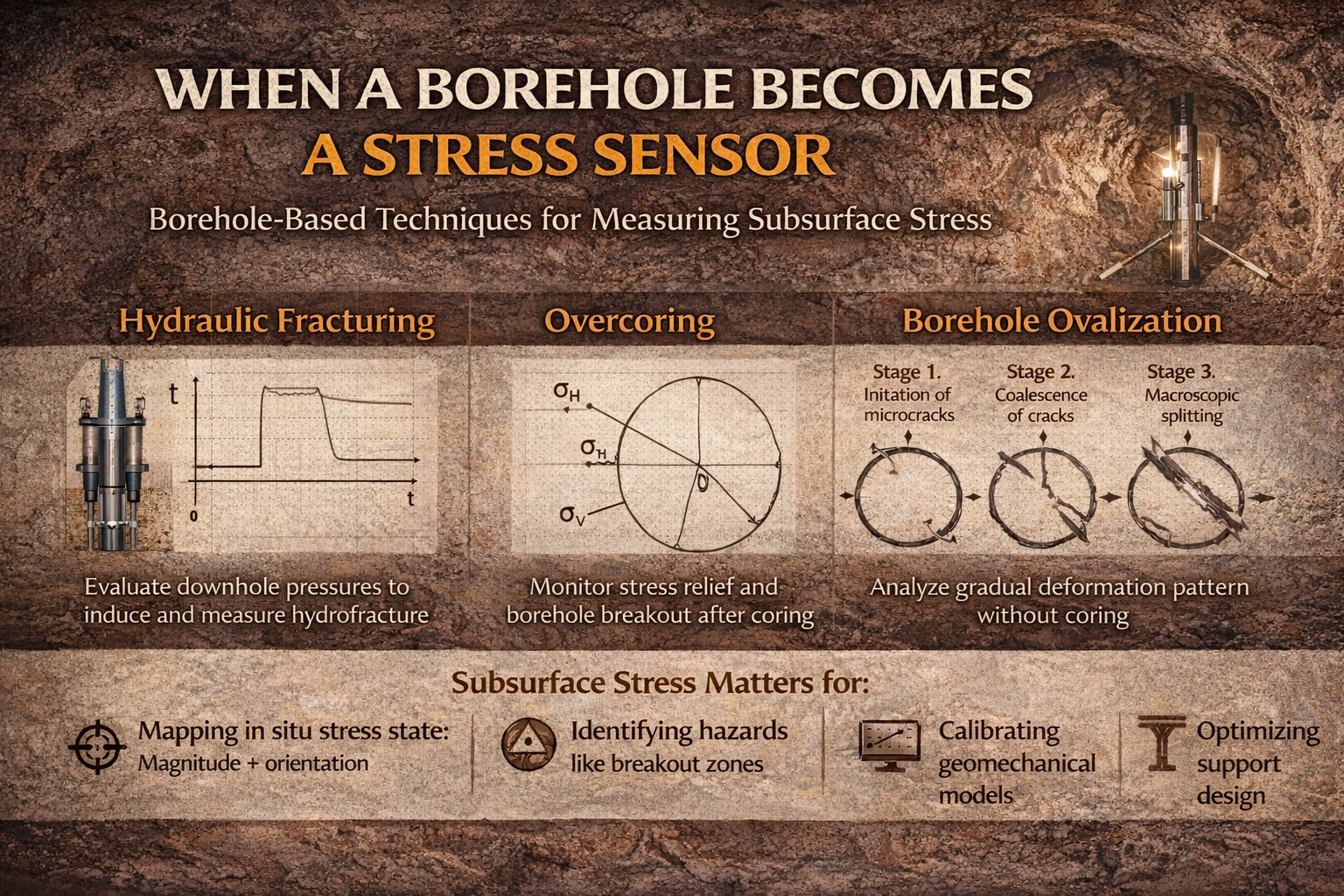

A simpler way to estimate in-situ stresses underground
Measuring the natural stress field underground is one of the most difficult and expensive tasks in geotechnical engineering. Yet every tunnel, shaft or deep excavation depends on knowing it.
Traditionally, the reference method has been hydraulic fracturing. It is direct and reliable, but also slow, costly, and operationally complex.
Our recent work explores a simpler question:
What if the borehole itself already contains the answer?
Full article:
https://doi.org/10.1007/s44290-024-00036-4
Reading stress from deformation
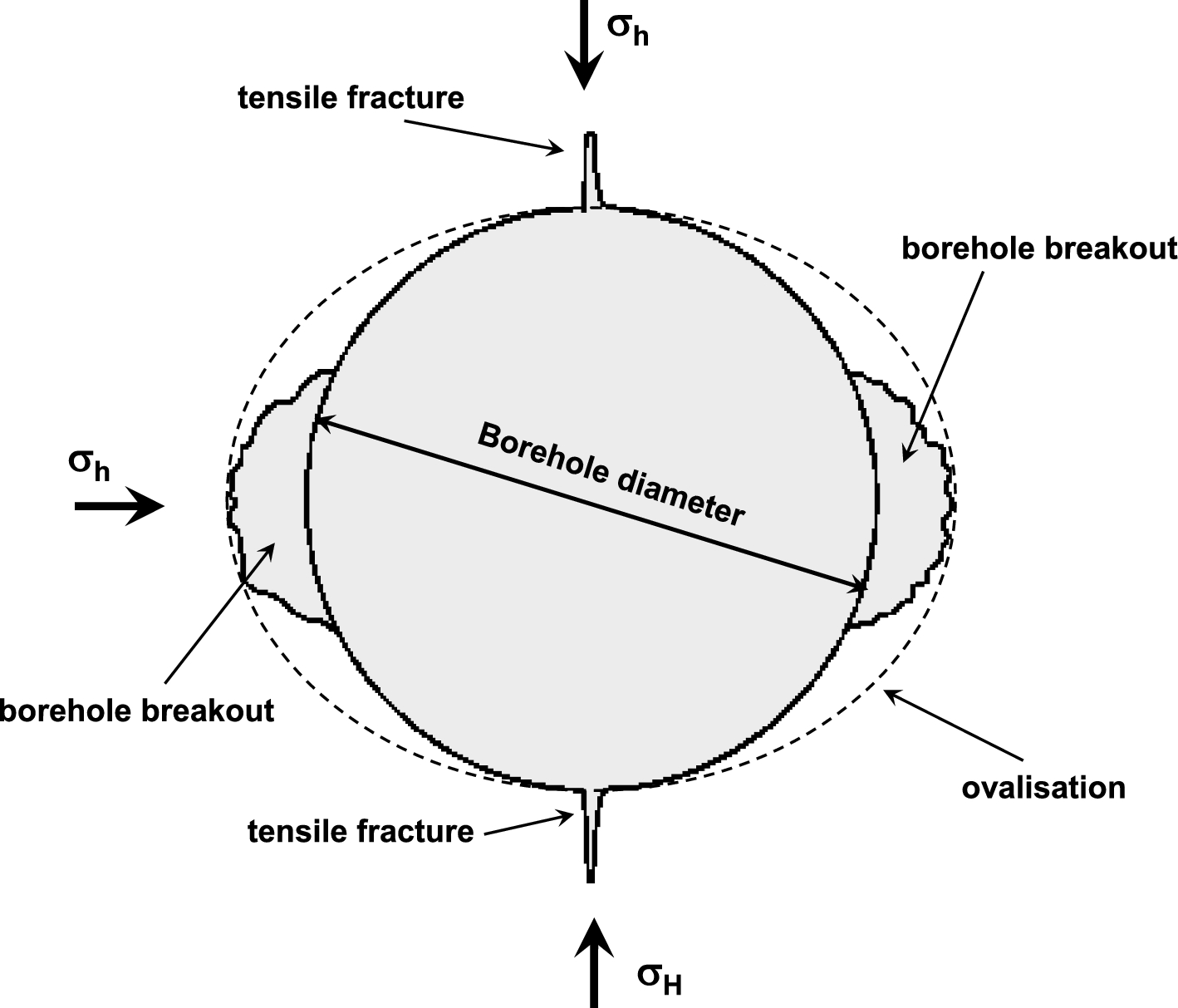
When stresses concentrate around a drilled hole, the circular section rarely stays circular. The borehole subtly flattens, developing breakouts and an oval shape aligned with the stress field.
This deformation is not random.
Decades of rock mechanics show that:
• elongation develops perpendicular to the minimum horizontal stress
• breakout width reflects stress concentration
• geometry encodes both orientation and magnitude
Instead of forcing the rock to fracture, we can simply measure this geometry.
Using six-arm calipers and televiewer logs, we reconstructed the borehole cross-sections and calculated:
• stress orientation
• σH/σh ratios
• horizontal stress magnitudes
All from shape alone.
Does it really work?
The key test was comparison with hydrofracturing profiles.
Across several argillaceous formations in Spain, the results showed:
• very close agreement in stress orientation
• consistent estimates of stress ratios
• reasonable magnitudes when cohesion is well constrained
In some cases, predicted directions differed by only a few degrees from hydrofrac measurements.
This is important.
Because hydraulic fracturing remains the gold standard, but it is also:
• expensive
• time-consuming
• dependent on fracture-free intervals
• difficult at depth
Ovalization analysis, by contrast, uses logging data already collected in most boreholes.
Where it performs best
The method is not universal.
Our results indicate it works best when:
• boreholes are deep enough for clear breakout development
• rock mass cohesion is known from laboratory tests
• multiple sections are analysed, not single intervals
• high-quality caliper or televiewer tools are used
Under those conditions, the borehole effectively becomes a passive stress sensor.
No injection. No packers. No induced fractures.
Just geometry.
Why this matters for engineering
For tunnels, mines and underground works, stress estimation is often limited by budget and logistics.
A method that is:
• faster
• cheaper
• minimally invasive
• and still reliable
can change practice.
Ovalization analysis will not replace hydrofracturing everywhere. But it can significantly reduce the number of tests required and provide continuous stress information along the borehole.
In many projects, that trade-off is decisive.
A broader perspective
There is also a conceptual lesson.
Sometimes the most useful measurements are already embedded in the system.
Instead of adding complexity, we can learn to interpret what the ground is already telling us.
In this case, a small deviation from circularity becomes a map of the underground stress field.
And a borehole becomes an instrument.

Follow the Topic
-
Discover Civil Engineering
This is a fully open access, peer-reviewed journal that supports multidisciplinary research and policy developments across the field of civil engineering.

Related Collections
With Collections, you can get published faster and increase your visibility.
Resilient Urban Transportation Systems: Planning, Design, Governance, and Technological Innovation
Urban transportation systems are critical components of modern cities, facilitating mobility and access while contributing to economic vitality. However, these systems face significant challenges, including climate change, population growth, and increasing urbanization, which can compromise their resilience and efficiency. As cities evolve, there is a pressing need to rethink transportation planning, design, and governance frameworks to better adapt to these challenges. Emphasizing resilience in urban transportation is essential to ensure that systems can withstand disruptions and continue to function effectively in the face of unforeseen events.
The purpose of this Collection is to provide a scholarly platform for exploring the multifaceted dimensions of resilient urban transportation systems.
Topics of interest include:
- Smart mobility and intelligent transport systems for adaptive and disruption-responsive urban movement.
- Policy and governance frameworks that promote sustainable, inclusive, and resilient mobility.
- Transportation equity and accessibility during public emergencies and urban disruptions.
- GIS and data-driven vulnerability assessment for transport infrastructure risk mitigation.
- Multi-modal transport planning integrating public transit, cycling, walking, and other sustainable modes to enhance network robustness.
- Climate-resilient transport infrastructure, including design and material innovations for roads, bridges, and transit systems under extreme weather and long-term climate change.
- Disaster preparedness and recovery frameworks for rapid restoration of mobility and logistics networks.
- Energy transition in urban transport, including electric mobility, renewable charging infrastructure, and low-carbon systems.
- Digital twins and predictive simulation for evaluating transport system performance under disruption scenarios.
- Resilient urban logistics and freight systems, including last-mile delivery during crises.
- AI and predictive analytics for incident management, including real-time monitoring and response.
- Safety and security in transport systems, addressing physical, digital, and cyber resilience.
This Collection supports and amplifies research related to: SDG 9 and SDG 11.
Keywords: Urban transport resilience; climate adaptation; intelligent transport systems; multi-modal networks; GIS and data analytics; transport equity; sustainable mobility; emergency response; digital twins; resilient logistics.
Publishing Model: Open Access
Deadline: Dec 23, 2026
Waste-Based and Sustainable Concrete Materials: Performance and Structural Applications
The construction industry is under increasing pressure to reduce its environmental impact while maintaining the safety, durability, and performance of civil infrastructure. In this context, waste-based and sustainable concrete materials have emerged as promising alternatives to conventional concrete through the incorporation of recycled aggregates, industrial by-products, agricultural wastes, supplementary cementitious materials, and other environmentally friendly constituents.
This Topical Collection aims to provide a focused platform for recent advances in the development, characterization, and application of waste-based and sustainable concrete materials. Particular emphasis is placed on material design, mechanical properties, durability performance, microstructural behavior, structural response, and practical applications in sustainable construction.
The Collection welcomes original research articles and review papers addressing experimental investigations, numerical modeling, performance assessment, durability evaluation, life-cycle considerations, and structural applications of sustainable concrete materials. Topics may include, but are not limited to, recycled aggregate concrete, waste ceramic concrete, fiber-reinforced sustainable concrete, geopolymer and alkali-activated materials, supplementary cementitious materials, low-carbon binders, durability under aggressive environments, structural strengthening, and performance-based design of sustainable concrete elements.
By bringing together contributions from researchers worldwide, this Collection seeks to advance knowledge on environmentally responsible and high-performance concrete technologies and to support the development of resilient, durable, and sustainable civil infrastructure.
This Collection supports and amplifies research related to SDG 9, and SDG 11.
Keywords: Sustainable Concrete, Fiber-Reinforced Concrete, Waste Materials, Recycled Aggregates, Cementitious Composites, Durability, Mechanical Performance, Structural Applications, Sustainable Construction, Advanced Concrete Materials
Publishing Model: Open Access
Deadline: Apr 30, 2027