POC1A promotes the proliferation, metastasis and stemness of bladder cancer by stabilizing BMI1 via USP7
Published in Cancer and Cell & Molecular Biology


The aggressive behavior of bladder cancer (BLCA) is driven by uncontrolled proliferation, distant metastasis, and stemness maintenance, yet the underlying mechanisms remain poorly understood[1, 2]. Elucidating these mechanisms is critical for developing novel targeted therapies and precision treatment strategies.
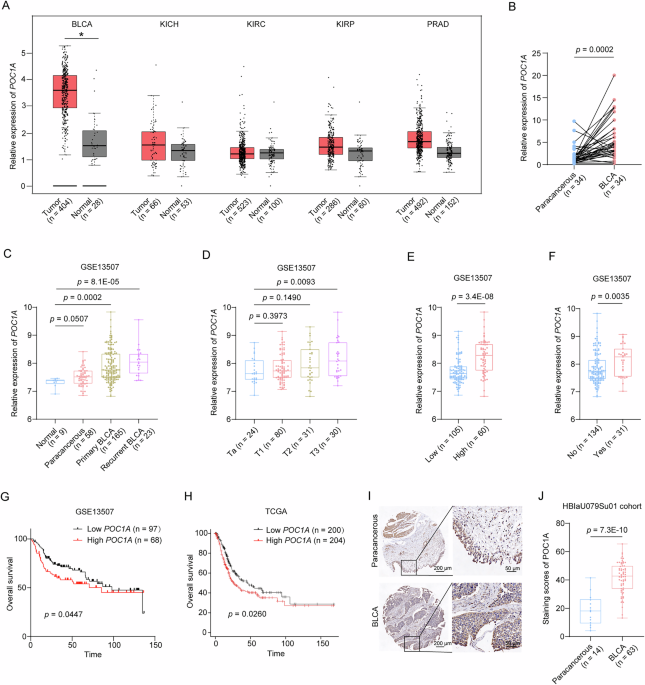
By integrating our in-house sequencing data with the TCGA database and three GEO datasets, and querying the GEPIA platform, we identified eight genes (RECQL4, POC1A, CENPA, NEK2, HJURP, KIF2C, KIF11, and DLGAP5) that were specifically overexpressed in BLCA. Among these, all except POC1A have been previously linked to BLCA, with DLGAP5, HJURP, and CENPA having been reported by our group[3-5]. This prompted us to focus on the functional role of POC1A in BLCA progression.
Clinically, POC1A was significantly elevated in BLCA tissues, positively correlating with tumor stage, grade, and progression while inversely correlating with overall survival. These findings suggest POC1A may be a critical determinant of BLCA progression.
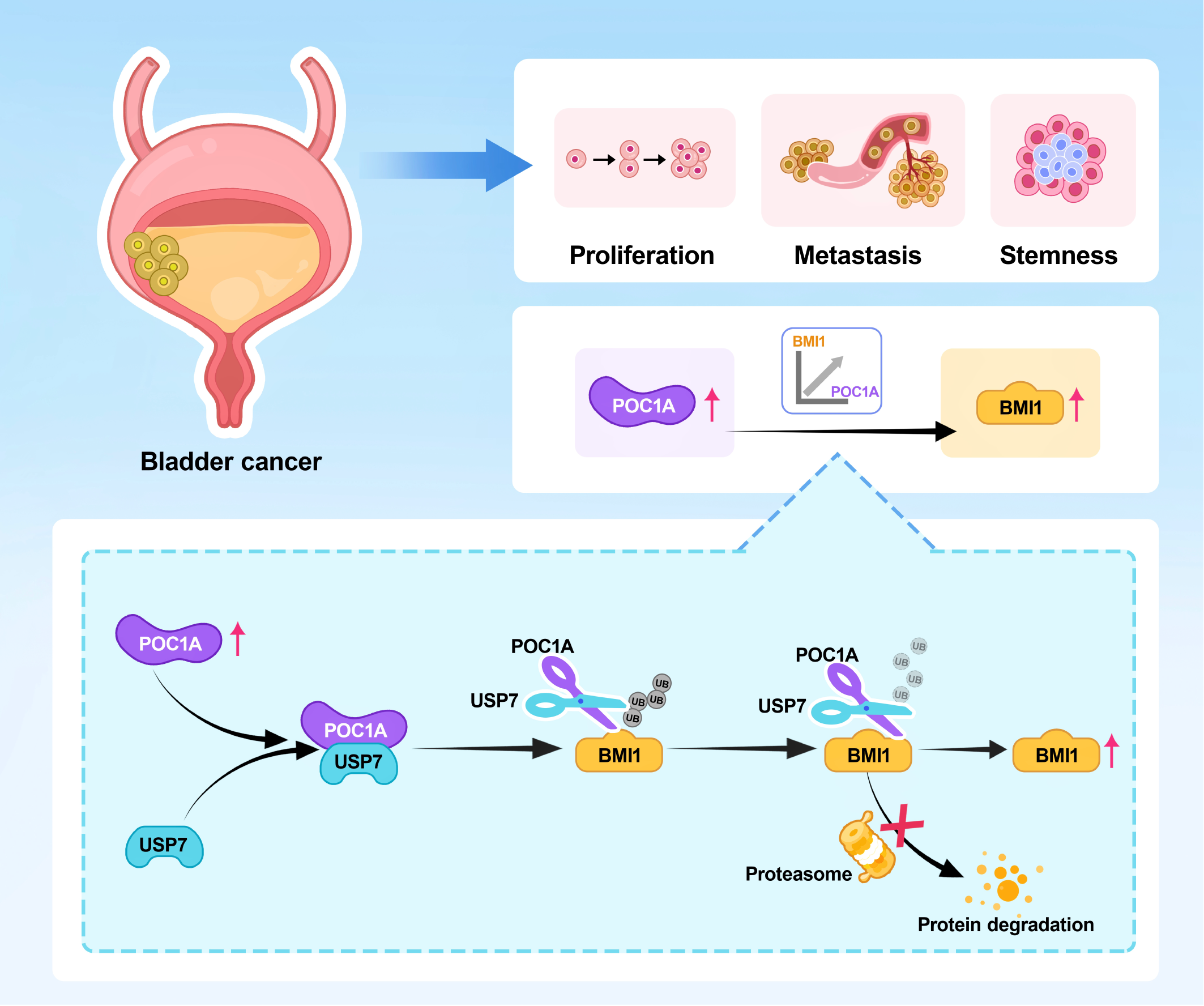
Mechanistically, POC1A acts as a molecular scaffold that bridges USP7 and BMI1, enhancing USP7-mediated deubiquitination of BMI1 and thereby stabilizing BMI1 protein. This represents a novel post-translational mechanism underlying BMI1 overexpression in BLCA. Based on these regulatory mechanisms, we further performed in vivo and in vitro experiments and validated that BMI1 and USP7 were crucial for POC1A-mediated regulation of BLCA proliferation, metastasis, and stemness.
To explore the translational potential of this complex, we turned to Unesbulin, a BMI1 inhibitor with favorable cellular permeability and BMI1-degrading activity[6]. Given that POC1A itself currently lacks small-molecule inhibitors, targeting its downstream effector BMI1 represents a viable therapeutic strategy. Across multiple BLCA cell lines, xenograft models, and patient-derived conditionally reprogrammed cells (CRCs), Unesbulin consistently suppressed BLCA growth both in vitro and in vivo.
In summary, our study reveals that POC1A drives BLCA progression by scaffolding the USP7-BMI1 interaction, leading to BMI1 deubiquitination and stabilization, which in turn promotes proliferation, metastasis, and stemness. We further validate Unesbulin as a promising therapeutic candidate and highlight the POC1A-USP7-BMI1 complex as an actionable target in BLCA.
Dr. Gang Wang, Dr. Yu Xiao, and Dr. Yi Zhang are the corresponding authors of this paper, with Dr. Houyi Wei, Dr. Renran Bai, and Dr. Jianmin Liu serving as co-first authors.
References:
[1] Hanahan D. Hallmarks of Cancer: New Dimensions. Cancer Discov 2022; 12: 31-46.
[2] Loh JJ, Ma S. Hallmarks of cancer stemness. Cell Stem Cell 2024; 31: 617-639.
[3] Zhou F, Deng Z, Shen D, Lu M, Li M, Yu J et al. DLGAP5 triggers proliferation and metastasis of bladder cancer by stabilizing E2F1 via USP11. Oncogene 2024; 43: 594-607.
[4] Deng Z, Zhou F, Li M, Jin W, Yu J, Wang G et al. DLGAP5 enhances bladder cancer chemoresistance by regulating glycolysis through MYC stabilization. Theranostics 2025; 15: 2375-2392.
[5] Cao R, Wang G, Qian K, Chen L, Qian G, Xie C et al. Silencing of HJURP induces dysregulation of cell cycle and ROS metabolism in bladder cancer cells via PPARgamma-SIRT1 feedback loop. J Cancer 2017; 8: 2282-2295.
[6] Van Tine BA, Ingham MA, Attia S, Meyer CF, Baird JD, Brooks-Asplund E et al. Phase Ib Study of Unesbulin (PTC596) Plus Dacarbazine for the Treatment of Locally Recurrent, Unresectable or Metastatic, Relapsed or Refractory Leiomyosarcoma. J Clin Oncol 2024; 42: 2404-2414.
Follow the Topic
-
Oncogene
This journal aims to make substantial advances in our knowledge of processes that contribute to cancer by publishing outstanding research.