Researcher Riddle: Figuring out corrections
Published in Healthcare & Nursing, Astronomy, and Social Sciences

Most published scientific research will contain at least one figure. A chart, a medical image, or a simple explanatory graphic are just some of the many examples of figures that you will see populating papers from every discipline. In fact, figures are a great tool to showcase research while summarizing information that would otherwise be difficult to read. However, what happens when we realise we have made a mistake in one of those figures? You might think that this would never happen to you, but these types of mistakes are relatively common, especially when you factor in how detailed and “number heavy” many figures tend to be.
Figure corrections can happen for a number of reasons. Most of the time, it comes down to genuine human error. In which case, good news, there are procedures to follow to amend such mistakes and correct the scholarly record, plus ensure your publication is as accurate as possible. Unfortunately, there are also times where mistakes are serious enough that a simple figure correction is not the appropriate course of action. This can include when multiple figures need to be corrected or the data itself is changing in some way. It can also include when integrity concerns have been raised.
We will provide some resources explaining the correct way of requesting a figure correction, but first test your knowledge with a scenario:
You are a scientific researcher who has just submitted the work of a lifetime. You have proofread it so many times that you could recite it by heart (as a matter of fact, even your colleagues can). As you gaze in pride on the final published version you notice a mistake. Aargh! Which of these mistakes would be suitable for a correction?:
A: There is a typo in the description of one of the figures. Instead of saying “Table 1.a” the description reads “Tabel 1.a)”.
B: One of the experiments you conducted would be even better with an additional control experiment to further improve the data. So you quickly run the control, gather the data, then add it alongside your experimental data in an updated figure. This additional data will make your paper even more well rounded and complete, it's absolutely necessary!
C: One of the graphs has a point which is plotted incorrectly. You can see the data is correct in the manuscript, this is just an error in the construction of the graph - but it really changes how the reader would see and interpret the information.
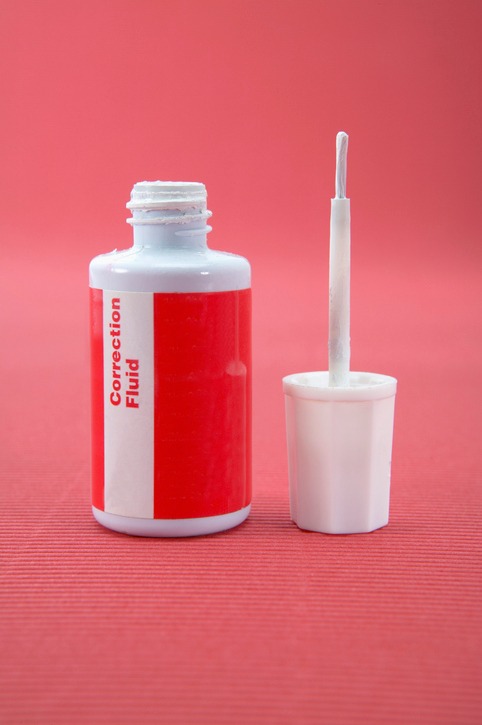
[image description: a picture of a whitening fluid with a label that reads “correction fluid” ]
The correct answer is C! The mistake mentioned in that scenario is an important one, that has implications for the interpretation of the experiment. Therefore, it is necessary to correct it, and the right way to go about it is to contact your Editor and, in addition to the corrected figure, provide them with 1) the original raw data and 2) an explanation as to how the incorrect figure came to be published.
Let’s take a look at the other scenarios and see what went wrong there.
- In scenario A, the mistake is not one that warrants a figure correction. It does not impact the interpretation or soundness of the data, nor does it contradict the conclusion.
- In scenario B, you would be trying to add an entire new set of data after the paper has already been reviewed and published. As part of Springer Nature's correction policy, we do not allow for the addition of data resulting from experiments performed after acceptance as this would result in non-peer reviewed data entering the scholarly record.
In conclusion, researchers are human and mistakes do happen. The right way to amend them is to carefully consider their implications for interpretation and soundness of your publication. If the mistake is a critical but small one, a correction is a good approach and the best way to present this to your Editor is with complete transparency. Being honest about the reason that led to a mistake, proving there is no impact on the overall soundness of your results, and doing so in a timely manner, whilst providing all supporting information, is the best way to ensure the Editor knows what happened and why and enable the correction happens speedily.
Relevant policy links for major imprints:
BMC
Nature
Springer
Palgrave Macmillan