The invisible economic shockwaves of natural disasters
Published in Social Sciences, Earth & Environment, and Economics





The "invisible loss"
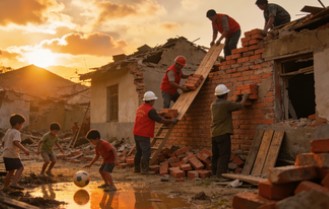
This project began with a simple observation that bothered us for years. Whenever a major disaster struck China, news reports would focus on the direct damage, such as buildings collapsed, farmland inundated, lives lost. Relief efforts would mobilize, donations would pour in, and gradually, the story would fade.
But as economic geographers, we kept wondering. What about the companies hundreds of kilometers away that rely on the supply chains from the disaster zone? What about the investors who suddenly lose confidence? These losses do not make the evening news, but they accumulate silently, sometimes exceeding the visible damage.
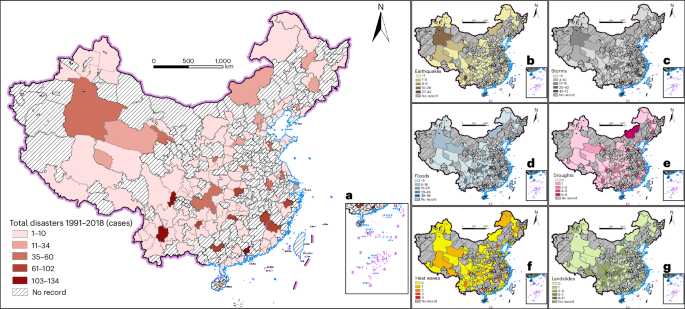
We decided to chase these ghosts. Using geocoded disaster data and firm-level investment records, we built a spatial econometric model that could track how economic shocks propagate through China's intercity economic network.
What we found
Traditional disaster assessments primarily focused on geographic proximity: if you are close to the disaster, you are affected; if you are far away, you are safe. But our analysis tells a different story. When a city suffers a natural disaster, every city connected to it through economic ties feels the shock. In fact, purely geographic models miss between 52.5% and 57.5% of total economic losses.
We also watched this effect intensify over time. As China's domestic economic networks grew more complex between 2000 and 2017, the spillover effects nearly doubled. Integration makes economies stronger, but it also makes shocks propagate faster and hit harder.
The "bullwhip" that whips back
Why does this happen? Think of it like cracking a whip. A small flick of your wrist sends energy traveling down the length of the whip, amplifying until the tip snaps. In supply chain management, they call this the "bullwhip effect"—small disturbances magnifying as they propagate through networks .
In our context, for instance, a flooded factory in City A means delayed shipments to City B, which means production slowdowns in City C, etc. By the time the shockwave reaches the end of the chain, it can be devastating, even though no physical disaster ever touched those final cities.
We also discovered that not all cities are equal shock-transmitters. Cities that sit at the center of economic networks—the "hubs"—spread more damage when they are hit. In this sense, having a safe neighbor, or a safe economic partner, is important.
So what?
- For policymakers: When allocate disaster preparedness funding, do not just look at previous flood maps. A city that rarely floods but sits at the heart of national economic networks might need as much resilience investment as a flood-prone one.
- For business: Diversify supply chains not just for efficiency, but for resilience. As a saying goes, "do not put all eggs in one basket".
- For our colleagues: Natural disasters are network events. We have to advance our analytical tools to catch up both local and non-local effects caused by natural disasters.
- For a better world: We are not saying we should fear economic integration. But just as we have learned to build earthquake-resistant buildings and flood-resistant levees, we now need to build shock-resistant economic networks. That means redundancy. That means distributed critical infrastructure. That means thinking about resilience as a network property.
Before the end
Our work is just one piece of a larger puzzle. Colleagues across the field are asking similar questions—how do floods cascade through urban networks? How do supply chains amplify or buffer shocks?
The Nature community is buzzing with these conversations, and we are grateful to be part of it. For example, in January 2026, I was delighted to discover that Nature Cities published a work of our Chinese colleagues, in which comparable results were simulated by a completely different research pattern. As mentioned by Fang et al. (2026), the spillovers of flood hazards concentrate in major hubs, amplifying systemic risk.
Many people may be more concerned with which method is superior in this matter. Yes, we have to use a more precise database with a more sophisticated method in the future. But such a "coincidence" let me believe that this field, though fraught with challenges, is full of vitality.
Last but not least, I would like to show my gratitude to the coauthors, C. He (professor) and W. Hu (PhD. candidate), from Peking University. Also, our associate editor (A. Laskey) as well as three anonymous reviewers offered great help. This work is sponsored by National Natural Science Foundation of China, all the authors show gratitude.

Follow the Topic
-
Nature Cities
This journal aims to deepen and integrate basic and applied understanding of the character and dynamics of cities, including their roles, impacts and influences — past, present and future.