Collection open for submission : Amino Acids and Climate Changes: Molecular, Physiological, and Ecological Perspectives
Published in Earth & Environment and Sustainability




The interaction between amino acids and climate changes represents a critical frontier in understanding the molecular and physiological adaptations of living organisms. As climate changes intensify, shifts in temperature, precipitation patterns, and atmospheric composition pose significant challenges to biological systems in water, soil, and air. Amino acids, as fundamental building blocks of proteins and crucial metabolic intermediates, play pivotal roles in stress responses and resilience mechanisms in plants, microbes, and some animal species. This Collection seeks to explore the intricate relationships between amino acid metabolism and the physiological adjustments organisms make in response to environmental stressors across diverse ecosystems.
Advancements in research on amino acids have revealed their importance in mediating resilience and ecosystem functioning under changing climatic conditions. Studies have shown how amino acids influence nutrient availability and contribute to biogeochemical cycles that underpin ecosystem health. Moreover, understanding these relationships is vital for nutritional security, as climate changes threaten food production systems globally. By leveraging recent discoveries, we can identify innovative strategies for enhancing resilience and adaptation in agricultural, aquatic, and terrestrial ecosystems.
Continued research in this area promises to yield valuable insights into the mechanisms of amino acid function in climate adaptation. Future studies may uncover novel amino acid structures and pathways that confer stress tolerance, paving the way for bioengineering crops, microorganisms, and small animal species capable of thriving in altered climates. Such advancements could play a critical role in mitigating the impacts of climate changes on food systems and ecological health.
This Collection supports and amplifies research related to SDG 13 (Climate Action) and SDG 14 (Life Below Water).
We invite authors to contribute to the Collection by submitting original research articles, mini reviews, and full reviews that provide new insights into the diverse roles of amino acids, peptides and proteins in climate changes.
Participating journal : Amino Acids, Springer.

Patr
Patrick Meffre was born in Marseille, France, in 1964. After engineering studies at the Ecole Nationale Supérieure de Chimie de Paris (ENSCP, Chimie ParisTech-PSL, a member of Université Paris-Sciences et Lettres, PSL, Paris, France), he receives his Ph.D. at the Université Pierre and Marie Curie, now Sorbonne Université (Paris), in 1991 under the supervision of Prof F. Le Goffic. After post-doctoral training with Prof S. Hanessian (Université de Montréal, Québec, Canada) he was appointed Assistant Professor at the Ecole Nationale Supérieure de Chimie de Paris in 1993. Since 2004 he moved to Nîmes Université (France) where he was appointed as Full Professor.
His current interests concern :
-The use of epiphytic plants (Tillandsia genus, colloquially called “air plants”) as natural source of biologically active compounds or as biomonitors of air pollution, and more specifically, Tillandsia species well acclimated to the local climate in Southern/Mediterranean Europe region.
-The extraction and identification of natural products from plants including volatile organic compounds (VOCs) and their biological activity.
-The synthesis of chiral or non-chiral biologically active compounds (antibacterial agents, adjuvants), of unusual amino acids, chiral synthons derived from natural amino acids and their biological activity.
Patrick Meffre is Deputy Editor, Amino Acids journal (Springer)
https://www.springer.com/journal/726
ck Meffre was born in Marseille, France, in 1964. After engineering studies at the Ecole Nationale Supérieure de Chimie de Paris (ENSCP, Chimie ParisTech-PSL, a member of Université Paris-Sciences et Lettres, PSL, France), he receives his Ph.D. at the Pierre and Marie Curie University (Paris) in 1991 under the supervision of Prof F. Le Goffic. After post-doctoral training with Prof S. Hanessian (Université de Montréal, Québec, Canada) he was appointed Assistant Professor at the Ecole Nationale Supérieure de Chimie de Paris in 1993. Since 2004 he moved to university of Nîmes (France) where he was appointed as Full Professor.
His current interests concern :
-The extraction and identification of natural products from plants including volatile organic compounds (VOCs) and their biological activity.
-The synthesis of chiral or non-chiral biologically active compounds (antibacterial agents, adjuvants), of unusual amino acids, chiral synthons derived from natural amino acids and their biological activity.
-The use of epiphytic plants (Tillandsia genus) as natural source of biologically active compounds or as biomonitors of air pollution.
Patrick Meffre is Deputy Editor, Amino Acids journal (Springer)
https://www.springer.com/journal/726
Follow the Topic
-
Amino Acids
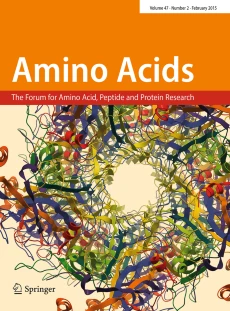
Amino Acids is an Open Access peer-reviewed journal focusing on the study of amino acids and related compounds across multiple disciplines.

Related Collections
With Collections, you can get published faster and increase your visibility.
Advancements and Applications in Structural Bioinformatics
Structural bioinformatics plays a crucial role in modern computational biology, driving breakthroughs in drug discovery, protein engineering, and understanding biomolecular interactions, as well as disease-causing modifications of these biomolecules. With the rapid development of Artificial Intelligence (AI)-based methods, enhanced molecular simulations, and integrative modeling approaches, this field is experiencing unprecedented progress.
This special issue aims to highlight cutting-edge research and novel applications in structural bioinformatics.
Structural bioinformatics is a broad field focused on applying computational approaches to proteins of biological and biomedical interest. It also addresses machine and deep learning methods dedicated to structural prediction, which have become essential for advancing protein structure and conformational modeling. New techniques for studying biomolecular interactions offer promising ways to better characterize protein-protein and protein-ligand interactions and understand their functional implications. Another important focus is computational drug design, which includes structure-based and AI-driven approaches for drug discovery and repurposing, as well as ligand docking, and molecular dynamics simulations. The field also includes integrative structural biology, combining experimental data and computational methods for multi-scale modeling of biomolecular systems. Finally, the development of structural databases, algorithms, and visualization tools remains central to supporting research in this field. This special issue aims to highlight the diverse yet interconnected and innovative aspects of structural bioinformatics.
We invite researchers to submit original research articles, reviews, and perspective papers that advance the field of structural bioinformatics.
Publishing Model: Open Access
Deadline: Sep 30, 2026
Incretin-Based Peptide Therapeutics: Advances in GLP-1 and GIP Receptor Modulation for Metabolic Disorders
Incretin-based peptide therapeutics, particularly those targeting GLP-1 (glucagon-like peptide-1) and GIP (gastric inhibitory polypeptide) receptors, have emerged as pivotal players in the management of metabolic disorders such as type 2 diabetes and obesity. These peptides are integral to the regulation of glucose metabolism and appetite control, making them ideal candidates for therapeutic intervention. Recent developments in peptide modulation have demonstrated promising results, with novel agonists and dual receptor modulators showing enhanced efficacy in clinical trials, paving the way for innovative treatment options.
Understanding the mechanisms underlying GLP-1 and GIP receptor modulation is crucial, as it not only provides insight into metabolic regulation but also reveals potential pathways for novel therapeutic strategies. Advances in this field have led to the development of long-acting formulations and combinatorial approaches that improve patient compliance and therapeutic outcomes. As the global prevalence of obesity and diabetes continues to rise, ongoing research in incretin-based therapies holds the promise of addressing these critical public health challenges.
Future research may lead to groundbreaking discoveries in incretin-based therapeutics, with a focus on personalized medicine approaches that consider individual patient profiles. Enhanced understanding of receptor interactions and the discovery of novel peptide structures could lead to the development of next-generation drugs that provide superior efficacy and safety profiles. Furthermore, advances in drug delivery systems may improve the bioavailability and effectiveness of these therapies, ultimately transforming the treatment landscape for metabolic disorders.
This Collection supports and amplifies research related to SDG 3 (Good Health and Well-being).
Publishing Model: Open Access
Deadline: Ongoing