TRANSITION ARCHITECTURE | A hope compass towards healthy, harmonious and thriving societies
Published in Sustainability and Education


As this year draws to a close, I would like to share a piece of work I was commissioned to develop for an engineering school: the design of a re-engaging and forward-looking introductory course on sustainability and societal responsibility.
These are themes I usually approach by analysing how systems function, identifying their failures, and then proposing corrective pathways. This time, however, I deliberately chose a different perspective.
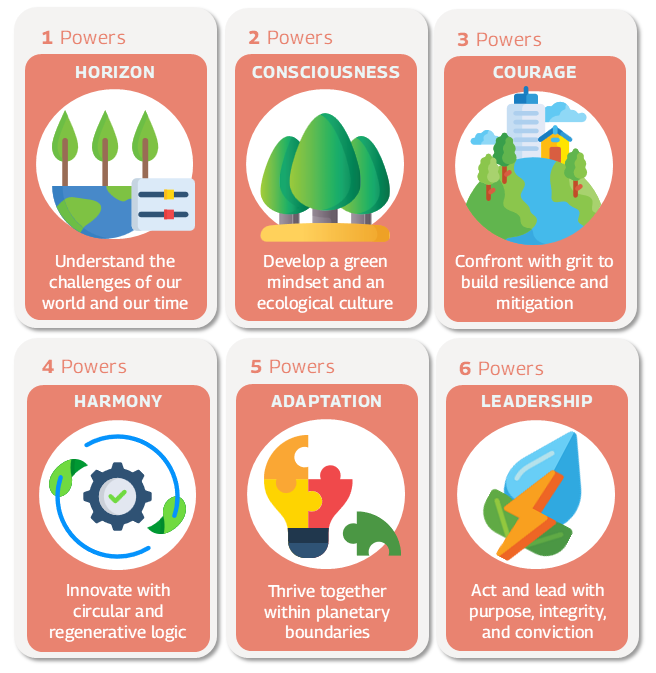
Confronted with a growing fatigue around traditional sustainability narratives, often perceived as alarmist or guilt-driven, I deliberately flipped the script. Instead of dwelling on what is broken, I offered only essential context before moving directly into a framework of solutions: an integrated response compass.
Ecologisation – propelling a systemic shift in societal norms
My aim was not simply to re-energise the conversation or to empower the students, but also to spark both the capacity and the desire to act differently. My ambition is to contribute to the ecologisation of society by shaping lucid, visionary citizens capable of navigating a paradigm shift and opening new trajectories towards a promising future.
Ecologisation involves a profound transformation in the ways we think, design, act and operate our economies. Sustainability becomes a transversal lens, informing every decision, every practice and every strategy, until it becomes second nature.
Indeed, Transition Architecture is a strategic foundation, a framework for thinking differently, imbuing projects with meaning, and positioning people as conscious actors shaping the world that is emerging.
What do we really mean by sustainability?
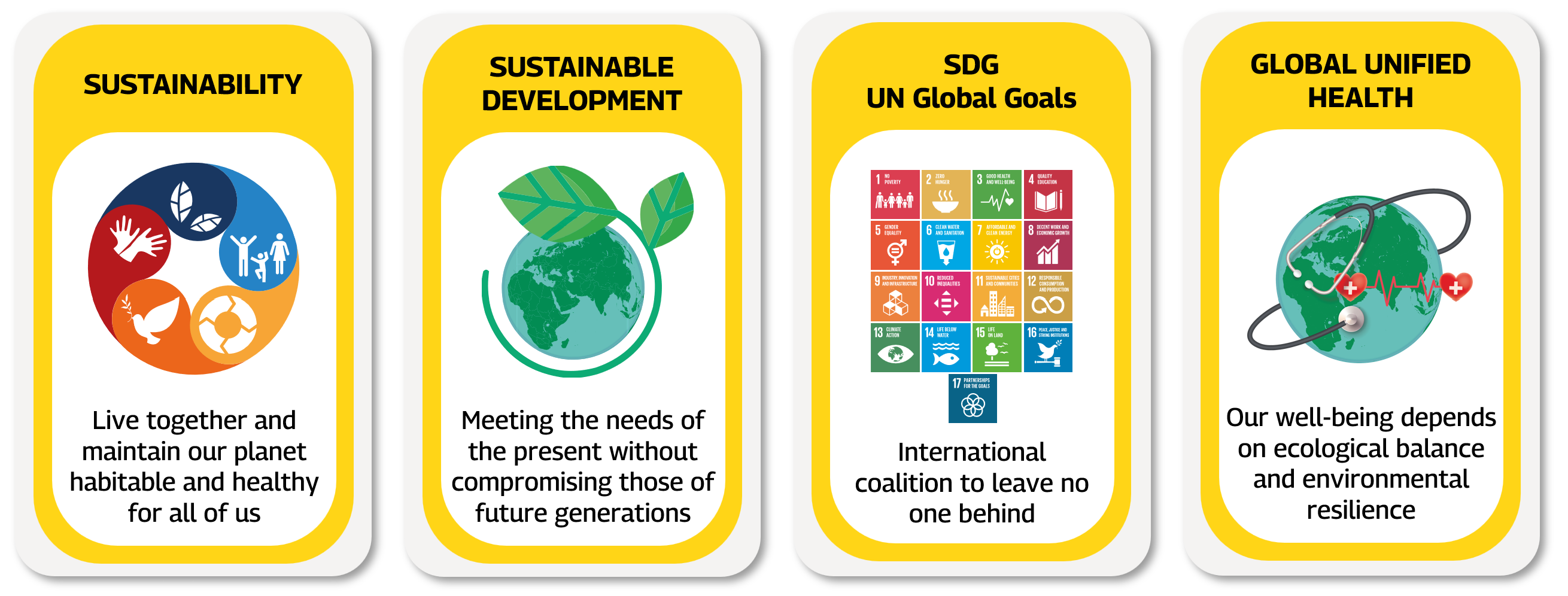
The historical definition of sustainable development, formalised in the 1987 UN report “Our Common Future”, describes development that meets the needs of the present without compromising the ability of future generations to meet their own needs. While this definition was visionary at the time, it is no longer adequate.
We are that future generation. And in many regions of the world, the planet’s capacity to meet even basic needs has already been compromised.
I therefore favour a more direct and contemporary definition of sustainability: “living together while keeping our planet habitable, viable and healthy for all.”
This definition is deliberately broad. It positions sustainability as an umbrella concept encompassing related notions such as sustainable development, corporate social responsibility, environmental stewardship and regenerative practices.
Why sustainability is not optional
If we invert the definition, the message becomes stark: without sustainability, our planet becomes uninhabitable.
Ecology is not one dimension among others. It is the foundation upon which all social, economic and political systems depend. Human civilisations emerged and prospered thanks to a stable climate and a generous biosphere. Preserving natural capital is therefore not a moral luxury, but a prerequisite for social stability, economic resilience and long-term peace.
The Anthropocene Diagnosis: two existential crises
Often perceived as a vast, imperturbable and inexhaustible globe, the Earth is in fact a living, dynamic and finite system in perpetual evolution. Its equilibrium rests on subtle balances that can be disrupted far more easily than we once believed.
Since the late eighteenth century, human activity has become a planetary force. Predatory industrialisation, colossal extraction, urban sprawl and intensive agriculture have scarred landscapes, altered biogeochemical cycles and destabilised the global climate system. Scientists now refer to this period as the Anthropocene: an era in which human actions dominate Earth’s natural processes.
Within this context, two major crises stand out.
- The first is climate disruption, driven by fossil fuel combustion and the accumulation of greenhouse gases in the atmosphere.
- The second is the collapse of biodiversity, now widely recognised as the sixth wave of mass extinction, undermining the ecosystems upon which life, and human survival, depends.
Many ecological shocks cascade into human systems, directly threatening food security, public health, economic stability and geopolitical balance.
Global responses and persistent momentum
The international community has not been idle. Since the first Earth Summit in Stockholm in 1972, global environmental governance, led primarily by the United Nations, has sought to coordinate collective responses to planetary risks.
This effort culminated in 2015 with the adoption of the 17 Sustainable Development Goals, providing a shared roadmap to 2030, and the Paris Agreement, ratified by over 190 countries, committing the world to limit global warming to below 2°C.
Progress has been uneven, and setbacks are numerous. Yet climate action continues. Even when the United States withdrew from the Paris Agreement at the federal level, many states, cities and organisations maintained and strengthened their commitments. For instance, the U.S. Climate Alliance has continued to reduce emissions and transition to green energy. This decentralised momentum matters. It shows that structural change is already underway, even in politically fragmented contexts.
A compass to find our way forward
As we entered the twenty-first century, we also left behind an era of relative stability. We now live in a VUCA world (volatile, uncertain, complex and ambiguous) where climatic, social and geopolitical reference points are in constant flux.
In such a context, legacy approaches and linear thinking are inadequate. What is required is a new paradigm of thought that provides coherence and pragmatic optimism.
This is where Transition Architecture finds its relevance. It is not a fixed blueprint, but a living approach designed to help navigate complexity, a set of practical tools that orient decisions, behaviours and innovations towards a desirable trajectory.
At its core, it is structured around three essential interconnected components: fundamentals, drivers and workstreams, which together provide both direction and actionable pathways.
The 6 fundamentals
At the heart of this framework lie six foundational principles. They are not optional guidelines, but essential conditions that underpin any genuine sustainable action.
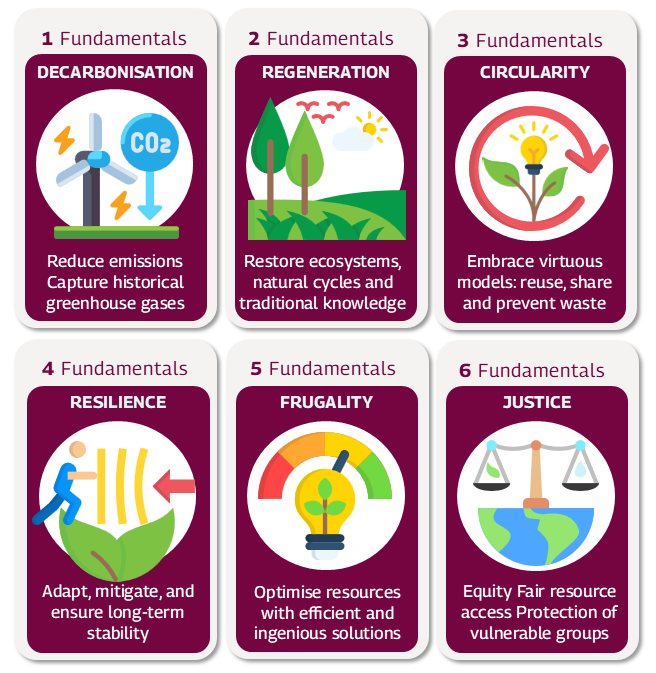
Decarbonisation and regeneration respond directly to the two existential crises.
Circularity is not about recycling. Recycling a glass bottle is not circular, particularly given the energy required to remelt and reform glass. Circularity is a mindset and a holistic approach that keeps our economies within planetary boundaries.
Resilience strengthens our capacity to absorb ecological and societal shocks while working towards mitigation and long-term stability.
Frugality promotes doing better with less, but it will only succeed if coupled with sobriety (controlled consumption). Otherwise, rebound effects cancel out progress.
Equity and justice are fundamental not only on moral grounds. They shape acceptance and legitimacy. Solutions perceived as unfair are rejected, regardless of their ecological merit. This has been illustrated repeatedly. In France, for example, certain neonicotinoid insecticides were banned in 2018 while remaining authorised at EU level until 2033, placing French farmers at an untenable disadvantage.
The resulting discontent led, in 2025, to the Duplomb law, an unfortunate short-term response lifting the ban and contradicting the regeneration fundamental.
The 6 drivers
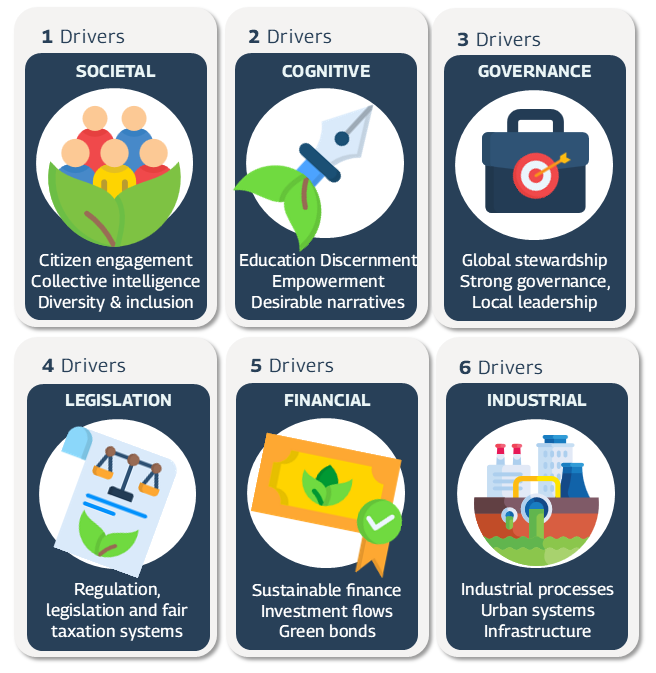
Fundamentals alone do not change systems swiftly enough. They require engines capable of translating intention into impact at the pace the situation demands.
The reaction to the Duplomb law illustrates this clearly. A young CSR (Corporate Social Responsibility) student launched a petition that gathered more than two million signatures, forcing its re-examination. The law was subsequently declared incompatible with the French Charter for the Environment, and the incriminated provision was annulled and should soon be replaced by fit-for-purpose measures.
Here, we can plainly observe powerful driving forces at work: citizen engagement, education, governance and legislation.
Industry and finance too carry significant weight, especially as extra-financial indicators such as ESG (Environmental, Social and Governance) increasingly guide investment flows towards responsible and accountable companies.
When synchronised, these drivers act like gears propelling the much-needed societal and cultural mutation.
The 6 workstreams
True transformation emerges through intertwined domains of action.
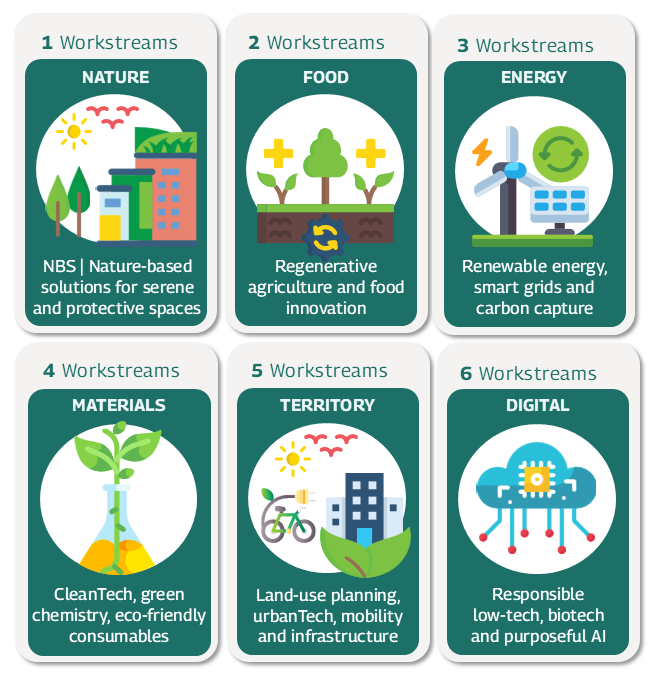
Not all solutions carry the same ecological weight. Nature-based solutions come first. They meet all sustainability fundamentals and generate cascading benefits for climate, biodiversity, natural cycles, community wellbeing and health.
Our food systems must be reinvented. Beyond a handful of large agri-food corporations, everyone is losing. Today’s models are environmentally destructive and leave countless farmers worldwide struggling in distress. They also fail us on a health level: pesticide residues make us ill, ultra-processed foods drive chronic diseases, and excessive meat consumption is linked to cardiovascular risks.
The energy transition is now firmly embedded in public consciousness, despite some pockets of denial. It is not about replacing every fossil-based activity with a green equivalent, but about reducing demand while deploying renewables intelligently.
Materials and manufacturing must reorient towards non-toxic, circular and low-impact models, including soil remediation, brownfield redevelopment and water purification systems.
Territorial planning aims to foster shared narratives that reshape how we inhabit land, favouring walkable, resilient communities and renewed connections with nature.
Digital technologies must remain means, not ends. They offer powerful and undeniable benefits and can, and should, be a force for good. But they are also a resource-hungry industrial system whose environmental cost is growing at a staggering pace. Generative AI in particular, if left unleashed, could quite literally devour the planet.
A unique opportunity
We stand at a civilisational crossroads. For the first time in history, humanity possesses both the knowledge and the tools to consciously shape its own becoming.
This is not solely a responsibility. It is a unique opportunity to sculpt our ways of living, to reconfigure the structures of our societies, to breathe new dynamics into our collective life, and to contribute to forging societies that are healthy, harmonious and thriving.
The future is not a fate to endure. It is a project to build together.
What can we do as individuals?
Students responded strongly to this approach, engaging actively and repeatedly asking what they could do at their own level. My answer often surprises them in its simplicity: take care of yourself. Start with your health.
Yes, one of the most powerful individual actions begins there, with our own wellbeing, especially through what we eat. Avoiding processed food, reducing red meat consumption and moving towards a flexitarian diet significantly enhances quality of life.
These choices may seem modest, yet their effects ripple outward, reverberating through agricultural systems and environmental outcomes.
Our plate is not trivial. It is political, ecological and deeply human.
Caring for our own health is already nurturing the biosphere because we belong to it.

After leading MAINTENANT, an award‑winning social enterprise in the UK, Amell returned to France and co‑founded SOUTENABILITE.org, a nonprofit dedicated to accelerating the ecological transition and advancing sustainable development and circular‑economy practices.
Its mission is to inspire and champion authentic eco‑initiatives through compelling video storytelling.
The organisation also delivers training and higher‑education courses and supports organisations through corporate consulting, with the aim of building capacity and amplifying responsible, circular, and regenerative strategies across communities and businesses.
Follow the Topic
What are SDG Topics?
An introduction to Sustainable Development Goals (SDGs) Topics and their role in highlighting sustainable development research.
Continue reading announcement
Please sign in or register for FREE
If you are a registered user on Research Communities by Springer Nature, please sign in