SDG3 Newsletter: Access for All
Published in Cell & Molecular Biology and Public Health



This SDG 3 Newsletter relates mainly to SDG target 3.8
In the blogs, find answers to the 5 quiz questions dotted throughout the newsletter. Comment the answers below to be named as a top scorer in the October newsletter! 📢
Use these links to navigate to a section:
- The Impact of Censorship on SDG3
- Anaesthesia in Remote Hospitals with Dr Daniela Kietzmann
- Climate Change and Mental Health Equity
- Genomics England Health Summit 2025: DEI in genomic medicine
- From discovery to real-world applications: Q&A with Dr Florence Bietrix
- World Population Day: the importance of social connection
- Harm reduction and access to healthcare
- Collection: ‘Migration and its Effects on Maternal and Child Health and Nutrition’
- Addressing gender gaps in clinical trials
- The state of gender bias in scientific publishing
In other news…
- Infectious diseases in a time of war and conflict
- Interview with Dr Shenoi, winner of the Jess Kraus Award in Injury Epidemiology
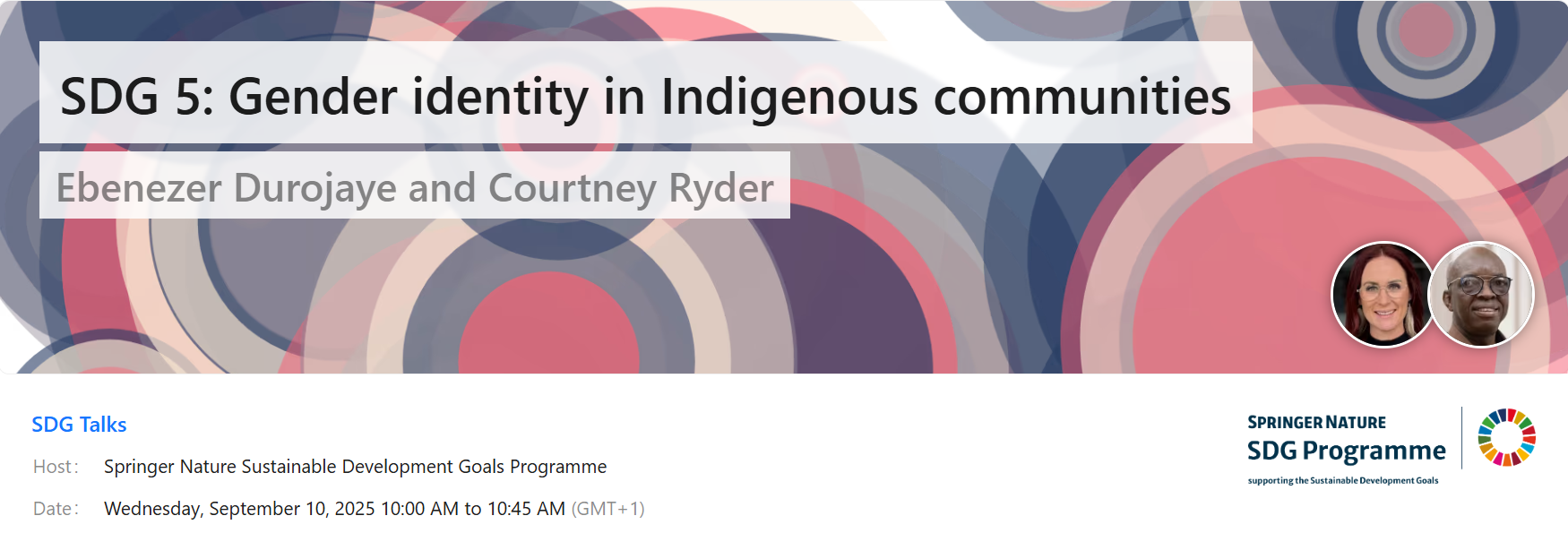
- Upcoming webinar: Gender identity in Indigenous communities
Access denied: the impact of censorship on SDG 3🚫
Keep up-to-date with this blog that explores how recent restrictions on language in US academic publications that limit the use of terms including ‘breastfeed’, ‘climate’, ‘Black’, ‘female’, and ‘sex’ could undermine research integrity and stall progress toward the SDG 3 targets.
🔐Currently, how many words have the US Federal Agencies restricted: 100+, 350+, or 1,000?

Book Q&A: Anaesthesia in Remote Hospitals with Dr Daniela Kietzmann📗
Read this blog where Dr Kietzmann highlights the global lack of access to safe anaesthesia, sharing her experiences in remote hospitals and advocating for essential improvements to protect patients undergoing surgery worldwide.
🔐Within a 500km radius in Tanzania's Southern Zone, what is the typical maximum number of anaesthesiologists: 3, 5, or 10?
Book spotlight: Climate change and Mental Health Equity📖
Don't miss this blog discussing Rhonda J. Moore’s book, Climate Change and Mental Health Equity. It explores how environmental stress intensifies mental health struggles in marginalised communities, calling for culturally sensitive care and urgent policy reform.
Genomics England Health Summit 2025: DEI in genomic medicine🧬
Learn about the Genomics England Health Summit 2025 which showcased efforts to enhance genomic testing and diagnostic accuracy for underrepresented groups, with research aimed at improving outcomes for patients from LMICs and ethnic minority backgrounds.
🔐According to Professor Catherine Williamson’s presentation, are Black women twice as likely, 3 times as likely, or 5 times as likely to die from pregnancy-related complications?

From discovery to real-world applications: a Q&A with Dr Florence Bietrix🧪
Read this Q&A where Dr Florence Bietrix, Section Editor at Journal of Translational Medicine, emphasises turning biomedical discoveries into practical, inclusive healthcare solutions.
World Population Day: the importance of social connection for population health🫂
Don't miss this blog for World Population Day, where the Editors-in-Chief of Population Health Metrics highlight the vital role of social connection in population health research and policy. Look out for a forthcoming journal collection on the topic!
Meeting people where they are: harm reduction and access to healthcare🗣️
Read this blog to learn why harm reduction community programmes and policy reforms are critical to meeting the SDG 3 targets. Harm reduction expands access to healthcare by reducing stigma, building trust and addressing inequality.
Open collection: ‘Migration and its Effects on Maternal and Child Health and Nutrition’🤱
Check out this blog about a collection open in Journal of Health, Population and Nutrition and International Journal for Equity in Health. The blog explores how migration affects maternal and child health and nutrition, emphasising the need for equitable access to healthcare and policy solutions that support vulnerable migrant populations. Submit to the collection here!
🔐Which SDG 3 target does this collection relate to? 3.1, 3.5 or 3.8?
Addressing gender gaps in clinical trials 🔬
Women remain underrepresented in clinical trials. Learn why in this blog.
The state of bias in scientific publishing🔍
Read about a recent analysis of gender representation throughout the publishing process at Nature Portfolio, and what is being done to address gender disparities.
🔐How many corresponding authors were included in the analysis? 10,000, 100,000 or 215,000?
In other news...
Increased risk of infectious diseases in a time of war and conflict🦠
In this BugBitten blog, Professor Krisztian Magori offers his insights into the impact of war and recent conflicts on infectious diseases and the level of compliance to international humanitarian protection laws.

Interview with Rohit P. Shenoi, winner of the Jess Kraus Award in Injury Epidemiology🏆
See this Q&A where the Editor-in-Chief of Injury Epidemiology, Professor Guohua Li, chats with this year’s recipient of the Jess Kraus Award, Dr Shenoi, about his award-winning article on drowning. There will be an award ceremony and a seminar presentation by Dr Shenoi at Columbia University this autumn/fall.
Upcoming webinar: Gender identity in Indigenous communities
Get involved!
Thank you to everyone who contributed to this newsletter.* If you would like to be involved with our SDG 3 initiatives, contact me. Follow me, Alice Coe, on Research Communities to be notified of future SDG 3 newsletters.
*With special thanks to: Yasmin Wilczur, Dr Daniela Kietzmann, Liz Chamberlain, Sophie Gray, Abiola Lawal, India Sapsed-Foster, Dr Florence Bietrix, Suzuki Limbu, Prof Shereen Hussein, Prof Jonathan Samet, Virginia Mercer, Louis Gautier, Prof Guohua Li, Dr Rohit P. Shenoi, and the BugBitten blog channel
Comment your quiz answers to be featured in the October newsletter! The next newsletter will focus on women's health.
Follow the Topic
-
Injury Epidemiology

This journal aims to be the premier venue for communicating epidemiologic studies of unintentional and intentional injuries and is dedicated to advancing the scientific foundation for injury prevention and control through timely publication and dissemination of peer-reviewed research.
-
Journal of Health, Population and Nutrition

This journal brings together research on all aspects of issues related to population, nutrition, and health. The journal publishes articles across a broad range of topics including global health, maternal and child health, nutrition, common illnesses, and determinants of population health.
-
Population Health Metrics

Population Health Metrics aims to advance the science of population health assessment, and welcomes papers relating to concepts, methods, ethics, applications, and summary measures of population health.
-
Journal of Translational Medicine

Journal of Translational Medicine is an open access journal publishing articles focusing on information derived from human experimentation so as to optimise the communication between basic and clinical science.
Related Collections
With Collections, you can get published faster and increase your visibility.
Advancing the Measurement of Social Connection for Population Health: New Evidence, Metrics, and Global Priorities
Social connection is increasingly recognized as a vital component of population health. It includes the structure of social networks, the support that flows through relationships, and the quality of interactions that contribute to well-being. Research across multiple disciplines has established that limited or poor social connection is linked to higher risks of premature mortality, mental health problems, cardiovascular disease, cognitive decline, lower educational attainment, and reduced economic participation. These findings highlight the need for rigorous and comparable metrics that can illuminate the distribution, determinants, and consequences of social disconnection at scale.
Despite a growing interest in social connection, population level measurement remains uneven. Studies often rely on single items, short scales, or constructs that capture only one aspect of the broader social landscape. Loneliness, social isolation, and social support are frequently treated as interchangeable, even though each reflects a different dimension of social life and may influence health through distinct pathways. In many settings, there is no routine surveillance of social connection. As a result, policymakers and practitioners lack the data needed to design effective interventions or monitor changes over time.
Conceptual clarity is a prerequisite for measurement. Social connection is multidimensional and includes the size and diversity of social networks, the availability of emotional or instrumental support, and the positive or negative qualities of relationships. Social isolation is the objective absence of social roles or interactions. Loneliness is the subjective experience of wanting more or better connection than one currently has. These concepts intersect but are not synonymous. Accurate assessment requires tools that reflect each dimension and that can be adapted or validated across cultures, languages, and life stages.
Research from low and middle income countries is particularly limited even though many of these settings experience social conditions that may heighten vulnerability to social disconnection. Large and rapid demographic transitions, urban migration, changing family structures, economic insecurity, and exposure to conflict or displacement can all shape patterns of social connection. Yet most validated instruments originate in high income countries, and many have not been adapted or tested for linguistic, cultural, and contextual relevance in LMIC populations.
The need for strong metrics extends beyond conceptual work. The use of digital technology, demographic change, shifting household structures, migration, and urbanization all influence how social connections form and function. These forces create new opportunities for measurement, such as digital interaction data or innovative mixed-method approaches, but they also introduce new challenges. Measures grounded in one cultural or linguistic context may not translate easily to another. Children, adolescents, older adults, and marginalized groups may require tailored instruments that reflect their social realities. Community and policy interventions also need evaluation frameworks that capture both intended and unintended effects on connection.
This special issue invites research that advances the science of measuring social connection for population health. Relevant contributions include but are not limited to:
1. New conceptual models and frameworks for assessing social connection at scale
2. Validation or adaptation of measurement instruments across cultures and population groups
3. Methods for distinguishing between loneliness, social isolation, and social support in surveillance systems
4. Epidemiologic analyses that examine levels, patterns, and trends in social connection
5. Studies linking social connection metrics with health, economic, or educational outcomes
6. Approaches to integrating social connection into existing population health surveys
7. Measurement of social connection in digital and hybrid social environments
8. Evaluation metrics for policies, community initiatives, and individual level interventions
9. Proposals for harmonized indicators that support international comparisons
All submissions in this collection undergo the journal’s standard peer review process. Similarly, all manuscripts authored by a Guest Editor(s) will be handled by the Editor-in-Chief. As an open access publication, this journal levies an article processing fee (details here). We recognize that many key stakeholders may not have access to such resources and are committed to supporting participation in this issue wherever resources are a barrier. For more information about what support may be available, please visit OA funding and support, or email OAfundingpolicy@springernature.com or the Editor-in-Chief.
Publishing Model: Open Access
Deadline: Aug 28, 2026
Open Issues in Population Health Modeling: Methodological, and Epidemiological Implications of Continuous Changes in Population Dynamics
Among the Sustainable Development Goals (SDGs), SDG 3 focuses on ensuring healthy lives and promoting well-being for people of all ages, combating communicable diseases, lowering mortality rates from non-communicable diseases, and promoting mental health. Indeed, a sustainable society fundamentally depends on the number of years its members can actively contribute to social and economic activities, which requires living in good health. Therefore, the concepts of lifespan, longevity, and health are intrinsically crucial when evaluating and planning sustainability policies for both the short and long term.
In this context, socio-political decision-makers can greatly benefit from long-term estimates derived from methodological advancements in the demographic and health domains. Such advancements can fuel new perspectives and theories within their respective fields. The development and application of rigorous quantitative methods not only refine data interpretation but also foster a deeper understanding of underlying social, health, and population dynamics. These innovations enable researchers to challenge existing paradigms, paving the way for more robust theoretical developments in public health and population studies.
This Collection seeks cutting-edge articles that advance theories and evidence related to longevity and population health metrics. We particularly encourage research focused on elegant methods for measuring health dynamics and forecasting changes in longevity around the globe. Contributions that advance the state of the art in the field, while embracing rigorous methodological approaches, are highly welcomed.
This Collection supports and amplifies research related to SDG 3, Good Health and Well-Being.
All submissions in this collection undergo the journal’s standard peer review process. Similarly, all manuscripts authored by a Guest Editor(s) will be handled by the Editor-in-Chief. As an open access publication, this journal levies an article processing fee (details here). We recognize that many key stakeholders may not have access to such resources and are committed to supporting participation in this issue wherever resources are a barrier. For more information about what support may be available, please visit OA funding and support, or email OAfundingpolicy@springernature.com or the Editor-in-Chief.
Publishing Model: Open Access
Deadline: Apr 30, 2026



Please sign in or register for FREE
If you are a registered user on Research Communities by Springer Nature, please sign in