Quarterly Highlights from the Medicine and Life Sciences Communities
Published in Cancer, Ecology & Evolution, and Microbiology






Welcome to the last Medicine and Life Sciences Communities round-up post for 2025. Over the past three months, researchers, editors and readers have engaged with a diverse range of posts spanning global health, research integrity, infectious disease, biodiversity and women’s health.
In this round-up, we spotlight five posts that captured particular attention from the community this quarter.
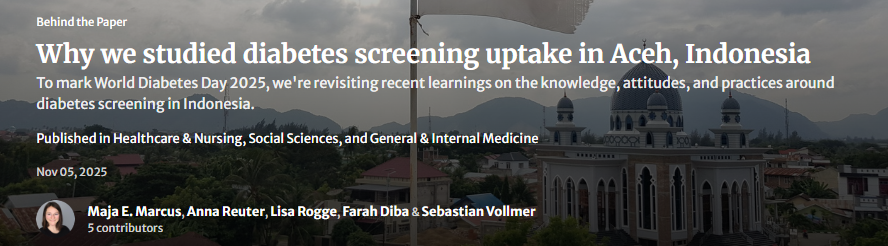
Why we studied diabetes screening uptake in Aceh, Indonesia
Diabetes is a growing global health challenge, yet screening and early diagnosis remain uneven, particularly in low- and middle-income settings. Understanding why people do or do not engage with screening programmes is essential for improving prevention and care.
In this Behind the Paper post from their BMC Global and Public Health article, @Maja E. Marcus, @Anna Reuter, @Lisa Rogge, @Farah Diba and @Sebastian Vollmer explain the motivation behind their study of diabetes screening uptake in Aceh, Indonesia. They explore how social, economic and health-system factors influence participation, shedding light on barriers such as access, awareness and trust in healthcare services.
Read the full post to learn how context-specific evidence can help design more effective screening strategies and improve outcomes for communities at risk of diabetes.
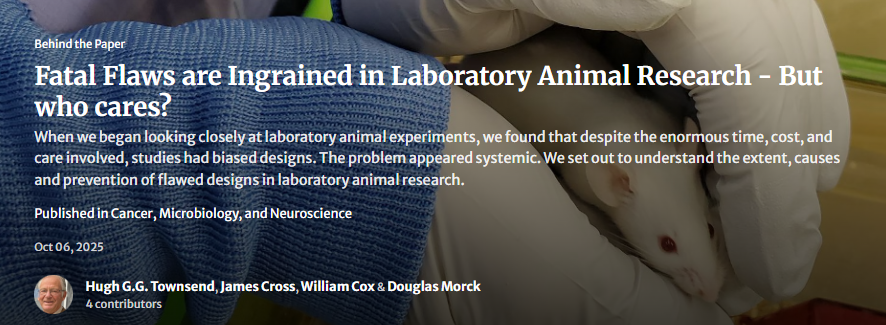
Fatal flaws are ingrained in laboratory animal research – but who cares?
Laboratory animal research has long been central to biomedical science, yet concerns about its reliability, ethics and reproducibility continue to grow.
In this provocative and reflective post, @Hugh G.G. Townsend, @James Cross, @William Cox and @Douglas Morck argue that structural flaws are deeply embedded in how animal research is designed, conducted and rewarded. From their original article in Scientific Reports, the authors question why these issues persist despite decades of critique, pointing to incentives, institutional inertia and gaps in accountability.
Read the full piece for a candid examination of a system under strain, and a call for more meaningful reform in how animal research is evaluated and valued.
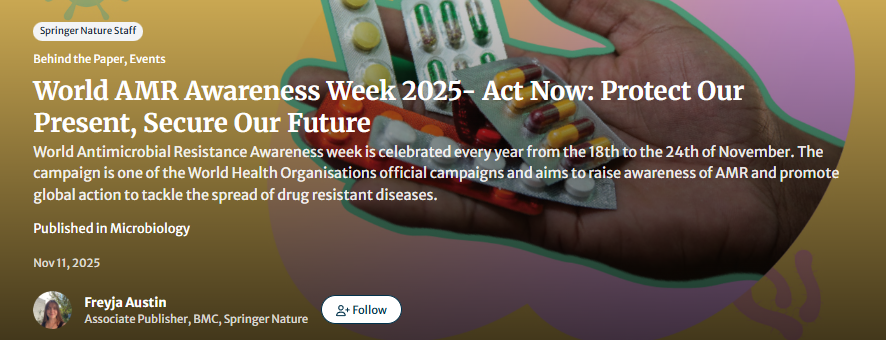
World AMR Awareness Week 2025
Antimicrobial resistance (AMR) remains one of the most urgent threats to global health, with consequences for modern medicine, food security and health equity.
Marking World AMR Awareness Week 2025, this timely post by @Freyja Austin highlighted why immediate, coordinated action is essential. The piece explores the scale of the AMR crisis, the drivers accelerating resistance, and the steps needed across policy, research and public engagement to slow its spread.
Read the full post to learn why tackling AMR requires action now, not in the future, and how collective responsibility is key to safeguarding health worldwide.
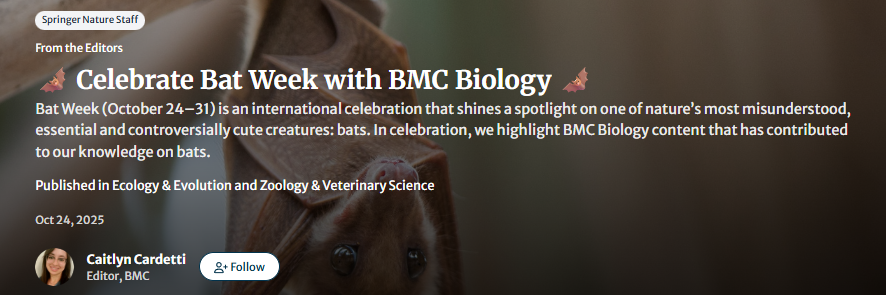
Bat Week with BMC Biology
Bats play critical roles in ecosystems around the world, from pollination and seed dispersal to insect control, yet they are often misunderstood or overlooked.
In this engaging From the Editors post, @Caitlyn Cardetti celebrated Bat Week by highlighting bat-related research published in BMC Biology. The post showcases recent studies that deepen our understanding of bat biology, behaviour and evolution, while also emphasising their importance for biodiversity and ecosystem health.
Read the full post to explore fascinating bat research and discover why protecting these remarkable mammals matters more than ever.
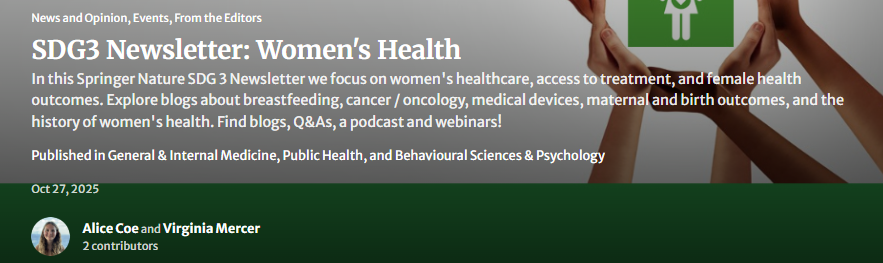
SDG3 Newsletter: Women’s Health
Women’s health remains central to achieving Sustainable Development Goal 3: Good Health and Well-being, yet persistent gaps in research, care and policy continue to affect outcomes worldwide.
In this SDG3 Newsletter, @Alice Coe and @Virginia Mercer bring together recent research, initiatives and community content focused on women’s health. The post highlights key themes, ongoing challenges and areas where targeted research and collaboration can make a real difference.
Read the full newsletter to stay up to date with developments in women’s health research and how the community is contributing to progress towards SDG3.
These blogs offer just a snapshot of the research stories, reflections and conversations that resonated with readers this quarter. Together, they highlight the breadth of topics and the global perspectives shared across the Medicine and Life Sciences Communities. I hope you enjoy exploring these posts as much as I did.
Further readings:

Helping researchers connect, collaborate, and communicate their work. Specialising in Medicine and Life Science and passionate about making science more visible and accessible.
Follow the Topic
-
BMC Global and Public Health
An open access, transparent peer review journal publishing outstanding and influential research and opinion of broad interest to all professional communities involved in global and public health research, policy-making, implementation and delivery worldwide.
-
Scientific Reports
An open access journal publishing original research from across all areas of the natural sciences, psychology, medicine and engineering.
-
BMC Biology
This is an open access journal publishing outstanding research in all areas of biology, with a publication policy that combines selection for broad interest and importance with a commitment to serving authors well.



Related Collections
With Collections, you can get published faster and increase your visibility.
Cancer metabolism
BMC Biology is calling for submissions to our Collection on Cancer metabolism. Cancer metabolism is a developing field that explores the biochemical and physiological changes that occur in cancer cells, which often exhibit distinct metabolic pathways compared to normal cells. Alterations such as the Warburg effect, where cancer cells preferentially utilize glycolysis for energy production even in the presence of oxygen, play a pivotal role in tumor progression and survival. Understanding the intricacies of cancer metabolism provides insights into how tumors adapt to their microenvironments and highlights potential therapeutic targets for intervention.
Future research in cancer metabolism promises to yield transformative insights that could reshape therapeutic approaches and improve precision medicine. The continued focus on metabolic pathways may lead to the identification of new biomarkers for cancer diagnosis and prognosis, as well as novel strategies to enhance the sensitivity of cancer cells to treatment. As we deepen our understanding of the metabolic landscape of tumors, we may uncover innovative strategies that exploit these vulnerabilities, ultimately leading to novel and more effective cancer treatments, as well as improved patient outcomes.
Recent advancements in the field, including the identification of metabolic reprogramming strategies and the influence of diet on tumor growth, have opened new avenues for research. Investigations into the roles of lipids, fatty acids, and dietary interventions, such as ketogenic diets, are revealing potential methods for manipulating tumor metabolism and enhancing the efficacy of existing treatments. We invite researchers to submit their work to this Collection, which aims to showcase groundbreaking research and technologies addressing cancer metabolism and support the advancement of this field, encompassing a wide array of topics related to metabolic pathways and their implications for cancer biology and therapy.
Potential topics include but are not limited to:
- Metabolic reprogramming in cancer cells
- The Warburg effect and its implications
- Role of mitochondria in cancer metabolism
- Impact of dietary interventions on tumor metabolism
- Glycolysis and lipid metabolism in cancer
- Animal models
- Imaging and method developments
- Metabolic engineering
This Collection supports and amplifies research related to SDG 3 (Good Health and Well-being).
All manuscripts submitted to this journal, including those submitted to collections and special issues, are assessed in line with our editorial policies and the journal’s peer review process. Reviewers and editors are required to declare competing interests and can be excluded from the peer review process if a competing interest exists.
Publishing Model: Open Access
Deadline: Oct 30, 2026
Symbiotic relationships
BMC Biology is calling for submissions to our Collection on Symbiotic relationships.
Symbiotic relationships are fundamental interactions between different organisms —mutualistic, commensal, and parasitic—that shape ecological dynamics and evolutionary trajectories across the tree of life. From the nutrient sharing networks formed by plants and fungi in mycorrhizal systems to the intricate partnerships between animals and their microbial communities, symbiotic relationships reveal the deep interdependence that underlies biodiversity and ecosystem function.
Investigating symbiotic relationships is vital for understanding how species co-evolve and adapt within their environments. Recent advances in molecular biology and ecological genomics have allowed researchers to unravel the genetic and biochemical mechanisms underpinning these interactions. These insights shed light on how organisms negotiate benefits and costs, co-adapt over evolutionary timescales, and respond to shifting environmental pressures. Beyond fundamental biology, symbiosis research increasingly informs practical applications in medicine, agriculture, biotechnology, and conservation, underscoring the significance of this field of research.
Continued exploration into symbiotic interactions promises to illuminate new dimensions of ecological and evolutionary complexity. Emerging technologies may uncover previously unknown partnerships and offer ways to harness beneficial relationships to enhance our health, ecosystem stability, crop productivity, and conservation strategies. Understanding how symbioses originate, persist, and adapt in changing environments is central to predicting and managing biological responses in a rapidly shifting world.
Topics of interest include (but are not limited to):
- Evolutionary impacts of symbiotic relationships, including transitions to parasitism, conflict resolution mechanisms and insights into costs, benefits, and trade-offs in maintaining these relationships
- Plant–Microbe and Plant–Fungi symbioses, including mycorrhizal networks, nitrogen-fixing symbioses, endophytic fungi and plant stress tolerance
- Animal-Microbiome interactions, including contributions to host health, genetic mechanisms underlying host–microbe recognition
- Biofilm communities as models for cooperative and competitive symbiosis
- Beneficial viral symbionts in unicellular and multicellular organisms
- Tripartite symbiotic systems, including ant-plant-fungus, lichen-algae-cyanobacteria
- Coral symbioses and their contributions to reef ecosystem health, restoration and recovery
- Holobiont frameworks across all taxa
- Resilience of symbiotic systems under climate change
- Synthetic biology approaches to design synthetic symbioses for various applications
This Collection supports and amplifies research related to SDG 13 (Climate action), SDG 14 (Life below water), and SDG 15 (Life on land).
All manuscripts submitted to this journal, including those submitted to collections and special issues, are assessed in line with our editorial policies and the journal’s peer review process. Reviewers and editors are required to declare competing interests and can be excluded from the peer review process if a competing interest exists.
Publishing Model: Open Access
Deadline: Dec 31, 2026