Quarterly Highlights from the Humanities and Social Sciences Communities

These Q2 2025 highlights show how humanities and social sciences research address real-world challenges with fresh insights.
Quarterly Highlights from the Humanities and Social Sciences Communities
Like

Share this post

Choose a social network to share with, or copy the URL to share elsewhere

This is a representation of how your post may appear on social media. The actual post will vary between social networks

During the second quarter of 2025, a range of blog posts from the Humanities and Social Sciences Communities attracted high readership. These stories span from exploring why climate change feels distant, to uncovering hidden routes of illegal wildlife trade, to building cultural indicators rooted in local context, and highlighting the voices of LGBTQIA+ researchers. What ties them together is their focus on connecting research to the real-world challenges we all face. 


Making Climate Change Visible  Informing the Boiling Frog: Binary climate data amplifies climate change perception
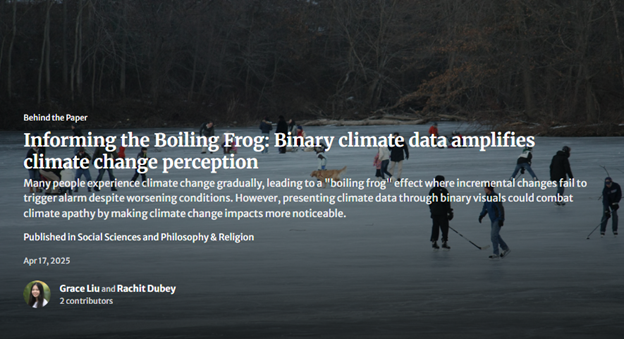
Why don’t we feel alarmed by climate change, even as the evidence keeps piling up? This study explores the “boiling frog” effect – how we gradually get used to change and fail to notice the crisis building around us. 

Published in Nature Human Behaviour, researchers @Grace Liu and @Rachit Dubey show that presenting climate data in binary terms (like “lake frozen / not frozen”) makes climate impacts feel more immediate and noticeable than traditional continuous temperature graphs, which affects how seriously we take the issue and whether we act. 

Read the blog post to discover how a simple shift in data design could help bring the crisis into sharper focus. 


How Does Data Science Helps Fight Wildlife Smuggling?  In pursuit of uncovering hidden wildlife trafficking hotspots
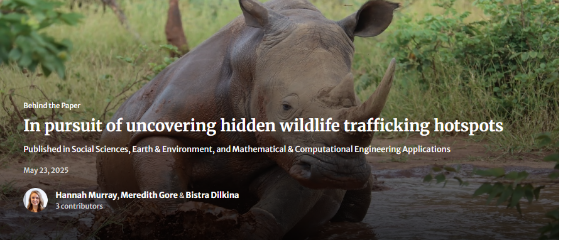
Illegal wildlife trafficking often remains hidden, and relying only on reported seizures of smuggled animals and products provides an incomplete picture. 

In a study published in Communications Earth & Environment, researchers @Hannah Murray, @Meredith Gore, and @Bistra Dilkina combined large open datasets and used machine learning to predict hidden trafficking hotspots in global flight networks. Their findings show that airports with high connectivity and in regions with weak governance or other environmental crimes are more likely to be involved in wildlife smuggling. Most strikingly, the model identified several likely hotspots even without any such recorded incidents – and later news confirmed links to trafficking.  

Read more to see how data science helps protect wildlife from crime. 


Measuring Culture in Abu Dhabi – Can Numbers Show What Makes It Unique?  Cultural Indicators in Abu Dhabi: theoretic framework and challenges for their building
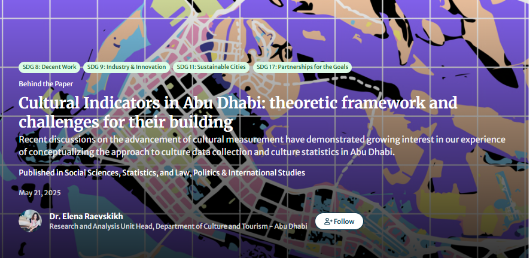
Abu Dhabi is building cultural indicators to capture its unique heritage and support its cultural life while remaining meaningful internationally.  

In a study published in Quality & Quantity, author @Dr. Elena Raevskikh and colleagues propose a new approach: starting from local cultural vocabularies and documents to create cultural indicators rooted in Abu Dhabi’s context, yet comparable with global frameworks like UNESCO’s Culture 2030 Indicators. 

Read the blog post to see how Abu Dhabi is pioneering this locally grounded yet globally relevant approach. 


June was Pride Month, so I’m highlighting two popular News & Opinions pieces from Q2 that explore identity, visibility, and advocacy within the research community. For more Pride-related content, you can also check out June Highlights from the Medicine and Life Sciences Research Communities. 

Intersecting Identities, Shared Struggles  Intersecting Identities, Shared Struggles: Black LGBTQIA+ Voices in the Fight for Health Equity (SDG 3)
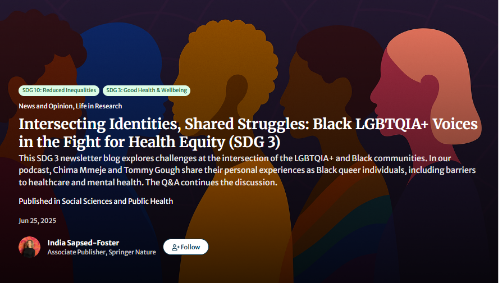
What happens when race and queer identity intersect? In @India Sapsed-Foster’s blog, advocates Chima Mmeje and Tommy Gough share their journeys as Black and LGBTQIA+ individuals facing layers of discrimination from family support, religious rejection to systemic bias in healthcare. For Black queer individuals, this often means facing double discrimination: homophobia within Black communities and racism within LGBTQIA+ spaces. However, they also highlight signs of change – younger generations pushing for acceptance, and the power of authentic representation in media. 

Read the full blog or listen to the podcast to learn how visibility, self-acceptance and storytelling empower Black LGBTQIA+ communities to claim space, advocate for inclusive care and support mental health. 


Supporting Trans and Nonbinary Scientists  Some resources for an empowered Pride
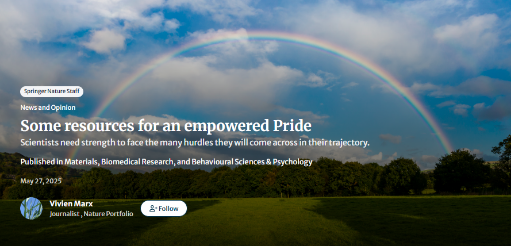
Scientists often face challenges, but for transgender and nonbinary scientists, these can be especially personal and steep. 

In this blog, journalist @Vivien Marx talks with scientists Dr. Megan Povey and Dr. Winston Hirschler Dredge about transitioning in academia and the freedom that comes from embracing one’s true self. 

The blog also highlights helpful resources like research papers, podcasts, interviews, books and guides on mental health, legal support and inclusive hiring advice. These resources highlight systemic gaps and offer actionable ways institutions and allies can help, from improving name change policies in publications to making fieldwork safer and workplaces more inclusive. 

Read the blog to see how visibility, support, and institutional change can help trans and nonbinary scientists thrive – and why this strengthens science for everyone. 


These blogs offer just a glimpse of how humanities and social sciences research sheds light on some complex questions about our world. Curious to dive deeper? Explore more stories in theBehind the Paperand Life in Reseach channels, where researchers share their journeys and inspirations. Don’t forget to browse other quarterly highlights across our Communities: 

Lastly, we have just launched a dedicated space for early career researchers – the ECR Hub. If you are an early career researcher looking for support, advice, to expand your network and learn about others’ experiences in research, visit the Hub and make sure to follow it to stay in the loop! 

We’d love to hear from you! Like, comment, or share posts that resonate with you. Your voice helps spark meaningful conversations and connects a global community of researchers. 

Please sign in or register for FREE

If you are a registered user on Research Communities by Springer Nature, please sign in

Go to the profile of Vivien Marx
6 months ago

Whee such a nice compilation and thank you! 

Follow the Topic

Cognitive Science
Humanities and Social Sciences > Philosophy > Philosophy of Mind > Cognitive Science
Trafficking
Humanities and Social Sciences > Society > Criminology > Transnational Crime > Trafficking
Cultural Heritage
Humanities and Social Sciences > Cultural Studies > Cultural Heritage
Queer Studies
Humanities and Social Sciences > Society > Gender Studies > Queer Studies
Educational Psychology
Humanities and Social Sciences > Behavioral Sciences and Psychology > Educational Psychology
Racism and Nationalism
Humanities and Social Sciences > Society > Sociology > Race and Ethnicity Studies > Racism and Nationalism

Related Collections

With Collections, you can get published faster and increase your visibility.

Women's Health

A selection of recent articles that highlight issues relevant to the treatment of neurological and psychiatric disorders in women.

Publishing Model: Hybrid

Deadline: Ongoing

AI-Driven Innovation and Multi-Sector Collaborations for Sustainable and Urban Development

In line with the objectives of the international conference "Sustainable and Socially Responsible Development in the Network of Socioeconomic Relations: The Triple Helix for Sustainable Development," held in Gdansk, Poland, in June 2024, this Special Issue invites contributions that apply qualitative, quantitative, and mix-methods research to explore cutting-edge developments in sustainable urban and socioeconomic development.

This Special Issue, titled "AI-Driven Innovation and Multi-Sector Collaborations for Sustainable and Urban Development,” will focus on the intersection of artificial intelligence, public-private-university partnerships, and sustainable development practices in urban settings. By emphasizing these critical areas, the issue will explore how AI-driven innovative technologies, policy frameworks, and collaborative models can address the complex challenges of sustainable development, particularly in urban settings.

The proposed Special Issue distinguishes itself by incorporating AI as a critical driver of change in sustainability practices that improve agglomeration functioning. Contributions are encouraged to cover a wide range of topics that explore the transformative potential of AI in promoting sustainability, optimizing urban systems, fostering labor market adaptations, and creating synergies between different sectors for a greener and more equitable future.

It aims to attract diverse submissions, including empirical studies, case studies, contributions to methodology, and policy analysis. Key areas of focus will include, but are not limited to:

AI in Sustainable Urban Systems: Exploring how AI-driven technologies are reshaping urban environments, optimizing transport networks, and enhancing resource efficiency, particularly in smart cities and sustainable mobility, addressing the challenges and opportunities of sustainable urban planning, focusing on integrating green technologies, promoting resilient infrastructure, and ensuring equitable access to resources.

AI and Triple Helix for Sustainable Development: Analyzing the role of public-private-university partnerships in AI-driven innovation, particularly in sustainability-related areas such as environmental management, urban planning, business models, and economic development. Contributions can examine case studies, collaboration models, and policy frameworks promoting multi-sectoral cooperation.

AI, Social Innovation and Sustainable Solutions: Investigating new approaches to fostering social innovation in the context of sustainable development. Topics may include innovative AI-driven solutions for urban challenges, community-driven development, and city social responsibility initiatives.

International Triple-Helix Cooperation for Sustainable Development: Examining global public-private-university collaborations and policy frameworks that support implementing sustainable development goals (SDGs) across different regions and sectors.

This Special Issue will offer academics, policymakers, and industry professionals a platform to present novel insights, engage in meaningful discussions, and explore actionable strategies and business models for advancing sustainable development through AI-driven innovation and multi-partner collaboration. By gathering diverse perspectives and cutting-edge research, this issue aims to contribute to a deeper understanding of the complex interactions between technology, policy, and sustainability, providing solutions for a more resilient and sustainable future.

To ensure the robustness and relevance of contributions, the Special Issue places a strong emphasis on the methodological rigor and diversity of approaches. We invite submissions employing:

1. Quantitative Research: Contributions using advanced AI-based models, algorithms, and tools for predictive analysis, classification, or clustering tasks in urban and socioeconomic contexts. This includes large-scale data analyses, machine learning applications, and econometric modeling to uncover patterns and trends in sustainability and urban development.

2. Qualitative Research: Studies exploring policy frameworks, case studies, and multi-stakeholder perspectives to understand the contextual and institutional dynamics of AI-driven innovation and sustainable development. Methods may include interviews, ethnographies, and participatory approaches.

3. Mixed-Methods Approaches: Research combining quantitative and qualitative techniques to capture both the measurable impacts of AI-driven solutions and the deeper sociocultural implications of their implementation.

4. Novel Methodological Contributions: Innovative approaches to integrating AI technologies with traditional research methods in sustainability science, urban planning, and public-private-university collaborations.

We invite researchers and practitioners from various disciplines to submit their work, offering methodological, research, and practical contributions that address the contemporary challenges of sustainable development.

List of Topic Areas

The Special Issue will cover a broad range of themes related to sustainable development, including but not limited to:

• AI Applications for Sustainable Development of Business Models

• Public-Private-University National and International Partnerships for AI-driven Innovation

• Urban Planning and Sustainable Transport

• AI-driven Social Innovation for Sustainable Communities

• Financing Sustainable Development AI-Projects

• AI and Public Policy Implementation for Sustainability

• AI, Environmental Management, and Smart Cities

• AI-based methods and algorithms for solving classification, prediction, and clustering tasks in urban areas and networks.

Submission Information

Papers should be submitted via the journal’s online submission system available through the journal homepage here.

When submitting, please choose the special issue: “AI-Driven Innovation and Multi-Sector Collaborations for Sustainable and Urban Development,” as the article type from the drop-down menu.

All papers must follow the guidelines outlined by the journal for submissions.

Submitted articles must not have been previously published, nor should they be considered for publication elsewhere while under review for this journal.

For any questions, interested authors can contact the guest editors.

This journal offers the option to publish Open Access. You are allowed to publish open access through Open Choice. Please explore the OA options available through your institution by referring to our list of OA Transformative Agreements.

Publishing Model: Hybrid

Deadline: Jan 31, 2026